This article contains affiliate links: if you buy through them we may earn a commission, at no extra cost to you. Learn more.
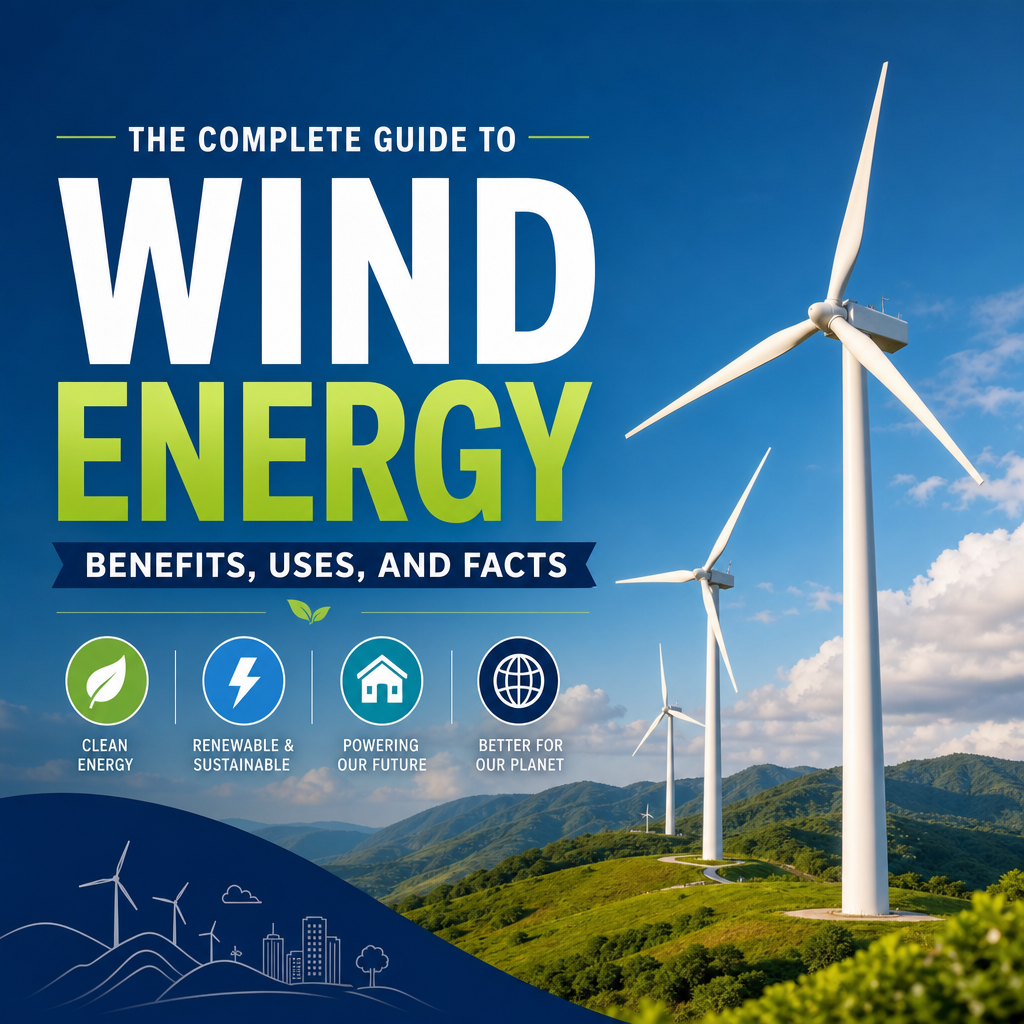
Wind energy is the energy of moving air, which wind turbines capture and turn into electricity. Wind blows because the sun heats Earth’s surface unevenly, so wind is a renewable form of solar energy. A turbine’s blades spin a shaft connected to a generator, producing power with no fuel and no emissions while it runs.
You feel wind energy every time a gust slams a door or tugs at an umbrella. Today that same push supplies about a tenth of America’s electricity, so some of the power in your outlets may well have come from a turbine on a distant ridge or prairie. Here is how wind power works, what it costs, and whether a turbine could ever make sense at your own home.
Wind energy at a glance
- What it is: the kinetic energy of moving air, turned into electricity by wind turbines.
- Where it comes from: uneven heating of land and water by the sun, which makes air rise in some places and rush in elsewhere.
- Renewable? Yes. Wind keeps blowing as long as the sun shines on Earth.
- Share of U.S. electricity: about 10.5% of utility-scale generation in 2025 (464 billion kWh), the largest renewable source (U.S. EIA).
- Main upside: no fuel, no emissions and no cooling water while running, and it is among the cheapest new sources of power.
- Main downside: the wind comes and goes, turbines are large and visible, and they can harm birds and bats.
How wind energy works
First, where wind comes from. During the day, air over land warms faster than air over water. The warm air expands and rises, and cooler, heavier air rushes in to take its place. That flow is wind.
A modern wind turbine turns that moving air into electricity in a few steps, as the U.S. Department of Energy (DOE) explains:
- The blades catch the wind. Each blade is shaped like an airplane wing. Air flowing across it lowers the pressure on one side, creating lift that is stronger than drag, so the rotor spins.
- A shaft carries the motion. The rotor (blades plus hub) turns a low-speed shaft inside the nacelle, the housing on top of the tower.
- A gearbox speeds it up. In most turbines, gears raise the slow rotation of the blades to the high speed a compact generator needs.
- The generator makes electricity. Copper windings turn through a magnetic field, producing current.
- Controls keep it safe and pointed into the wind. An anemometer and wind vane measure the wind. A yaw drive turns the nacelle to face it, and a pitch system twists the blades to control speed. DOE says turbines typically start in winds of about 7 to 11 mph and shut down above 55 to 65 mph to avoid damage.
- Power goes to the grid. Cables carry the electricity down the tower and on to the power grid.
In physics terms, a turbine converts the kinetic energy of air into mechanical energy in the spinning shaft, then into electrical energy. That is also why turbines are built tall: DOE notes that placing a turbine high above and far away from obstacles such as buildings and trees means less turbulence, more output and a longer turbine life.
A short history of wind power
- As early as 5,000 BC: sailboats on the Nile River ran on wind (EIA).
- By 200 BC: simple wind-powered water pumps were used in China, and windmills with woven-reed blades ground grain in Persia and the Middle East.
- By the 11th century: wind pumps and windmills were widely used for food production in the Middle East.
- Colonial America and the West: colonists used windmills to grind grain, pump water and cut wood, and settlers put up thousands of wind pumps across the western U.S.
- 1888: inventor Charles F. Brush built a 60-foot wind dynamo with 144 cedar blades behind his mansion on Euclid Avenue in Cleveland to light his home. Small wind generators spread to farms in the late 1800s and early 1900s.
- 1930s: rural electrification brought power lines to farms, and most small wind machines fell out of use.
- October 19, 1941: the 1.25-megawatt Smith-Putnam turbine on Grandpa’s Knob, Vermont, became the first turbine to feed more than 1 MW into a utility grid. A blade broke off in 1945 and the project ended.
- 1970s and 1980s: oil shortages revived interest. DOE and NASA built a series of large research turbines, and in the early 1980s thousands of turbines went up in California.
- 1990 to 2025: wind grew from less than 1% of U.S. electricity to about 10.5%. In 2019 it passed hydropower as America’s top renewable source of electricity.
Types of wind turbines and wind farms
| Type | What it looks like | Where it is used |
|---|---|---|
| Horizontal-axis turbine | Propeller-style, usually three blades, facing into the wind | Nearly all turbines in use today, from small farm units to giants |
| Vertical-axis turbine | Blades attached top and bottom to a vertical rotor; the Darrieus design (patented 1931) looks like an eggbeater | Very few in use; some small and experimental models |
| Land-based (onshore) wind farm | Rows of large turbines on ridges and plains | Most U.S. wind power, especially Texas and the Plains |
| Offshore wind farm | Turbines set in coastal waters, connected to shore by undersea cables | Stronger, steadier ocean winds near coastal cities |
| Small or distributed wind | A single turbine on a tall tower, roughly 400 watts to 100 kW | Farms, ranches, rural homes and remote cabins |
Turbines keep getting bigger because larger rotors catch more wind. According to Lawrence Berkeley National Laboratory, the average new U.S. land-based turbine installed in 2023 was rated at 3.4 MW, with a hub about 103 meters (340 feet) up and a rotor 134 meters (440 feet) across. The EIA says the largest turbines are as tall as 20-story buildings with blades over 100 feet long, and the biggest now reach about 15 MW. A small turbine for a home, by contrast, is around 10 kW.
Where wind energy is used today
In the United States. Wind turbines produced about 464 billion kWh in 2025, roughly 10.5% of all U.S. utility-scale electricity, from projects in 43 states (EIA). That is up from about 6 billion kWh in 2000. Five states, Texas, Iowa, Oklahoma, Kansas and Illinois, made about 52% of the nation’s wind power in 2025. In some states wind is the main source: DOE reports it supplied more than half the electricity in Iowa and South Dakota in 2023.
Offshore wind is still small in the U.S. At the end of 2024, two commercial offshore wind farms were operating: South Fork Wind (about 130 MW, serving New York) and Vineyard Wind 1 (174 MW so far, off Massachusetts). As of May 2026, the EIA listed about 5,089 MW of planned offshore capacity off New York, Rhode Island and Virginia.
Around the world. The International Renewable Energy Agency (IRENA) counted 1,291 gigawatts of wind capacity at the end of 2025, after a record 159 GW was added that year, nearly three-quarters of it in China. Offshore turbines made up about 7% of that wind capacity. The energy think tank Ember estimates wind generated about 8.5% of the world’s electricity in 2025. Some countries lean on wind far more than the U.S.: it supplied 57% of Denmark’s electricity in 2023, according to Berkeley Lab.
Wind energy at home: what is realistic
A backyard wind turbine sounds great, and for a few rural households it is. For most suburban and city homes, it is not practical. DOE’s guidance for small wind is a good reality check:
- Land: at least 1 acre, plus room to meet local setback rules from property lines.
- Wind: an average annual wind speed of at least 10 mph for a grid-connected system, or 9 mph for an off-grid system, measured at the height of the turbine hub.
- Height: towers typically 60 to 140 feet, well above nearby trees and buildings. Local zoning may limit tower height.
- Size: home systems usually range from 5 to 30 kW. DOE estimates that a turbine of 5 to 15 kW, depending on local wind, is needed to make a real dent in a typical home’s use.
- Not on the roof: DOE warns that all turbines vibrate, and mounting one on a building can bring that noise and vibration inside.
- Lifespan: about 20 years on average; with maintenance and replacement parts, some have run 50 to 60 years.
Before spending thousands, measure. A home weather station with an anemometer on a pole will show you your real wind over a season, which matters far more than how windy it feels. Hills and open ground beat valleys and tree-lined lots. If the numbers look good, talk to a qualified small-wind installer about your site, your utility’s interconnection rules and permits; the wiring and tower work are jobs for licensed professionals.
Small turbines in the few-hundred-watt range are a different, more modest tool. They charge 12- or 24-volt battery banks on boats, cabins, farm gates and RVs, often alongside solar panels, so a battery can charge whenever either one is producing. They will not run a house.
No land or wind? You can still use wind power. Many utilities and retail electricity suppliers sell renewable or “green power” plans, and the EPA explains how households can buy green power or renewable energy certificates (RECs). Read the fine print to see what the plan actually funds.
Products that put wind energy to work at home
Measure first, then build small, and teach the kids along the way. Prices change often; the prices below are what we saw on Amazon in October 2026. Check the current price before you buy.
Ambient Weather WS-2902 Wi-Fi Weather Station
- Wind speed and direction sensor
- Also rain, temperature, UV, solar radiation
- Wi-Fi data and alerts
Automaxx Windmill 600W Wind Turbine Kit
- 600 W max at 12 V or 24 V
- 4.5 mph cut-in speed
- MPPT charge controller included
Thames & Kosmos Wind Power V4.0
- Build a working 3-ft turbine
- Charges a battery, runs a model car
- Weatherproof battery box
Ambient Weather WS-2902 (about $200, seen October 2026). The smartest first purchase for anyone thinking about a turbine. Its outdoor sensor array measures wind speed and direction along with temperature, humidity, rain, UV and solar radiation, and it sends the data over Wi-Fi so you can see trends on your phone. Mount the sensor as high and clear as you safely can for a fair reading.
Check the Ambient Weather WS-2902 price on Amazon
Automaxx Windmill 600W (about $800, seen October 2026). A small horizontal-axis turbine for 12- or 24-volt battery systems on cabins, boats, farms and off-grid setups. Automaxx lists a 600-watt maximum, a 4.5 mph cut-in speed, marine-grade materials, a weight of 26.5 lb and an included MPPT charge controller with overcharge cutoff and a manual stop switch. The 600 W is a peak in strong wind, not a daily average. You will need a sturdy pole, batteries and, for anything tied to your home’s wiring, a licensed electrician.
Thames & Kosmos Wind Power V4.0 (about $45, seen October 2026). Kids build a real, working 3-foot turbine that charges a battery and drives a small model car. It comes with ground stakes and a weatherproof battery box, so it can stay outside and show on a breezy day how wind becomes electricity.
Pros and cons of wind energy
| Pros | Cons |
|---|---|
| Renewable and free fuel | Variable: output rises and falls with the wind |
| No air or water pollution while running (with rare exceptions) | Birds and bats can be killed by spinning blades |
| Needs no cooling water, unlike coal, gas and nuclear plants | Noise and changed views bother some neighbors |
| Among the lowest-cost new power on land | Offshore wind costs much more than onshore |
| Supports more than 125,000 U.S. jobs (DOE) | Producing turbine metals and materials has its own environmental footprint |
| Can produce day and night when the wind blows | Most current blades cannot be recycled |
Environmental and safety impact
The EIA calls wind one of the cleanest ways to make electricity: turbines release no emissions that pollute the air or water, with rare exceptions, and they need no water for cooling. The trade-offs are real, though. Blades make noise as they turn, and some people dislike the sound or the look. Birds and bats can be injured or killed if they fly into the blades. DOE has funded research on wind and wildlife for more than 30 years.
Producing the metals and other materials in turbines affects the environment too, and fossil fuels may be used to make them. Most turbine parts can be reused or recycled, but the EIA notes that blades, as built today, cannot; researchers are testing new resins that would make blades recyclable. Turbine fires and fluid leaks happen but are rare. For homeowners, the main safety risks are falls and electrical work during installation, so leave tower raising and wiring to trained installers.
How much does wind energy cost?
Big wind farms. Lazard’s 2026 Levelized Cost of Energy+ analysis puts unsubsidized onshore wind at about $37 to $99 per megawatt-hour, which overlaps with utility-scale solar ($40 to $98) and is below a new gas combined-cycle plant ($51 to $129). Offshore wind is much higher, at $105 to $167. Lazard notes that wind and solar costs rose in its latest study because of higher capital costs, interest rates and tariffs, though they remain the cheapest new-build options. These are lifetime cost estimates, not the rate on your bill.
A home turbine. DOE’s consumer guides estimate that buying and installing a small wind system costs roughly $5,000 to $10,000 per kilowatt, or about $10,000 to $70,000 in total depending on size, zoning, permits and the cost of connecting to the utility. Those are estimates from 2021 and 2022 guides; get current quotes. How fast it pays back depends mostly on your wind and your electricity rate.
No federal credit in 2026. The 30% residential clean energy credit (Section 25D) that covered small wind ended under the One Big Beautiful Bill Act of July 4, 2025; the IRS does not allow it for expenditures after December 31, 2025. Check state, utility and local programs at DSIRE (dsireusa.org) and in our tax credits and rebates section.
The future of wind energy
Growth has slowed in the U.S.: wind generation rose about 3% in 2025, while utility-scale solar jumped 34% (EIA). Still, the trends point up in a few clear ways. Turbines keep getting taller with longer blades, which lets them work in places with weaker wind. Older wind farms are being “repowered” with new rotors and parts; Berkeley Lab counted 0.6 GW partially repowered in 2023. Offshore wind has about 5 GW planned along the East Coast (EIA, May 2026). Worldwide, wind additions hit a record in 2025, led by China. Recyclable blades are in development but not yet standard.
Wind energy compared with other energy sources
| Source | Share of U.S. utility-scale electricity, 2025 | Capacity factor, 2025 | Unsubsidized new-build cost (Lazard 2026, $/MWh) | At home? |
|---|---|---|---|---|
| Wind (onshore) | About 10.5% | 34.2% | $37 to $99 | Only with land and steady wind |
| Solar (PV) | About 7% | 24.4% | $40 to $98 (utility) | Rooftop, community or portable |
| Hydropower | About 6% | 35.3% | Not in Lazard’s study | Rarely (needs a stream with a drop) |
| Natural gas (combined cycle) | About 41% (all gas) | Not compared here | $51 to $129 | Heating, cooking, generators |
Capacity factor compares what a plant actually produces with what it would make running at full power all year (EIA Electric Power Monthly). Wind beats solar on this measure because it can blow day and night, but it is less predictable hour to hour.
Wind energy FAQs
How does wind energy produce electricity?
Wind flowing over a turbine’s wing-shaped blades creates lift, which spins the rotor. The rotor turns a shaft, usually through a gearbox that speeds it up, and the shaft drives a generator where copper windings move through a magnetic field to make electricity. Cables carry the power down the tower to the grid.
Can I put a wind turbine on my house?
Usually it is not a good idea. DOE warns that turbines vibrate and pass that vibration into the building they are mounted on, which can cause noise problems, and wind near rooftops is slow and turbulent. Home turbines work best on their own tall tower, on at least an acre of land, where the average wind is 10 mph or more.
How much wind do you need for a wind turbine?
DOE suggests an average annual wind speed of at least 10 mph (4.5 meters per second) for a grid-connected home turbine and at least 9 mph (4 m/s) for an off-grid system, measured at hub height. Large turbines typically start turning in winds of 7 to 11 mph and shut down above 55 to 65 mph.
How much of U.S. electricity comes from wind?
About 10.5% of U.S. utility-scale electricity came from wind in 2025, roughly 464 billion kWh, according to the EIA. Wind has been the country’s largest renewable source of electricity since it passed hydropower in 2019. Texas, Iowa, Oklahoma, Kansas and Illinois produced about half of it.
Do wind turbines kill birds?
Yes, some birds and bats are injured or killed when they fly into turbine blades, and the EIA lists this as one of wind power’s main environmental impacts. DOE has funded research for more than 30 years on understanding and reducing these impacts.
What happens when the wind stops blowing?
The turbines slow down or stop, and the grid makes up the difference with other power plants, such as natural gas, nuclear and hydropower, and with stored energy. At home, small wind systems are usually paired with batteries, solar panels or the grid so the lights stay on during calm spells.
Is there a tax credit for home wind turbines in 2026?
Not at the federal level. The 30% residential clean energy credit that covered small wind turbines ended for expenditures after December 31, 2025, under the One Big Beautiful Bill Act. Some states, utilities and local programs may still offer help; search DSIRE (dsireusa.org) for your ZIP code.
Keep exploring
Wind is one of several sources in our guide to the types of energy. Compare it with other renewable energy, see how wind and sun work together in off-grid energy systems, learn how to store what you make in our energy storage guides, or start with the basics in Energy 101.