This article contains affiliate links: if you buy through them we may earn a commission, at no extra cost to you. Learn more.
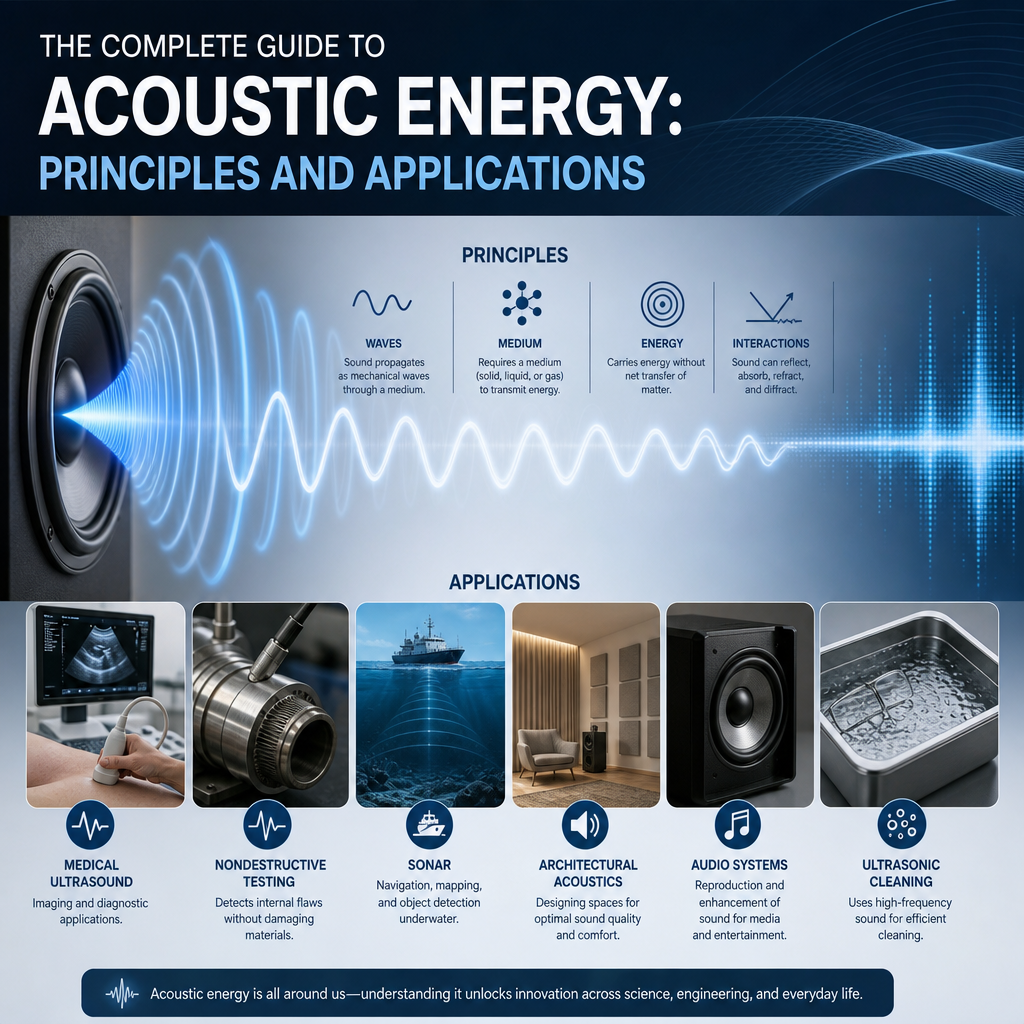
Acoustic energy, or sound energy, is the energy carried by vibrations moving through air, water or solids as pressure waves. A guitar string, a speaker cone or your vocal cords push on the air around them, and that push travels outward until it reaches an ear or fades away as a tiny amount of heat.
Sound fills every home: the hum of the fridge, the dishwasher, a barking dog, music, the lawn mower next door. It carries surprisingly little energy, so it will never power your house. But it carries plenty of information, and at high levels it can permanently damage hearing. This guide covers the physics, and what that means for a quieter, safer home.
Acoustic energy at a glance
- What it is: energy moving through a material as waves of compression and expansion (longitudinal waves).
- Where it comes from: anything that vibrates: voices, instruments, engines, appliances, wind and waves.
- Renewable? It is not an energy source. Sound is a byproduct of other energy, usually a small one.
- Share of U.S. energy: none worth counting. The U.S. EIA notes that the energy in sound is typically lower than in other forms.
- Main upside: it carries information well: speech, music, sonar, medical ultrasound.
- Main downside: loud sound damages hearing for good. About 40 million U.S. adults aged 20 to 69 have noise-induced hearing loss (CDC).
How acoustic energy works
Picture a speaker playing a low note. Step by step:
- Something vibrates. The speaker cone moves forward and back many times a second.
- It pushes the air. Moving forward, it squeezes air molecules together (a compression). Moving back, it leaves a thinner region (a rarefaction).
- The pattern travels. Each layer of air pushes the next. The molecules themselves only jiggle in place; it is the pattern of pressure, and the energy, that travels. In room-temperature air (20°C) it moves at about 343 meters per second.
- It spreads and fades. The energy spreads over a larger and larger area, so it gets quieter with distance, and some is absorbed by carpets, curtains and walls as a little heat.
- Your ear decodes it. The eardrum vibrates with the pressure changes, and the inner ear turns them into nerve signals.
A bit deeper: because sound is a pressure wave, it needs something to travel through. That is the big difference from radiant energy, which crosses empty space. Sound actually moves faster in denser, stiffer materials: about 1,480 m/s in fresh water and about 5,960 m/s in steel, compared with 343 m/s in air (OpenStax). That’s why you can hear a train through the rails before you hear it through the air.
The formula
Three relationships from introductory physics (OpenStax College Physics) explain most of what you need.
- Wave speed: v = f × λ, where v is speed (m/s), f is frequency (Hz) and λ is wavelength (m).
- Intensity: I = P ÷ A, the sound power P (watts) spread over area A (square meters), in W/m².
- Sound level in decibels: β = 10 × log₁₀(I ÷ I₀), where I₀ = 10-12 W/m², about the quietest sound a person can hear at 1,000 Hz.
The decibel scale is logarithmic. Every 10 dB step means 10 times the sound power, and about 3 dB means double. So 90 dB is not “a bit louder” than 80 dB: it carries 10 times the energy.
Units
| Unit | What it measures | Everyday scale |
|---|---|---|
| Hertz (Hz) | Frequency: vibrations per second | People hear roughly 20 to 20,000 Hz |
| Watts per square meter (W/m²) | Sound intensity | Threshold of hearing: 10-12 W/m² |
| Decibel (dB) | Sound level on a log scale | Whisper about 30 dB; conversation 60 dB and up |
| A-weighted decibel (dBA) | Decibels adjusted to how the ear hears | Used in workplace limits and sound meters |
| Noise Reduction Rating (NRR) | How much hearing protectors block, in dB | Printed on earmuff and earplug packages |
Worked example
How much power is in a loud sound? Take a very loud 100 dB, around a busy sports stadium. Solve the decibel formula for intensity: I = I₀ × 10(β ÷ 10) = 10-12 × 1010 = 0.01 W/m². If you could capture every bit of it over a full square meter, you would get one hundredth of a watt. A 9-watt LED bulb, a common replacement for a 75-watt incandescent, needs 900 times that. And 100 dB is loud enough to damage hearing. That’s why “sound-powered homes” are not a thing.
Your eardrum at the edge of hearing. OpenStax notes that at the threshold of hearing, only about 10-16 watts falls on the eardrum. The ear handles a range of about a trillion (1012) from the faintest sound to one that hurts. It is an extraordinarily sensitive detector, which is exactly why it is easy to damage.
Wavelength of a note. A 343 Hz tone in 20°C air has λ = v ÷ f = 343 ÷ 343 = 1 meter. A 20 Hz bass note is about 17 meters long, and a 20,000 Hz whistle under 2 centimeters.
Types of acoustic energy
- Infrasound: below about 20 Hz, too low for people to hear.
- Audible sound: about 20 to 20,000 Hz: speech, music, noise.
- Ultrasound: above 20,000 Hz (20 kHz). Medical scanners use frequencies in the megahertz range.
- Underwater sound: travels farther in water than light or radar, which is why ships use sonar.
A short history
- March 7, 1876: Alexander Graham Bell received U.S. patent 174,465 for transmitting vocal sounds telegraphically. Three days later he called his assistant: “Mr. Watson, come here. I want to see you.”
- 1877: Thomas Edison invented the phonograph at his Menlo Park lab, the first machine that could record sound and play it back, using a needle and tin foil wrapped on a cylinder.
- 1900: Wallace Clement Sabine, a young Harvard physics professor, developed a formula that predicts a room’s reverberation time from its size and materials. Boston’s Symphony Hall, opened October 15, 1900, was the first auditorium designed using his scientifically derived acoustical principles.
- Twentieth century: sonar for mapping the seafloor and finding hazards, and medical ultrasound for seeing inside the body without ionizing radiation.
Energy conversions
- Electrical to sound: speakers, headphones, doorbells and smoke alarms. A coil and magnet move a cone; see magnetic energy.
- Sound to electrical: microphones in your phone and smart speaker turn pressure waves into a tiny electrical signal. See electrical energy.
- Mechanical to sound: a hammer, an engine, a guitar string. See mechanical energy.
- Sound to thermal: sound absorbed by soft surfaces ends up as a very small amount of heat. See thermal energy.
In most machines, sound is wasted energy. A noisy appliance is turning a little of its power into vibration instead of useful work, which is one reason a new rattle or grind is worth checking.
Where acoustic energy is used today
- Medicine: diagnostic ultrasound images the inside of the body by timing echoes, with no ionizing radiation. High-intensity focused ultrasound can heat or destroy tissue; FDA-approved uses include treating uterine fibroids and pain from bone metastases (NIBIB).
- Ocean mapping: NOAA uses sonar to make nautical charts, find hazards and shipwrecks, and map the seafloor. Active sonar sends a ping and times the echo; passive sonar just listens.
- Buildings: concert halls, classrooms and offices are designed for reverberation time, following Sabine’s work.
- Communication and entertainment: phones, speakers, hearing aids and recording.
- Industry and safety: about 22 million U.S. workers face potentially damaging noise at work each year (CDC, via OSHA), which drives hearing conservation programs.
How loud is too loud? Hearing safety
The CDC says that over time, any sound at 85 decibels or higher can cause hearing loss, and that the damaged ear cells cannot be repaired. Typical levels from the CDC:
| Sound | About (dB) | Risk |
|---|---|---|
| Whisper | 30 | Safe |
| Refrigerator hum | 40 | Safe |
| Dishwasher | 45 to 65 | Safe |
| Normal conversation | 65 to 80 | Safe |
| Lawn mower | 80 to 100 | Can damage hearing with exposure |
| Sports event | 94 to 110 | Damage possible in under 30 minutes |
| Headphones at max volume | 96 to 110 | Damage possible in a few minutes |
| Siren | 110 to 129 | Damage possible in under a minute |
| Fireworks | 140 to 160 | Can cause permanent loss near the ear |
The work limits. NIOSH recommends no more than 85 dBA averaged over an 8-hour day, and every 3 dB louder halves the safe time: 88 dBA for 4 hours, 91 dBA for 2 hours. OSHA’s legal limit is looser, 90 dBA for 8 hours with a 5 dB exchange rate, and employers must run a hearing conservation program from 85 dBA. For your own ears, the NIOSH rule is the safer guide.
A quick test. If you have to raise your voice to be heard by someone 3 feet away, the noise is around 85 dBA. If you have to shout, it’s around 95 dBA or more (NIOSH). Ringing ears after a mower, a concert or a shop session is a warning sign.
It’s not just jobs. More than half of U.S. adults with hearing damage from noise do not have noisy jobs, and about 1 in 4 adults who say their hearing is excellent or good already has some damage (CDC). Yard tools, power tools, loud music and events add up.
Acoustic energy at home: what you can actually do
- Measure before you guess. A basic sound level meter tells you whether the shop, the mower or the home theater crosses 85 dBA.
- Protect your ears for loud chores. Wear earmuffs or earplugs for mowing, leaf blowing, power tools and fireworks. 3M advises that the printed NRR may overestimate real-world protection and suggests cutting it by 50% to estimate actual noise reduction.
- Turn it down. Keep headphones well below maximum, especially for kids.
- Soften hard rooms. Rugs, curtains, upholstered furniture and bookshelves absorb sound and shorten echoes, the same principle Sabine used.
- Treat new appliance noise as a clue. A new grinding or rattling noise from a fan, pump or compressor can mean wear. Have it checked before it fails.
- Don’t buy sound-to-power gadgets. As the worked example shows, even very loud sound carries a tiny amount of power. For backup power that actually works, see our energy storage guides.
Products that put acoustic energy to work at home
Prices change often. The prices below are what we saw on Amazon in October 2026; check the current price before you buy.
TopTes TS-501B Sound Level Meter
- 30 to 130 dB
- A and C weighting
- Max/min and data hold
Extech 407730 Sound Level Meter
- 40 to 130 dB
- ±2 dB accuracy, 0.1 dB resolution
- Records max/min
Walker's Razor Slim Passive Earmuff
- NRR 27 dB
- Low-profile, foldable
- Sized for smaller heads
3M PELTOR Optime 95 Earmuffs
- NRR 21 dB
- For noise up to 95 dBA
- Stainless steel headband
For most homes, the TopTes TS-501B (about $30, seen October 2026) is plenty: it reads 30 to 130 dB with A and C weighting and holds the maximum reading, so you can walk the mower past it and check the peak.
Check the TopTes TS-501B price on Amazon
If you want a long-standing test-equipment brand, the Extech 407730 (about $107) covers 40 to 130 dB with ±2 dB accuracy. For protection, the Walker’s Razor Slim Passive earmuff (about $23) has an NRR of 27 dB in a low-profile, foldable design made for smaller heads, and the 3M PELTOR Optime 95 (about $20) is a light, NRR 21 dB muff the maker rates for noise up to 95 dBA, fine for mowing and light power tools.
Pros and cons of acoustic energy
| Pros | Cons |
|---|---|
| Carries speech, music and alarms | Very little energy: useless as a power source |
| Ultrasound images the body without ionizing radiation | Loud sound causes permanent hearing loss |
| Sonar maps the seafloor where light can’t reach | Needs a medium; can’t travel through space |
| Easy to measure with an inexpensive meter | Noise is wasted energy in machines and stress for people |
| Simple to control at home with soft materials | Everyday chores can quietly add up to hearing damage |
Environmental and safety impact
Sound leaves no residue, but noise is a real pollutant for people. Hearing loss from noise is permanent: it destroys hair cells in the inner ear, and it cannot be reversed with surgery or medicine (OSHA). For workplaces, the best control is removing or quieting the noise source; hearing protection comes after engineering and scheduling fixes. The same order works at home: choose quieter tools and appliances, put distance between you and the noise, then wear protection.
What it costs
Sound costs nothing to produce on purpose, and very little energy: the power that reaches your ears is a tiny fraction of what a speaker or appliance uses. The real costs are on the safety side. A basic sound meter is about $30 and a pair of earmuffs about $20 to $25 (Amazon, October 2026). Compared with permanent hearing loss, that is cheap insurance.
The future of acoustic energy
The real progress is in using sound, not harvesting it: sharper medical ultrasound, more uses of focused ultrasound as treatment, better seafloor mapping and quieter equipment. Researchers do study ways to scavenge tiny amounts of power from vibration and sound for sensors, but the physics in the worked example above sets a hard limit. Expect sound to stay an information carrier, not a power plant.
How acoustic energy compares
| Form | Wave type | Needs a material? | Speed |
|---|---|---|---|
| Acoustic (sound) | Longitudinal pressure wave | Yes | 343 m/s in air at 20°C |
| Radiant | Transverse electromagnetic wave | No | 299,792,458 m/s in a vacuum |
| Kinetic | Motion of objects | It is the moving object | Any |
| Thermal | Random motion of molecules | Yes | Spreads by conduction, convection, radiation |
Try it at home
See sound move. Stretch plastic wrap tightly over a bowl and sprinkle a pinch of salt or rice on top. Hold a baking sheet near it and hit the sheet with a wooden spoon. The grains jump: pressure waves from the sheet traveled through the air and shook the plastic. Next, press your ear to one end of a long table while a friend taps the other end lightly, then listen through the air. The tap sounds clearer through the wood, because sound travels better in solids.
Acoustic energy FAQs
Can sound energy be converted into electricity?
Yes, a microphone does exactly that, but only as a tiny signal. Even a damaging 100 dB sound delivers about 0.01 watts per square meter, so harvesting sound for real power is not practical. Researchers explore it for very low-power sensors, not for homes. For backup power, batteries and solar are the practical choices.
How many decibels is too loud?
The CDC says sounds at 85 dB or higher can damage hearing over time. NIOSH sets 85 dBA for 8 hours as its recommended limit, and every 3 dB more halves the safe time. A siren at 110 to 129 dB can cause damage in under a minute, so distance and hearing protection matter.
Is sound energy kinetic or potential?
The U.S. Energy Information Administration lists sound among the kinetic forms of energy: it is energy in motion, carried by vibrating molecules. As a wave passes, energy also shifts back and forth between motion and the squeezing of the material, but overall sound is classed as kinetic.
Why can’t sound travel through space?
Sound is a pressure wave, so it needs molecules to push on: air, water or a solid. Space is very nearly a vacuum, with almost nothing to carry the vibration. Light and radio waves are different: they are electromagnetic waves that need no material, which is how astronauts talk by radio.
What does the NRR on earmuffs mean?
NRR, the Noise Reduction Rating, is the number of decibels a hearing protector blocks in lab tests. Real use is usually less, so 3M suggests cutting the NRR by half to estimate actual protection. An NRR 27 muff might realistically reduce a 100 dB leaf blower by roughly 13 to 14 dB.
What are examples of acoustic energy?
Voices, music from a speaker, a ringing phone, a barking dog, thunder, a lawn mower and a dishwasher are everyday examples. Less obvious ones include medical ultrasound, which uses frequencies above human hearing, and the sonar pings ships use to map the seafloor.
Keep exploring
Sound is one small piece of the energy picture. See how all the forms connect in our types of energy guide, compare it with the waves that do carry big energy in radiant energy, learn what makes speakers work in magnetic energy, and pick up practical basics in Energy 101 and energy saving tips.