This article contains affiliate links: if you buy through them we may earn a commission, at no extra cost to you. Learn more.
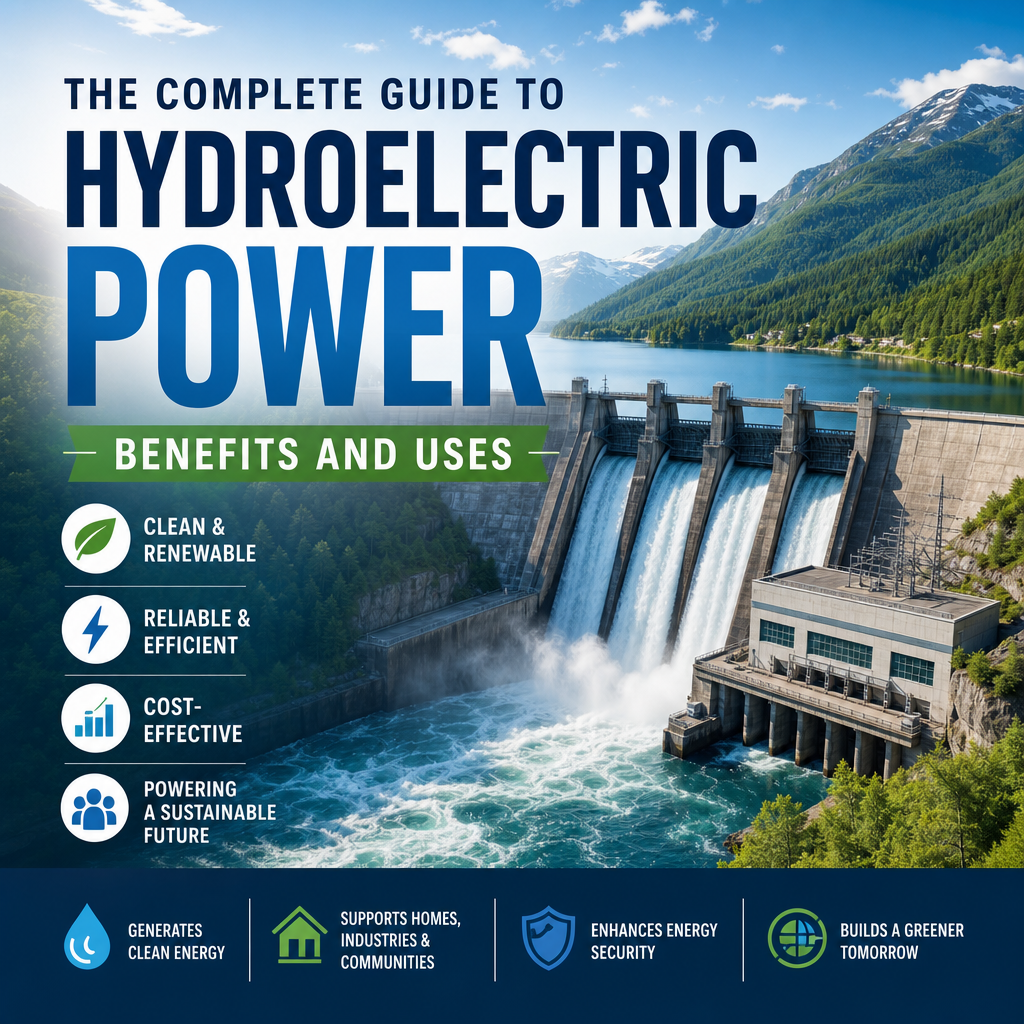
Hydroelectric power, or hydropower, is electricity made from moving water. Water flowing downhill, usually from a dam’s reservoir or a fast river, spins a turbine connected to a generator. Because rain and snow keep refilling rivers, hydropower is renewable, and it was America’s largest source of renewable electricity until wind passed it in 2019.
If you live in the Pacific Northwest, there is a good chance the light you are reading by came from a river. Even if you don’t, hydropower quietly helps keep the grid steady for everyone, and the big pumped-storage plants act as the country’s largest batteries. Here is how hydroelectric power works, where it is used, what it costs, and what it means for your home.
Hydroelectric power at a glance
- What it is: electricity generated by water turning a turbine and generator.
- Where it comes from: the water cycle. The sun evaporates water, rain and snow fall on high ground, and gravity pulls the water back down through rivers.
- Renewable? Yes, though output depends on rain and snow and drops in droughts.
- Share of U.S. electricity: about 5.6% of utility-scale generation in 2025, roughly 247 billion kWh (U.S. EIA).
- Main upside: clean, long-lived and flexible. Reservoirs let operators release water when power is needed, and pumped storage stores energy at grid scale.
- Main downside: dams change rivers, block fish and can flood land and communities, and output drops in dry years.
How hydroelectric power works
The simple version: falling water pushes on blades, the blades turn a shaft, and the shaft spins a generator. A typical dam plant does it like this:
- A dam stores water up high. The reservoir behind the dam holds water at a higher level than the river below. That stored water has potential energy.
- Water rushes through a pipe. Gates open and water flows down a large pipe called a penstock, picking up speed. Potential energy becomes kinetic energy.
- The turbine spins. The water strikes and turns the blades of a turbine.
- The generator makes electricity. The turbine’s shaft turns a generator, which converts the motion into electricity for the grid.
- Water returns to the river. After the turbine, the water flows out downstream. It is used, not used up.
How much power a site can make depends on two things, according to the U.S. Energy Information Administration (EIA): the volume of water flowing and the height it falls, which engineers call the head. A tall dam with a modest flow and a low dam on a huge river can both make a lot of electricity. That is also why a gentle creek in a flat backyard makes very little.
Hydro turbines, a bit deeper
The U.S. Department of Energy (DOE) sorts hydro turbines into two families. Impulse turbines use the speed of a water jet to push the runner. The Pelton wheel, invented by Lester Allan Pelton in the 1870s, suits very high heads and low flows; cross-flow turbines handle larger flows and lower heads. Reaction turbines sit fully in the water and use both its pressure and its movement. The Francis turbine, developed in 1849 and called the first modern hydropower turbine, works at medium to high heads of about 130 to 2,000 feet. Kaplan and propeller turbines, with adjustable blades on some models, suit lower heads and big flows. A newer group, kinetic turbines, sits in a river or tidal current and uses the water’s motion without a dam.
A short history of hydropower
- More than 2,000 years ago: the Greeks used water wheels to grind wheat into flour (DOE).
- 1849: the Francis turbine, the first modern hydropower turbine, was developed.
- 1880: in Grand Rapids, Michigan, a water turbine drove a dynamo that lit 16 lamps in a theater and storefront, the first industrial use of hydroelectricity in the U.S.
- 1881: a turbine-powered dynamo lit street lamps in Niagara Falls, New York.
- September 30, 1882: a hydroelectric plant on the Fox River in Appleton, Wisconsin, began operating; the EIA calls it the first U.S. commercial hydroelectric plant.
- 1893: the Redlands plant in California came online using alternating current, which could carry power much farther.
- 1930: the first U.S. pumped-storage plant opened, following early plants in Italy and Switzerland in the 1890s.
- 1933 to 1942: the Tennessee Valley Authority was created (1933), Hoover Dam was completed on the Colorado River (1936), the Bonneville Power Administration was set up (1937) and Grand Coulee Dam was built (1933 to 1941). By 1940, hydropower supplied about 40% of U.S. electricity.
- Mid-1970s: most of the large U.S. dams in use today had been built by then.
- 2019: wind passed hydropower as the leading U.S. renewable source of electricity.
Types of hydroelectric power plants
| Type | How it works | Good for |
|---|---|---|
| Storage (dam and reservoir) | A dam holds back a reservoir; water is released through turbines when power is needed | Large, steady and flexible output; examples include Grand Coulee and Hoover Dam |
| Run-of-the-river | Uses the river’s natural flow, with little or no reservoir | Smaller footprint, but output follows the river’s flow |
| Pumped storage | Pumps water uphill to an upper reservoir when power is cheap or plentiful, then lets it fall through turbines when demand peaks | Storing energy for the grid; it uses more power than it returns |
| Kinetic (in-stream) | Turbines placed directly in river or tidal currents, no dam | Mostly early-stage and small projects |
Pumped storage deserves a closer look because it is the grid’s giant battery. DOE says the 43 U.S. pumped-storage plants make up 88% of all utility-scale energy storage in the country. The catch is efficiency: the EIA notes most pumped-storage plants need 15% to 30% more electricity to pump the water up than they get back when it flows down. They still earn their keep by soaking up power when it is plentiful and supplying it when it is scarce. Read more in our energy storage section.
Where hydroelectric power is used today
In the United States. Conventional hydropower produced about 247 billion kWh in 2025, about 5.6% of U.S. utility-scale electricity and about 23% of the renewable share, according to the EIA. That is a bit below its 2001 to 2025 average of about 6.5%, because other sources have grown and because output depends on the weather. The U.S. had about 79,900 megawatts of conventional hydro capacity in 2025.
Hydropower is concentrated in the mountainous West. In 2025, Washington produced 26% of U.S. hydroelectricity, followed by Oregon (12%), California (11%), New York (10%) and Montana (4%). DOE says Washington got about 60% of its own electricity from hydropower in 2023. The state is home to Grand Coulee Dam, the largest hydropower facility in the U.S., with more than 6,809 MW and up to 21 billion kWh a year, according to the Bureau of Reclamation. Hoover Dam, on the Colorado River, has about 2,080 MW and averaged about 4.2 billion kWh a year from 1947 to 2008.
Around the world. Hydropower is the world’s largest single source of low-carbon electricity, supplying about 14% of global power in 2025, according to the energy think tank Ember. The International Renewable Energy Agency (IRENA) counted 1,296 gigawatts of renewable hydropower capacity at the end of 2025, plus 160 GW of pure pumped storage. Growth is slow and concentrated: hydro capacity rose 18.4 GW in 2025, and 96% of that was in China. Weather matters a lot. Ember found global hydro output barely changed in 2025, as gains in China and India were offset by drops in Brazil, Turkey and the European Union.
Hydroelectric power at home
Let’s be honest: for almost every homeowner and renter, making your own hydroelectric power is not practical. You need a stream or river on your land with a steady, year-round flow and a real drop in height, and you need the legal right to use that water. If you have that rare combination, typically on rural mountain property, a small “micro-hydro” system can be one of the most reliable home energy sources there is, because water often keeps flowing day and night. Talk to your state’s water agency about water rights and permits, and work with an experienced micro-hydro installer and a licensed electrician.
For everyone else, hydropower still touches your home in useful ways:
- Know your mix. Your utility’s power-source disclosure or annual report shows how much of your electricity comes from hydro. In the Northwest it can be most of it.
- Choose renewable power. Many utilities and retail suppliers sell green-power plans, and the EPA explains how households can buy renewable electricity or renewable energy certificates (RECs).
- Store energy the way dams do. Pumped storage fills up when power is plentiful and gives it back at peak times. A home battery or portable power station does the same thing on a small scale; see our energy storage guides.
- Save water and energy together. In drought years, less water means less hydropower. Cutting your own use helps; start with our energy-saving tips.
- Learn it hands-on. A water-turbine science kit shows kids exactly how a dam turns falling water into electricity.
Products that bring hydropower home
Since few of us have a river in the backyard, the best way to put hydropower to work at home is to understand it. These kits let kids (and curious adults) build working water turbines and compare them with solar and wind. Prices change often; the prices below are what we saw on Amazon in October 2026. Check the current price before you buy.
Thames & Kosmos Hydropower Science Kit
- 12 experiments and builds
- Water turbine lights an LED
- Shows how water does mechanical work
Thames & Kosmos Renewable Energy Lab
- 24 experiments
- Solar panel, wind turbine and hand-crank generator
- Classroom or home, NGSS-aligned
Thames & Kosmos Hydropower Science Kit (about $50, seen October 2026). Twelve experiments and building projects show how flowing water can do physical work and, with a small water turbine and generator, light an LED. It is a hands-on way to see the head-and-flow idea from this page in action at the kitchen sink.
Check the Thames & Kosmos Hydropower kit price on Amazon
Thames & Kosmos Renewable Energy Lab (about $174, seen October 2026). A bigger, curriculum-style set with 24 experiments and a 32-page manual. Kids build models such as a windmill, a hand-crank generator and an electric car with the included solar panel and wind turbine parts. The hand-crank generator works on the same principle as a hydro plant’s generator: spin a shaft, make electricity.
Pros and cons of hydroelectric power
| Pros | Cons |
|---|---|
| Renewable; the water is used, not used up | Output falls in droughts and dry years |
| No fuel cost and low operating cost | Dams block fish migration and change water temperature, chemistry and silt |
| Long life: plants often run 65 to 85 years (DOE) | Reservoirs can flood farmland, natural areas, historic sites and communities |
| Flexible: reservoirs let operators release water when power is needed | Reservoirs can release methane and carbon dioxide from rotting plants (amounts uncertain) |
| Pumped storage is the largest form of U.S. grid storage | Pumped storage uses more electricity than it gives back |
| Some projects also irrigate farms; Grand Coulee’s waters about 680,000 acres | Most large U.S. dams were built before the mid-1970s, and new ones are slow and costly |
Environmental and safety impact
Running a hydro plant produces no air pollution, and the EIA says the emissions from building a dam are offset over its 50- to 100-year life by the clean electricity it makes. The bigger impacts are on rivers. Dams can block fish from reaching their spawning grounds, and they change natural water temperatures, water chemistry, flow and the amount of silt moving downstream, which can harm native plants and animals. Fish ladders help fish climb past dams, and at Safe Harbor Dam, elevators lift migrating shad to the reservoir. DOE-backed research aims for turbine designs that kill fewer than 2% of fish passing through, compared with 5% to 10% for the best existing turbines.
Reservoirs can cover farmland, natural areas and archaeological sites and may force people to move. They can also release greenhouse gases as plants and other material decompose underwater; the EIA says the amounts are uncertain and vary a lot from site to site. Near home, respect the warning signs around dams: water levels and currents can change quickly when gates open.
How much does hydroelectric power cost?
Hydropower’s big cost is building the dam; once that is paid for, it is one of the cheapest plants to run because the “fuel” is free. EIA data for 2024 put average operating and maintenance expenses for hydroelectric plants (including pumped storage) at about 15 mills per kWh, or 1.5 cents, compared with about 23 mills for nuclear plants and about 41 mills for fossil steam plants, which also pay for fuel. Those are averages across existing plants, not what you pay at home. Building new large dams is costly and slow, and Lazard’s 2026 cost study did not include new hydropower because few projects were starting construction.
For a home micro-hydro system, prices depend completely on the site: the length of pipe, the drop, the turbine, the batteries or grid connection and permits. Get site-specific quotes. The federal residential clean energy credit (Section 25D) ended for expenditures after December 31, 2025, so there is no federal tax credit for home renewable systems in 2026; check state and utility programs at DSIRE (dsireusa.org) and our tax credits and rebates section.
The future of hydroelectric power
Few big new dams are coming in the U.S., but hydropower is not standing still. The most active area is pumped storage: DOE says the country has the potential to more than double its pumped-storage capacity, which would help store more wind and solar power. DOE’s 2016 Hydropower Vision report laid out a roadmap for growth, and its HydroWIRES initiative, launched in 2019, studies how hydro can best support a grid with more variable power. Other real, ongoing work includes fish-friendly turbines and upgrades to aging plants. Worldwide, nearly all new hydro capacity in 2025 was built in China.
Hydroelectric power compared with other energy sources
| Source | Share of U.S. utility-scale electricity, 2025 | Capacity factor, 2025 | Renewable? | Can store energy? |
|---|---|---|---|---|
| Hydropower | About 5.6% | 35.3% | Yes | Yes, with reservoirs and pumped storage |
| Wind | About 10.5% | 34.2% | Yes | No, needs separate storage |
| Solar (PV) | About 7% | 24.4% | Yes | No, needs separate storage |
| Nuclear | About 18% | 91.0% | No | No, runs steadily |
Capacity factor compares actual output with what a plant would make running at full power all year (EIA Electric Power Monthly). Hydro’s output also swings with how much rain and snow fall in a given year. Ocean water can make power too; see tidal energy and wave energy.
Hydroelectric power FAQs
How does hydroelectric power work?
Water stored behind a dam, or flowing in a fast river, is sent through a large pipe called a penstock. The moving water spins the blades of a turbine, and the turbine turns a generator that makes electricity. The water then returns to the river downstream. The more water and the farther it falls, the more power the plant can make.
Is hydroelectric power renewable?
Yes. Hydropower runs on the water cycle: the sun evaporates water, it falls as rain and snow, and rivers carry it back downhill. The water passes through the turbines and returns to the river, so it is not used up. Output does depend on precipitation, though, and drops during droughts.
How much of U.S. electricity comes from hydropower?
About 5.6% of U.S. utility-scale electricity came from conventional hydropower in 2025, roughly 247 billion kWh, according to the EIA. That was about 23% of all renewable electricity. Washington, Oregon, California and New York produce the most, and Washington alone made about a quarter of the nation’s hydroelectricity.
What are the disadvantages of hydroelectric power?
Dams can block fish migration, change a river’s temperature, chemistry and silt, and flood land, natural areas and historic sites, sometimes forcing people to move. Reservoirs can release greenhouse gases from decaying plants. Output falls in droughts, and building new large dams is slow and costly; most big U.S. dams were built before the mid-1970s.
What is the largest hydroelectric dam in the United States?
Grand Coulee Dam on the Columbia River in Washington is the largest U.S. hydropower facility. The Bureau of Reclamation lists its generating capacity at more than 6,809 megawatts, and it can produce up to 21 billion kWh of electricity a year. It was built between 1933 and 1941 and also supplies water to irrigate about 680,000 acres.
Can I generate hydroelectric power at home?
Only if you have a suitable stream on your property: steady year-round flow, a real drop in height and the legal right to use the water. With that, a small micro-hydro system can supply power day and night. Most homes do not have such a site, so check water rights and permits with your state and hire experienced installers and a licensed electrician.
What is pumped storage hydropower?
Pumped storage works like a giant battery. When electricity is plentiful, pumps move water to an upper reservoir; when demand peaks, the water flows back down through turbines to make power. It uses more electricity than it returns, but DOE says it provides 88% of U.S. utility-scale energy storage.
Keep exploring
Hydropower is one of the sources in our guide to the types of energy. See how it fits into renewable energy and clean energy more broadly, compare it with solar energy, or browse the basics in Energy 101.