This article contains affiliate links: if you buy through them we may earn a commission, at no extra cost to you. Learn more.
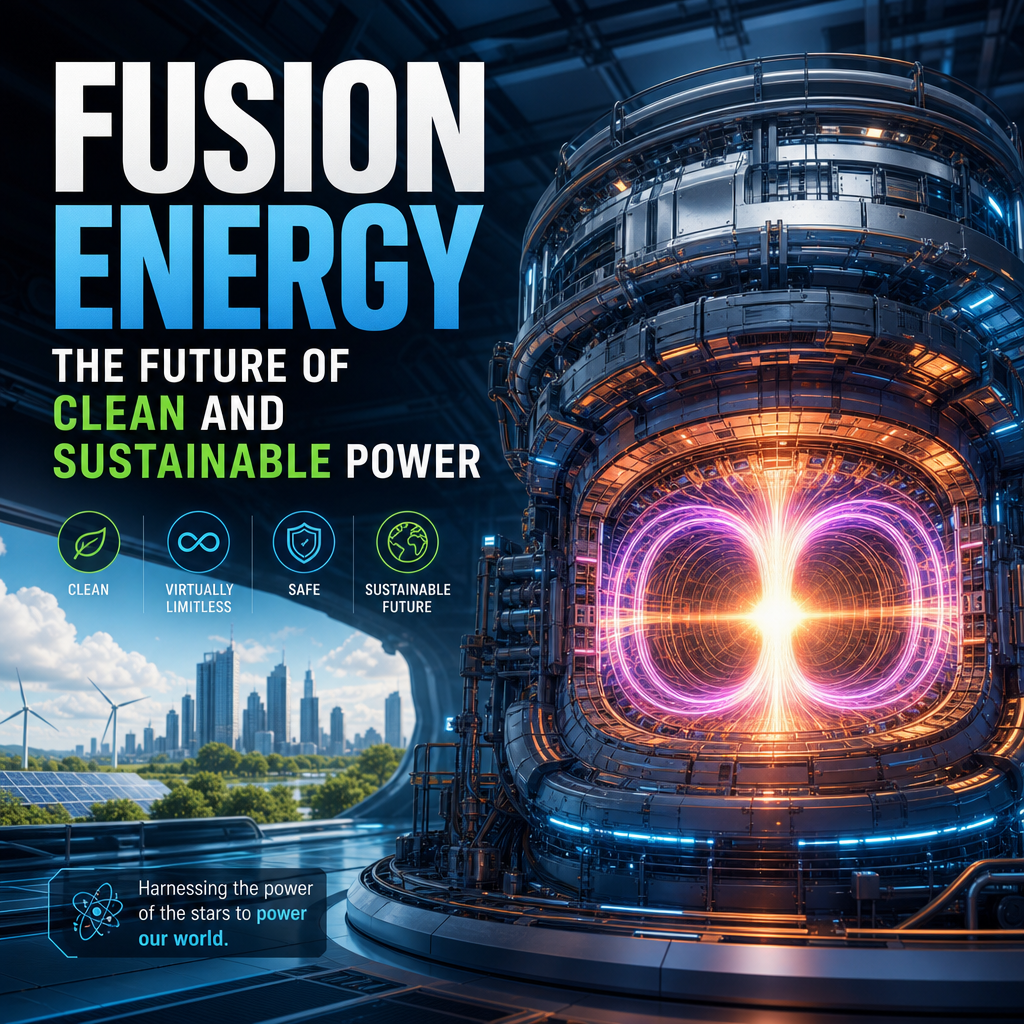
Fusion energy is the energy released when two light atomic nuclei, such as forms of hydrogen, join to make a heavier one. It is what powers the sun and the stars. On Earth, scientists have made fusion happen in experiments, but no power plant yet sends fusion electricity to the grid.
In a way, fusion already powers your home. Every ray of sunshine that warms your living room or charges a solar panel on your roof started as fusion in the sun’s core. The big question, and the reason fusion makes headlines, is whether we can build a small, controlled sun here on Earth and plug it into the grid. This guide separates what has really been achieved from what companies hope to do.
Fusion energy at a glance
- What it is: energy from joining light atoms into heavier ones; the opposite of fission, which splits heavy atoms.
- Fuel: mostly deuterium and tritium, two heavy forms of hydrogen. Deuterium comes from seawater; tritium can be bred from lithium (ITER).
- Renewable? Not strictly, but the fuel supply is enormous, which is why it is often called nearly limitless.
- Share of U.S. electricity: 0% in 2025. No fusion power plant is operating anywhere yet.
- Biggest real milestone: on December 5, 2022, the National Ignition Facility in California got more fusion energy out of a fuel target than the laser energy put into it.
- Main upside: huge energy from tiny amounts of fuel, no greenhouse gases and no long-lived radioactive waste (DOE).
- Main downside: nobody has yet built a machine that makes more electricity than it uses, and dates for the first plants are company targets, not certainties.
How fusion energy works
Start with the sun. NASA says the sun’s core is about 27 million °F (15 million °C). There, crushing gravity and heat force hydrogen nuclei together to form helium. According to ITER, the sun turns about 600 million tonnes of hydrogen into helium every second.
Why does that release energy? The helium that forms weighs a tiny bit less than the pieces that went into it. The U.S. Department of Energy (DOE) explains that this missing mass becomes energy through Einstein’s E = mc². Because c, the speed of light, is huge, a tiny bit of mass makes a lot of energy.
On Earth we can’t use the sun’s gravity, so we need a different recipe. Step by step:
- Pick the easiest fuel. Deuterium and tritium (D-T) fuse at the “lowest” temperature and give the most energy, says ITER.
- Make a plasma. Heat the fuel until the electrons are stripped from the nuclei. DOE calls this a plasma: a gas so hot that its electrons are freed from the atoms.
- Get it hotter than the sun. Fusion machines like ITER are designed to run at about 150 million °C, roughly ten times hotter than the sun’s core, to make up for the lack of the sun’s pressure.
- Hold it together. Nothing solid can touch that plasma, so it is held by powerful magnetic fields or squeezed for a split second by lasers.
- Catch the energy. The fusion reactions throw off fast particles that heat the machine’s walls. In a future power plant, that heat would make steam to spin a turbine, just like other power plants.
The payoff is the energy density. DOE says a pickup truck full of fusion fuel holds as much energy as 2 million metric tons of coal or 10 million barrels of oil.
Fusion vs. fission: what’s the difference?
Both are forms of nuclear energy. Fission splits heavy uranium atoms and runs every nuclear power plant today, about 18% of U.S. electricity in 2025. Fusion joins light atoms and is still experimental. A fission reactor depends on a chain reaction that must be controlled. Fusion has no chain reaction: if conditions slip, the plasma cools and the reaction simply stops, as ITER puts it. That is a big reason fusion is seen as safer, though it is also why it is so hard to keep going.
Ways to make fusion on Earth
- Tokamaks. Doughnut-shaped machines that hold plasma in a ring with strong magnets. The design came from Soviet research in the 1950s and 1960s and is still the most studied. ITER and Commonwealth Fusion Systems’ SPARC are tokamaks.
- Stellarators. Twisted, more complex magnet shapes that can, in principle, run continuously. Germany’s Wendelstein 7-X in Greifswald, the largest, made its first plasma on December 10, 2015, and is built for plasma pulses of up to 30 minutes.
- Inertial confinement (lasers). Lasers crush a tiny fuel capsule so fast that it fuses before it can fly apart. The National Ignition Facility (NIF) at Lawrence Livermore National Laboratory focuses 192 laser beams on a target the size of a peppercorn.
- Other approaches. Private companies are trying other designs. Helion, for example, uses a “field-reversed configuration,” in which magnets slam two plasmas together, and plans to burn deuterium and helium-3.
A short history of fusion: real milestones
These are results that were measured and published, not promises:
- 1950s–1960s: Soviet researchers develop the tokamak.
- 1997: the Joint European Torus (JET) makes 16 megawatts of fusion power from 24 megawatts of heating, a fusion power record that ITER still cites today.
- December 10, 2015: Wendelstein 7-X makes its first plasma.
- December 5, 2022: NIF achieves ignition. Its lasers delivered 2.05 megajoules (MJ) to the target and got 3.15 MJ of fusion energy back, the first time any experiment released more fusion energy than the energy used to drive it.
- Late 2023: in its final experiments, JET releases a record 69 MJ of fusion energy in about six seconds, from only 0.21 milligrams of fuel. JET ended operations at the end of 2023 (EUROfusion).
- April 7, 2025: NIF sets its own record, 8.6 MJ out from 2.08 MJ of laser energy, a target gain of about 4.
- By June 2026: NIF had reached ignition 11 times, Lawrence Livermore says.
One honest caveat about “ignition”: NIF’s gain compares fusion energy to the laser light that hit the target. It does not count the much larger amount of electricity needed to make that laser light. NIF’s own description says its beams build up to about 4 million joules of energy before being converted to about 2 million joules of ultraviolet light for the target. So NIF proved the physics works; it did not make net electricity. DOE says many advances are still needed before fusion can power homes and businesses.
Where fusion is today
ITER, the big public project
ITER is a giant tokamak being built in Saint-Paul-lez-Durance in southern France by seven members (China, the European Union, India, Japan, Korea, Russia and the United States), with 34 nations involved in all. Its goal is to produce 500 megawatts of fusion power from 50 megawatts of heating, a tenfold gain, and to study a “burning” plasma that keeps itself hot. Its current schedule calls for research operations to start in 2034 and deuterium-tritium operation in 2039.
Private companies and their targets
Several companies have raised money and signed power deals. Their dates are goals they have announced, not results:
- Commonwealth Fusion Systems (CFS) is building SPARC, a compact tokamak with high-temperature superconducting magnets, in Devens, Massachusetts. CFS says it aims for SPARC to produce more fusion energy than it takes to run the plasma (Q greater than 1) in 2027. Its first power plant, ARC, is planned for Chesterfield County, Virginia, in the early 2030s at about 400 megawatts, and Google has agreed to buy half its power.
- Helion signed a power purchase agreement with Microsoft in 2023 for electricity from its first fusion plant, which Helion says is scheduled for 2028. Helion also says its Polaris machine is the first privately built device to show measurable deuterium-tritium fusion.
Fusion history is full of missed dates, so treat any single company’s timeline with care. A good sign of real progress is a result measured and published by a national lab or an independent group, like NIF’s ignition shots or JET’s records.
Fusion energy at home: what it means for you
There is nothing fusion-powered you can buy or sign up for today, and no utility sells fusion electricity. Here is what is actually useful:
- Use the fusion reactor you already have: the sun. Solar energy is fusion energy that reaches your roof as radiant energy. Rooftop panels, a balcony kit or a portable panel with a power station are the practical way to tap it. Browse our solar and energy storage guides.
- Don’t wait for fusion to cut your bill. Even on the most hopeful company timelines, fusion would likely supply only a tiny share of the grid through the 2030s. Insulation, a smart thermostat and efficient appliances save money now; see our energy-saving tips.
- Check incentives before buying solar or storage. The federal 30% home solar and battery credit ended for systems installed after December 31, 2025. State, utility and local rebates still exist; search DSIRE for your area.
- Be wary of “fusion” products. Anything sold today as a home fusion device, or as “cold fusion” power, is not a working fusion generator.
- Learn about it with your family. Fusion is one of the great science stories of our time, and a good book is the best way in.
Books to understand fusion energy
Prices change often. The prices below are what we saw on Amazon in October 2026; check the current price before you buy.
The Star Builders: Nuclear Fusion and the Race to Power the Planet
- By Arthur Turrell
- Paperback (also Kindle, hardcover)
- General readers
Fusion's Promise
- By Matthew Moynihan and Alfred B. Bortz
- Paperback (also Kindle)
- Fusion technology and climate
The Star Builders by Arthur Turrell (paperback about $10, seen October 2026): a book for general readers about nuclear fusion and, as its subtitle says, the race to power the planet. A good first read for anyone who saw the ignition headlines and wants the story behind them.
Check The Star Builders price on Amazon
Fusion’s Promise by Matthew Moynihan and Alfred B. Bortz (paperback about $30, seen October 2026): its full title promises a look at how technological breakthroughs in fusion could help with climate change on Earth, and even carry people to Mars. A fit for readers who want more of the technology.
Pros and cons of fusion energy
| Pros | Cons |
|---|---|
| Enormous energy from tiny amounts of fuel (DOE: a pickup truck of fuel ≈ 2 million metric tons of coal) | No machine has yet made more electricity than it consumes |
| Abundant fuel: deuterium from seawater, tritium bred from lithium | Requires temperatures around 150 million °C and extremely precise control |
| No greenhouse gases and no long-lived radioactive waste (DOE) | Tritium is radioactive and must be handled and bred carefully |
| No chain reaction; the reaction stops if conditions slip (ITER) | Huge, costly research machines; ITER’s D-T operation is not planned until 2039 |
| Could run day and night, unlike sun and wind | Commercial timelines are company targets and have slipped before |
Environmental and safety impact
On paper, fusion is one of the cleanest ways to make power. DOE says it does not produce greenhouse gases or long-lived radioactive waste, and the fuel is so energy-dense that very little is needed: JET’s record pulse used about 0.21 milligrams. Because there is no chain reaction, a fusion machine cannot “run away” the way people fear a fission reactor might; if anything goes wrong, the plasma cools and the reaction stops.
That does not mean zero radioactivity. Tritium, one of the two main fuels, is a radioactive form of hydrogen, and future plants will have to handle it safely and make more of it from lithium. The machines themselves are large industrial plants that will need materials, water and land like any power station. These impacts are still being worked out because no commercial plant exists yet.
What fusion energy costs
Nobody knows yet. With no fusion power plant in operation, there is no real-world cost per kilowatthour to compare with solar, gas or nuclear, and any figure you see is an estimate from a model or a company. What we do know is that research machines are expensive. Germany’s Max Planck Institute for Plasma Physics, for example, reports that Wendelstein 7-X cost about 1.44 billion euros from 1995 through 2021, including site infrastructure. For now, the question for homeowners is not what fusion power will cost, but what today’s options cost, and those are covered in our guides to solar and home batteries.
The future of fusion energy
Here is a fair reading of where things stand in October 2026:
- Proven: fusion can release more energy than the laser energy driving it (NIF, repeated 11 times by mid-2026), and tokamaks can sustain record D-T fusion for several seconds (JET).
- Being built: ITER, aiming for research operations in 2034 and D-T in 2039; CFS’s SPARC, aiming for Q greater than 1 in 2027.
- Announced, not yet proven: first power plants in 2028 (Helion, for Microsoft) and the early 2030s (CFS’s ARC in Virginia, half for Google).
- Still to solve: net electricity from a whole plant, long-lasting materials, breeding tritium, and getting costs low enough to compete.
If the hopeful timelines hold, the first fusion electricity could reach the grid around the end of this decade or early in the next. Even then, building enough plants to matter would take many more years. Fusion is worth following closely, but it is a long-term story, not a plan for your next electric bill.
How fusion compares with other energy sources
| Source | Status | Share of U.S. electricity (2025) | Fuel | Waste |
|---|---|---|---|---|
| Fusion | Experimental; first plants targeted for 2028–early 2030s | 0% | Deuterium (seawater), tritium (from lithium) | No long-lived radioactive waste (DOE) |
| Fission (nuclear) | Mature, since the 1950s | About 18% | Uranium | Long-lived spent fuel |
| Solar | Mature and growing | About 7% | Sunlight (fusion in the sun) | None while running |
| Coal | Mature, in decline | About 17% | Coal (ancient plants) | CO2, air pollution and ash |
Fusion energy FAQs
Has fusion energy been achieved?
Fusion reactions, yes; fusion power plants, no. On December 5, 2022, the National Ignition Facility got 3.15 megajoules of fusion energy from 2.05 megajoules of laser energy, the first “ignition.” It has repeated that 11 times by mid-2026, with a record of 8.6 megajoules in 2025. No machine has yet produced more electricity than it uses.
When will fusion power be available?
No one can say for sure. Helion says its first plant, contracted to supply Microsoft, is scheduled for 2028, and Commonwealth Fusion Systems plans its first plant in Virginia in the early 2030s. The big international ITER project plans deuterium-tritium experiments in 2039. Treat company dates as goals, since fusion timelines have slipped many times before.
Is fusion energy safe?
Fusion is considered inherently safer than fission because there is no chain reaction: if anything goes wrong, the plasma cools and the reaction stops. DOE says fusion produces no greenhouse gases or long-lived radioactive waste. It does involve tritium, a radioactive form of hydrogen, which future plants will need to handle carefully.
Why is fusion so hard to achieve?
Atomic nuclei repel each other, so they only fuse when they are extremely hot and close together. The sun manages it with crushing gravity at about 15 million °C. On Earth, machines like ITER need about 150 million °C, and the plasma has to be held away from every wall by magnets or squeezed by lasers long enough to give back more energy than it took.
Is the sun’s energy fusion energy?
Yes. NASA explains that nuclear reactions in the sun’s core, where hydrogen is fused into helium, power the sun’s heat and light. That means solar panels, and even the plants that became coal and oil, run on fusion energy that left the sun long ago. Rooftop solar is the closest thing to home fusion power available today.
What fuel does a fusion reactor use?
Most designs use deuterium and tritium, two heavy forms of hydrogen, because they fuse most easily. Deuterium is extracted from seawater, and tritium can be bred from lithium inside the reactor, according to ITER. Some companies, like Helion, plan to use deuterium and helium-3 instead.
Keep exploring
Fusion is one of many types of energy. Compare it with today’s fission-based nuclear energy, see how the sun’s fusion reaches you as solar energy, or read about hydrogen energy, another fuel built on the lightest element. For the science basics, visit Energy 101.