This article contains affiliate links: if you buy through them we may earn a commission, at no extra cost to you. Learn more.
Tidal energy is renewable power made from the regular rise and fall of the ocean’s tides, which are driven mainly by the moon’s gravity. Dams across bays, or underwater turbines in fast tidal currents, turn that moving seawater into electricity. Tides are highly predictable, but only a few coasts have strong enough tides to use.
If you have ever left a towel on the sand and come back to find the water at your feet, you have watched tidal energy at work. Twice a day, in most places, the sea climbs up the shore and slides back out again, moving enormous amounts of water. People have tried to catch that motion for centuries. Here is how tidal power works, where it really runs today, what it costs, and what it means for you if you live by the coast or far from it.
Tidal energy at a glance
- What it is: electricity from the rise and fall of tides (tidal range) or from the fast currents tides create (tidal stream).
- Where it comes from: the gravitational pull of the moon and, about half as strongly, the sun, together with Earth’s rotation.
- Renewable? Yes. Tides will keep coming as long as the moon orbits Earth.
- Share of U.S. electricity: effectively zero. The U.S. has no commercial tidal power plants, only demonstration projects in Alaska, Maine and New York (EIA, 2024).
- Potential: the U.S. tidal resource that today’s technology could capture is about 220 terawatt-hours a year, roughly 5% of the country’s 2019 electricity generation (NREL, 2021).
- Main upside: perfectly predictable. Tide tables can be written years ahead, unlike wind or sunshine.
- Main downside: it only works at a few sites with big tides or strong currents, and it still costs several times more than wind or solar.
How tidal energy works
Why we have tides
The moon’s gravity pulls on Earth’s oceans, raising a bulge of water on the side facing the moon and another on the opposite side. As Earth spins, coastlines pass through these bulges, and the water rises and falls. The sun pulls too, but because it is so much farther away its tide-making effect is only about half the moon’s, according to NOAA.
A “lunar day” lasts 24 hours and 50 minutes, so high tides usually arrive about 50 minutes later each day, roughly 12 hours and 25 minutes apart. Most of the U.S. East Coast gets two high and two low tides of about equal size each lunar day; the West Coast gets two of uneven size; and parts of the Gulf of Mexico get just one of each. Twice a month, at new and full moon, the sun and moon line up and make bigger “spring tides” (nothing to do with the season). About a week later, when they pull at right angles, tides are smaller “neap tides.”
That rhythm is the whole appeal: a grid operator can know the tidal output at a site for any hour next year. The catch is size. The EIA notes that tidal power plants generally need a tidal range (the height difference between high and low tide) of at least 10 feet to be economical. The world’s biggest tides are in Canada’s Bay of Fundy. In the U.S., Turnagain Arm near Anchorage, Alaska, reaches about 30 feet, and Eastport, Maine, about 20 feet (NOAA).
Turning tides into electricity, step by step
- The tide moves a huge volume of seawater, either up and down (range) or sideways through a narrow channel (stream).
- A structure makes that water flow through a turbine: a dam with gates, or a rotor standing in the current.
- The moving water spins the turbine blades, which turn a generator, the same way wind turns a wind turbine.
- A cable on the seabed carries the electricity to shore and into the grid.
Water is about 800 times denser than air, the EIA points out, so a tidal turbine can be much smaller than a wind turbine and still produce useful power from a fairly slow current. If you want the physics, this is kinetic energy (moving water) and, in a dam, potential energy (water held high) being turned into electrical energy.
Types of tidal power
- Tidal barrages. A low dam across a bay or river mouth, with gates and turbines. The basin fills and empties with the tide, and water is let through the turbines when there is a big enough difference in level. The two largest tidal plants in the world are barrages.
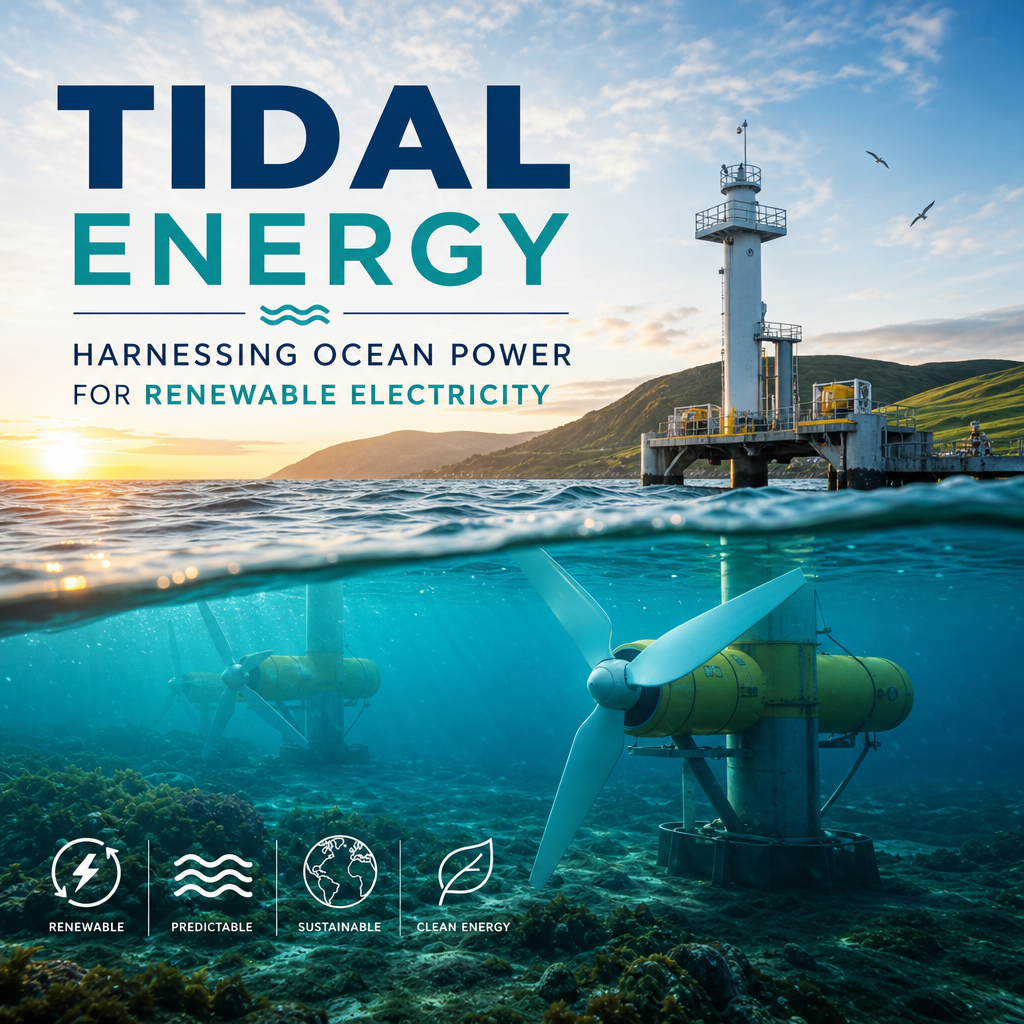
- Tidal stream turbines. Underwater rotors mounted on the seabed or hung from floating platforms in fast tidal channels. They look and work much like wind turbines and do not block the whole waterway. This is where most new development is happening.
- Tidal fences. Rows of vertical-axis turbines set across a channel, like a turnstile for the tide (EIA).
- Tidal kites. A newer design that Ocean Energy Europe says can tap slower currents than classic turbines, which could open up many more sites. A full-scale 1.2-megawatt kite went into the water in the Faroe Islands in 2024.
A short history of tidal power
- More than 1,000 years ago: people in Europe build tide mills that trap water at high tide and use it to grind grain as it drains (EIA).
- November 26, 1966: France opens the La Rance tidal power station in Brittany, the world’s first tidal power plant: 24 turbines of 10 megawatts each, 240 MW in total, still running today.
- August 4, 2011: South Korea’s Sihwa Lake station begins operating at 254 MW, taking over as the world’s largest.
- 2016–2018: the MeyGen project installs four 1.5 MW turbines in the Pentland Firth, Scotland, and enters full operation in April 2018.
- 2020–2021: Verdant Power’s three-turbine array in the East River produces 210 megawatt-hours in six months, a U.S. marine energy record (DOE).
- July 28, 2021: Orbital Marine Power’s O2, a 74-meter floating platform with two 1 MW turbines, starts sending power to the grid in Orkney, Scotland.
Where tidal energy is used today
Worldwide, tidal power is still small, and almost all of it comes from two barrages:
| Plant | Country | Type | Capacity | Output |
|---|---|---|---|---|
| Sihwa Lake (2011) | South Korea | Barrage, generates on the incoming tide | 254 MW | About 550 GWh a year |
| La Rance (1966) | France | Barrage | 240 MW | About 500 GWh a year, the use of about 225,000 people (EDF) |
| Annapolis Royal | Canada | Barrage | 20 MW | Listed by EIA as the third largest |
| MeyGen Phase 1 | Scotland, UK | Tidal stream, 4 seabed turbines | 6 MW | More than 37 GWh by 2020 |
| Orbital O2 | Scotland, UK | Floating tidal stream | 2 MW | About 2,000 UK homes’ worth (maker estimate) |
In Europe, almost 32 MW of tidal stream turbines have been installed since 2010, according to Ocean Energy Europe’s 2024 statistics. About 12.7 MW were generating at the end of 2024 and the rest had been retired after their test programs. Tidal stream turbines in Europe produced 13.4 gigawatt-hours in 2024. Governments in the UK and France have now backed about 152 MW of tidal farms planned over the next five years, including 122 MW under the UK’s ring-fenced Contracts for Difference.
In the United States, there are no commercial tidal plants (EIA). The best resource by far is in Alaska: Cook Inlet alone holds about 36% of the nation’s tidal resource and sits next to the grid that serves Anchorage and most of the state’s people (NREL). Other promising sites include Puget Sound in Washington, the coast of Maine, Delaware Bay and New York’s East River, where Verdant Power’s turbines have fed Con Edison’s grid. The U.S. committed a record $141 million in public support to ocean energy in 2024, including $35 million for two tidal projects (Ocean Energy Europe).
Tidal energy at home: what you can actually do
Here is the honest answer: no homeowner can install a tidal power system. Tidal plants need permits for the seabed, marine engineering and grid connections that only utilities and specialist developers can handle, and even a waterfront home on a creek almost never has the steady, fast current or tidal range that a turbine needs.
What you can do:
- Support it where you live. If you are in Alaska, Maine, Washington or New York, tidal projects may come up in utility plans and public hearings. Ask your utility whether it offers a renewable or green power plan.
- Make your own clean power instead. For most homes, rooftop or balcony solar energy plus a battery is the realistic way to run on renewables. See our solar guides and energy storage guides.
- Check rebates, not federal credits. The federal residential clean energy credit (25D) ended for systems finished after December 31, 2025. Look for state, utility and local programs on DSIRE and in our rebates section.
- Live with the tide. On the coast, knowing when high and low tide come helps with boating, fishing and beach days. A tide clock on the wall tracks that 12-hour-25-minute rhythm for you.
- Learn it hands-on. A water-power science kit shows kids how moving water spins a turbine and lights an LED, the same idea as a tidal plant.
Products that bring tidal energy home
Tidal power is a utility-scale technology, so these picks are about understanding it and living with the tides. Prices change often. The prices below are what we saw on Amazon in October 2026; check the current price before you buy.
Thames & Kosmos Hydropower Science Kit
- 12 experiments and building projects
- Water turbine lights an LED
- About $50
JUSTIME 8.5-inch Atlantic Tide Clock
- Shows high and low tide
- Made for U.S. and Canadian Atlantic coasts
- About $47
Ocean, Tidal, and Wave Energy: Power from the Sea
- Energy Revolution series
- Ocean, tidal and wave power explained
- From about $7
The Thames & Kosmos Hydropower Science Kit is the closest thing to a tidal plant you can build on a kitchen table. Its 12 experiments use moving water to do work, from a simple waterwheel to a small power station that generates electricity to light an LED, and the 32-page manual explains where the energy in rivers, waves and tides comes from.
Check the Thames & Kosmos Hydropower Kit price on Amazon
The JUSTIME tide clock is about 8.5 inches across, runs on one AA battery and is meant for indoor use. The maker says it is designed for the Atlantic coasts of the U.S. and Canada, where tides follow the regular twice-a-day pattern. On the Pacific and Gulf coasts, where tides are uneven or once a day, a tide clock is less accurate; use NOAA’s tide predictions there.
Tidal energy pros and cons
| Pros | Cons |
|---|---|
| Predictable years in advance, hour by hour | Only a few coasts have tides or currents strong enough |
| Renewable, with no fuel and no smokestack emissions | Costs about $0.25–$0.57 per kWh today, versus about $0.03–$0.12 for most other renewables (estimates) |
| Water is about 800 times denser than air, so turbines can be compact | Salt water, storms and strong currents make installing and repairing equipment hard and expensive |
| Barrages can last for decades: La Rance has run since 1966 | Barrages change water levels and flows across a whole estuary |
| Underwater turbines are out of sight from the shore | Possible risk to fish, seals and diving birds near spinning blades is still being studied |
| Power comes in regular pulses that are easy to plan around | Output drops to near zero at slack water between tides, so it needs other sources or storage |
Environmental and safety impact
Barrages have the biggest footprint. Damming a bay changes how high the water rises, how fast it moves and how sediment settles, which can affect the wildlife that depends on the estuary. The effects can also be positive: at Sihwa Lake, a seawall built in 1994 had trapped polluted water, and letting the tide flow through the new power plant helped clean up the lake, according to the PNNL-run Tethys database.
Tidal stream turbines are lighter on the landscape, but their rotating blades could injure marine mammals, fish or diving seabirds. The international OES-Environmental 2024 State of the Science report treats collision as a key question. Monitoring so far has found that seals tend to avoid operating turbines at close range, but scientists say more years of data are needed, especially as single turbines grow into farms.
On the climate side, tidal power burns no fuel and releases no carbon dioxide while it runs.
How much does tidal energy cost?
Tidal power is still expensive because few turbines have been built, and every one is a custom marine project. A 2025 study prepared for the DOE’s Water Power Technologies Office collected the main estimates of the levelized cost of electricity (the average cost per kilowatt-hour over a project’s life):
- Today: about $0.25 to $0.57 per kWh for tidal stream (IRENA, 2021) and about $0.33 per kWh (UK research center ORE Catapult, 2024).
- Targets: about $0.11 per kWh by the early 2030s (IRENA) and $0.06 to $0.14 per kWh by 2035 (ORE Catapult). These are projections, not promises.
- For comparison: most other renewable technologies now cost about $0.03 to $0.12 per kWh (IRENA, 2024).
Where tidal already makes sense is on islands that would otherwise burn imported diesel. Ocean Energy Europe notes that tidal energy can already compete with island diesel generation, and the Faroe Islands’ utility has signed a power purchase deal for tidal kites.
The future of tidal energy
The next step is moving from single test turbines to small farms. In Europe, about 152 MW of tidal stream projects across 11 pre-commercial farms have public support and are scheduled over the next five years, including France’s 17 MW FloWatt project, and MeyGen’s seabed lease allows up to 398 MW, far beyond its first four turbines. France has a draft target of 250 MW of tidal stream capacity. Ocean Energy Europe expects these farms to bring costs down, the way early wind farms did.
In the U.S., DOE-funded national labs have been taking new measurements in Puget Sound, Maine’s Western Passage and Cook Inlet to sharpen resource maps. Realistically, tidal power will stay a niche source here for years, most useful for coastal Alaska, island communities and places where its clockwork timing helps balance wind and solar. NREL estimates that capturing even one-tenth of all U.S. marine energy (tidal, wave and more) would equal about 5.7% of national electricity generation.
How tidal energy compares
| Tidal energy | Wave energy | Hydroelectric power | |
|---|---|---|---|
| Driven by | Moon and sun gravity | Wind blowing over the ocean | Rain and snow filling rivers |
| Predictability | Excellent, years ahead | Varies with the weather | Good, depends on water flows |
| U.S. technical resource (NREL) | About 220 TWh a year | About 1,400 TWh a year | Already a major U.S. source |
| Commercial status | A few plants worldwide, none in the U.S. | Demonstrations only | Mature, widely used |
| Home use | No | No | Only rare micro-hydro sites |
Read more in our guides to wave energy, hydroelectric power and ocean thermal energy.
Tidal energy FAQs
Is tidal energy renewable?
Yes. Tides are created by the gravity of the moon and sun acting on Earth’s oceans as the planet spins, and that will continue for as long as people are around. A tidal plant burns no fuel and uses the same water over and over. That makes tidal energy both renewable and, while it runs, free of carbon dioxide emissions.
Does the U.S. use tidal energy?
Not commercially. The EIA says the U.S. has no commercial tidal power plants, only demonstration projects in Alaska, Maine and New York. The best-known is Verdant Power’s turbine array in New York City’s East River, which produced 210 megawatt-hours in six months in 2020–2021. Alaska’s Cook Inlet holds about 36% of the country’s tidal resource.
What is the largest tidal power plant in the world?
Sihwa Lake Tidal Power Station in South Korea, with 254 megawatts from ten 25.4 MW turbines. It opened on August 4, 2011, and produces about 550 gigawatt-hours a year. It took the title from France’s La Rance station (240 MW), which opened in 1966 and was the first tidal power plant in the world.
Why isn’t tidal energy used more?
Mostly location and cost. Tidal plants need a tidal range of at least about 10 feet or very fast currents, which only a few coasts have. Building and maintaining equipment in salty, stormy, fast water is hard, so tidal power currently costs roughly $0.25 to $0.57 per kWh, several times more than wind or solar. Barrages can also disrupt estuary wildlife.
What is the difference between tidal and wave energy?
Tidal energy comes from the slow rise and fall of the sea caused by the moon and sun, so it is predictable years ahead. Wave energy comes from wind-made waves moving across the ocean surface, so it changes with the weather. Tidal devices sit in narrow channels and bays; wave devices sit on open, exposed coasts. Both are still early-stage in the U.S.
Can I use tidal energy at my waterfront home?
Almost certainly not. Tidal turbines need strong, steady currents or a large tidal range, seabed permits and marine engineering, which puts them out of reach for individual homes. If you want renewable power at the coast, rooftop solar with a battery is the practical route; talk to a licensed installer about your home.
Keep exploring
Tidal power is one of several ways to get energy from the sea. Compare every source side by side in our types of energy overview, see why the ocean counts among renewable energy sources, and find out how wind energy, the ocean’s neighbor offshore, is already powering homes. For the basics behind it all, browse Energy 101.