This article contains affiliate links: if you buy through them we may earn a commission, at no extra cost to you. Learn more.
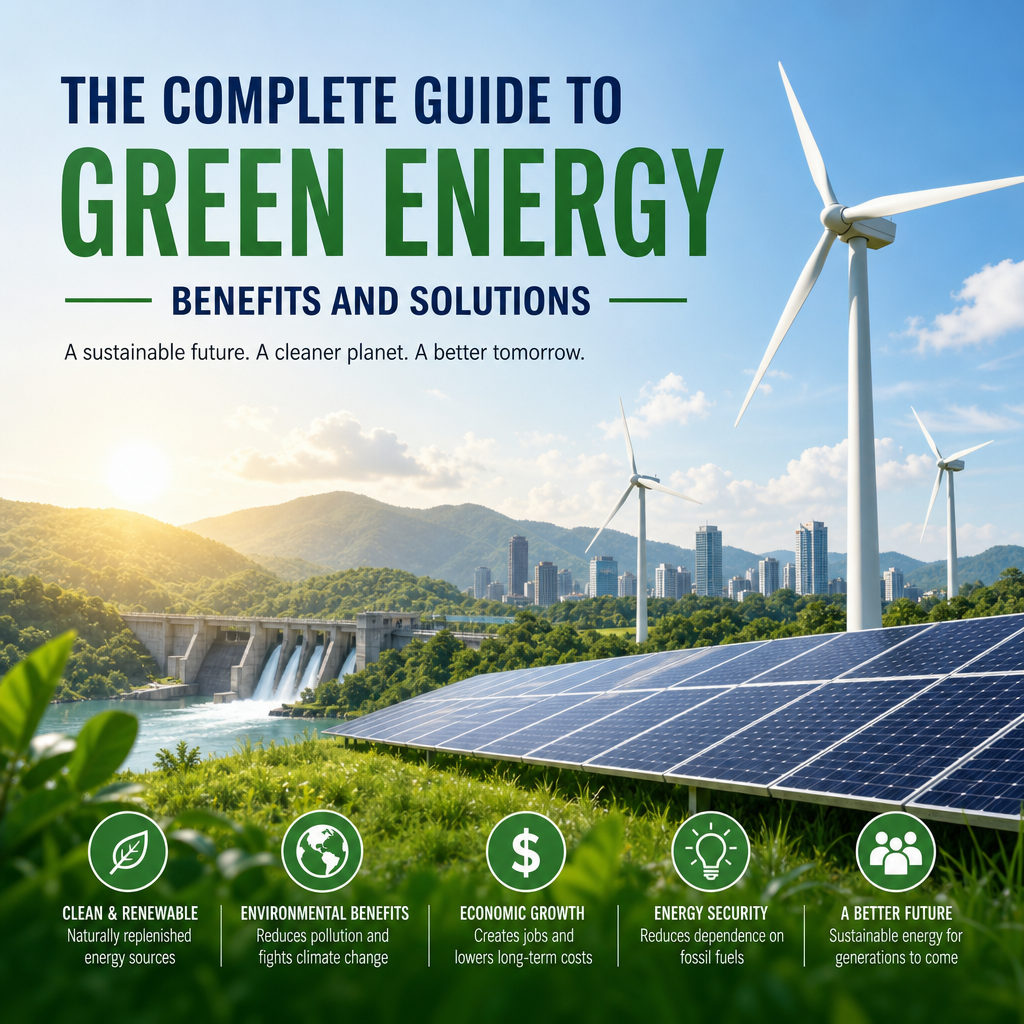
Green energy is renewable energy with the lowest impact on the environment: electricity from solar, wind, geothermal, biogas, eligible biomass and low-impact small hydropower. The U.S. EPA calls it “green power” and treats it as the cleanest subset of renewables, leaving out large dams. In the U.S. it is also something you can choose and buy.
That last part is what makes green energy different from the other big energy words. You may not be able to build a wind farm, but you can often switch your home’s electricity to wind or solar with a phone call, join a community solar project, or make some of your own power on a balcony or roof. This guide explains what green energy really is, how buying it works, what it costs, and how to avoid paying for a label that does nothing.
Green energy at a glance
- What it is: the renewable sources with the greatest environmental benefit; the EPA’s term is “green power.”
- Where it comes from: solar, wind, geothermal, biogas, eligible biomass and low-impact small hydro. Large hydropower and nuclear are not included.
- Renewable or not: always renewable. Every green source is renewable, but not every renewable source is green.
- How many buy it: in 2023, about 9.7 million U.S. electricity customers bought about 319 million MWh of voluntary green power, about 8% of all U.S. retail electricity sales (NREL).
- Main upside: any household can take part, even renters, often without new equipment.
- Main downside: some programs cost extra or sell claims that are hard to verify, so you need to know what to check.
Green energy vs. renewable and clean energy
Think of three circles, one inside the other. The biggest is clean energy, defined by low emissions, which includes nuclear power and often energy efficiency. Inside it is renewable energy, defined by resources that refill themselves: sun, wind, water, plants and the Earth’s heat. The smallest circle, in the middle, is green energy.
What moves a source from “renewable” into “green” is its impact. The EPA explains that some renewable technologies have environmental trade-offs; large hydroelectric dams, for example, affect fisheries and land use, so they count as renewable but not as green power. The EPA also stresses that green power is “voluntary, or surplus to regulation”: it is what customers choose to buy beyond what their state already requires utilities to supply.
And alternative energy? That is the loosest label of all, meaning any alternative to conventional fossil fuels. It can include nuclear and even fuels that are not renewable, so it says little about environmental impact.
How green energy works: you can’t tag an electron
Here is the surprising part. When you buy green power from the grid, the electricity reaching your outlets is the same mix everyone nearby gets. Power from wind farms, solar farms and gas plants blends together on the wires, and nobody can tell which electron came from where. So how can anyone say they use green energy?
- A green power plant makes electricity. A wind turbine, solar farm or geothermal plant sends power into the grid.
- A certificate is created. For every megawatt-hour (1,000 kWh) it delivers, the plant earns one renewable energy certificate, or REC. The REC holds the “green” part: the environmental benefits of that power.
- Someone buys the certificate. Your utility, an electricity supplier or you yourself buy RECs to match some or all of your electricity use.
- The certificate is retired. Once a REC is used to back a claim, it is retired in a tracking system so nobody else can count the same green power twice.
The EPA puts it plainly: RECs are the instrument electricity consumers must use to back up any claim that they use renewable electricity. So the question to ask about any green offer is simple: who ends up with the RECs? That detail matters when you compare the options below.
A short history of green power
The EPA’s history of the U.S. voluntary market shows how buying green energy went from an experiment to an everyday option:
- 1996: New Hampshire runs the first competitive retail green power pilot.
- 1997: the Green-e certification program launches, run by the nonprofit Center for Resource Solutions in San Francisco, to protect buyers in a new, unregulated market.
- 1998: California, Massachusetts and Rhode Island open electricity to retail choice, and AllEnergy Marketing in Massachusetts sells the first retail REC product.
- 1999 and 2001: Texas sets up the first renewable standard with REC trading, then the first REC tracking system.
- 2001: the EPA launches the Green Power Partnership to encourage organizations to use green power voluntarily.
- 2004: Moab, Utah, becomes the first EPA-recognized Green Power Community.
- 2010: Google signs the first voluntary offsite power purchase agreement in the U.S., the start of large corporate green power deals.
Types of green energy
These are the sources the EPA counts as green power in the U.S. voluntary market. Each links to its full guide on our types of energy hub where one exists.
- Solar: rooftop panels, community solar gardens and large solar farms. The one source most homes can produce themselves.
- Wind: the largest renewable source of U.S. electricity, about 11% of utility-scale generation in 2025 (EIA), and the backbone of many utility green programs.
- Geothermal: power plants that tap underground heat, mainly in the West; under 1% of U.S. electricity in 2025.
- Biogas: methane captured from landfills, farms and wastewater plants and burned for power instead of escaping into the air.
- Eligible biomass: plant and wood waste that meets sustainability rules, not just any wood that is burned.
- Low-impact small hydro: small hydropower plants that avoid major harm to rivers and fish. Large dams, about 6% of U.S. electricity in 2025, are renewable but not green.
How to buy green energy for your home
This is where green energy becomes practical. Which options you have depends on your state and your utility, but every U.S. household has at least one. An EPA analysis of 2018 data found that 84% of residential consumers had access to green power beyond certificates, while Arkansas, Louisiana, South Dakota and West Virginia had limited or no access.
1. Your utility’s green pricing program
About 850 U.S. utilities offer an optional green power product, according to the EPA. You sign up online or by phone, and the utility matches your use with renewable power and RECs. Programs come in two styles: blocks (often 100 kWh each) or a percentage of your use, such as 25%, 50% or 100%. You pay a premium as an extra line on your bill. In 2022, about 1,252,000 customers bought 16.6 billion kWh this way (EPA, citing NREL).
2. A competitive green supplier
In states with retail electricity choice, you can pick a different company to supply your power while your utility still delivers it. The EPA counts 18 states plus Washington, D.C., with retail choice, though some, like California, limit who can switch. Read the contract: watch for teaser rates that jump after a few months and early cancellation fees.
3. Community solar
Community solar lets you subscribe to a share of a nearby solar farm. The U.S. Department of Energy describes it as solar whose benefits flow to multiple customers, built for people who cannot put panels on their own roof: renters, people with shaded or unsuitable roofs, and people who cannot pay for a system. DOE cites NREL analysis that roughly half of homes and businesses cannot host rooftop solar. You pay for your share and receive a credit on your utility bill; DOE reports that subscribers in some markets save 5% to 15% a month. There are projects in 44 states and D.C.
One honest catch: the EPA notes that community solar programs commonly do not pass the RECs to subscribers, which means you are saving money and supporting solar, but you cannot strictly claim to use solar power. If that claim matters to you, ask who keeps the RECs. Households in some low-income assistance programs can use DOE’s Clean Energy Connector, which as of December 2024 worked in D.C., Illinois, Maryland, Massachusetts, New Mexico and Rhode Island and required projects to offer at least 20% savings.
4. Community choice aggregation
In community choice aggregation (CCA), your city or county buys power for all its residents, often with more renewable content than the utility, while the utility keeps delivering it. The EPA lists ten states that allow CCAs, including California, Illinois, Massachusetts, New Jersey, New York and Ohio. Most enroll residents automatically and let them opt out, so you may already be in one: check your bill.
5. Renewable energy certificates (RECs)
Anyone, anywhere, can buy RECs separately from their electricity (“unbundled” RECs). You keep your current utility and buy certificates equal to your use. It is the most widely available option. Look for the Green-e certified mark, which shows an independent check that the product is what it claims.
6. Make your own
Rooftop solar is the most direct path for homeowners with a sunny roof; see our solar energy section. Renters and apartment dwellers can start smaller with a portable solar panel and power station that run real devices on sunshine. Anything wired into your home’s electrical system needs a permit and a licensed electrician or installer.
| Option | Who can use it | Equipment needed | Can you claim green power? |
|---|---|---|---|
| Utility green pricing | Customers of about 850 utilities | None | Yes, RECs are bundled |
| Competitive supplier | 18 states + D.C. with retail choice | None | Yes, if RECs are included |
| Community solar | Where programs exist (44 states + D.C.) | None | Only if RECs go to you |
| Community choice (CCA) | 10 states, by city or county | None | Depends on the program |
| Unbundled RECs | Everyone | None | Yes |
| Rooftop or portable solar | Owners; portable for renters | Panels, inverter or power station | Rooftop: check who gets the RECs |
Products for making your own green power
Prices change often. The prices below are what we saw on Amazon in October 2026; check the current price before you buy.
For renters, campers, or anyone who wants to see solar work before a rooftop project, a portable solar setup is the most hands-on form of green energy. We researched and compared these; we did not test them.
Jackery Solar Generator 1000 v2 with 200W Solar Panel
- 1,070Wh LiFePO4 power station
- 1,500W AC output, 3 AC outlets
- 200W panel included; about $699
EcoFlow 220W Bifacial Portable Solar Panel
- 220W front, collects light on both sides
- IP68, adjustable 30-60° stand
- 15.4 lb, folds; about $399
The Jackery Solar Generator 1000 v2 bundles the Explorer 1000 v2 power station (1,070 Wh, 1,500 W of AC output) with a 200 W folding panel, so it works out of the box; Jackery notes the station charges by solar only from Jackery panels. The battery uses LiFePO4 chemistry that Jackery rates at over 70% capacity after 4,000 cycles. If you already own an EcoFlow power station, the EcoFlow 220W bifacial panel is the matching panel: it collects light on its back side too and has a built-in stand that helps you aim it at the sun. Either way, a portable kit powers devices, not your whole home.
Check the Jackery Solar Generator 1000 v2 price on Amazon
For more ways to store the power you make, see our energy storage section.
Where green energy is used today
On the grid, EIA reports that renewables made 24% of U.S. utility-scale electricity in 2025: wind 11%, solar 7%, hydropower 6%, biomass about 1% and geothermal under 1%. Remove large hydro and most of what is left (wind, solar, geothermal, much of the biomass) fits the green power definition.
The voluntary market, where people and companies choose green power, keeps growing. NREL’s latest report found 9.7 million customers bought about 319 million MWh in 2023, 17% more than in 2022, equal to about 44% of all non-hydro renewable sales. NREL notes that the market is shifting toward long-term contracts, driven mainly by companies with ambitious renewable targets.
Pros and cons of green energy
| Pros | Cons |
|---|---|
| The lowest-impact renewables, with very low life-cycle emissions. | Wind and solar vary with weather, so the grid still needs backup. |
| Available to every household, including renters, often with no equipment. | Utility programs can add a premium to your bill. |
| Community solar can lower your bill instead of raising it. | Many community solar programs keep the RECs, so you cannot claim the green power. |
| RECs and Green-e certification make claims trackable. | Unbundled RECs don’t change the power that reaches your home. |
| Sends a clear market signal for more wind and solar. | Some supplier contracts can have rate jumps and cancellation fees. |
Environmental impact: why “green” sets a higher bar
The IPCC’s review of life-cycle studies (2014) gives median emissions, in grams of CO2 equivalent per kilowatt-hour, of 11 for onshore wind, 38 for geothermal and 41 for rooftop solar, against 490 for natural gas and 820 for coal. Hydropower’s median is a low 24, but its range runs up to 2,200 grams, because some reservoirs release methane from flooded plants. That spread, plus the effects on fish and land the EPA describes, is exactly why large dams are left out of green power.
Green sources still have a footprint: solar and wind farms use land, turbines can harm birds and bats, and panels and batteries need mined materials and recycling at the end of their life. Buying green power does not make those go away, but it shifts demand toward the sources with the smallest overall impact.
What green energy costs
Costs depend on how you buy it, and some options save money:
- Utility green pricing: the EPA reports that from 2006 to 2015 the average residential premium mostly hovered around 2 cents per kWh, about $18 a month for an average household. Newer figures are not published on the same basis, so check your utility’s current rate.
- Community solar: often a saving rather than a cost; DOE reports 5% to 15% monthly bill savings in some markets.
- Unbundled RECs: prices vary by seller and product; compare the price per MWh and look for Green-e certification.
- Making your own: a portable kit like those above costs a few hundred dollars and up; rooftop solar costs far more and pays back over years.
For scale, EIA’s preliminary data put the average U.S. residential price at 18.31 cents per kWh in July 2026, and the average residential customer bought 10,791 kWh in 2022, about 899 kWh a month. At that average price, a 2-cent premium would add about 11% per kWh. And remember the federal credits for home solar and batteries (25D) ended for systems completed after December 31, 2025, so in 2026 look for state and utility incentives on DSIRE (dsireusa.org) and in our tax credits and grants section.
The future of green energy
Green supply is growing fast. EIA reported in February 2026 that developers planned a record 86 GW of new utility-scale capacity for 2026, including 43.4 GW of solar, 24 GW of batteries and 11.8 GW of wind; if built, that is more green power for every utility program to draw from. In its 2026 report, Lazard again found new onshore wind ($37 to $99 per MWh) and utility-scale solar ($40 to $98) to be the lowest-cost new power without subsidies, though costs rose for all technologies.
For households, the change to watch is access. Community solar now has projects in 44 states and D.C., and EIA counts 23 states plus D.C. committed to 100% renewable or clean electricity by 2050 or earlier, which pushes utilities to add more renewable supply and simpler ways to choose it.
How green energy compares
| Term | Defined by | Large hydro? | Nuclear? | Can you buy it as a product? |
|---|---|---|---|---|
| Green energy | Lowest-impact renewables (EPA) | No | No | Yes: green pricing, RECs, community solar |
| Renewable energy | Resource refills naturally | Yes | No | Partly |
| Clean energy | Low or zero emissions | Yes | Usually yes | Rarely as a home product |
| Alternative energy | Not conventional fossil fuel | Varies | Often | No |
Green energy FAQs
Is green energy the same as renewable energy?
Not quite. All green energy is renewable, but not all renewable energy is green. The EPA defines green power as the subset of renewables with the greatest environmental benefit: solar, wind, geothermal, biogas, eligible biomass and low-impact small hydro. Large hydroelectric dams are renewable but excluded because of their effects on fisheries and land use.
How can I get green energy for my home?
Start by asking your utility whether it offers a green pricing program, and check whether your state has community solar, a community choice program or retail choice. If none fit, buy Green-e certified renewable energy certificates, which are available everywhere. Homeowners with a sunny roof can install solar; renters can start with a portable solar kit.
Is buying green energy worth it?
It depends on the option. Community solar can lower your bill while supporting solar. Utility green pricing usually costs extra, historically around 2 cents per kWh according to the EPA, in exchange for a verified claim that your use is matched by renewable power. Whatever you choose, make sure the RECs are retired on your behalf.
Is nuclear power green energy?
No. Nuclear power has very low life-cycle emissions, so it is usually counted as clean energy, but the EPA classifies it as a conventional source, not renewable, and it is not part of green power. Uranium is a mined fuel, and spent fuel stays radioactive for thousands of years. See our nuclear energy guide for the full picture.
What is a renewable energy certificate (REC)?
A REC is a certificate created for every megawatt-hour of renewable electricity delivered to the grid. It represents the environmental benefits of that power. Because grid electricity is mixed, the EPA says RECs are what consumers must hold to back up a claim that they use renewable electricity. Once used for a claim, a REC is retired so it cannot be counted twice.
Does community solar mean I use solar power?
Not always. You get bill credits for your share of a solar farm’s output, and DOE reports savings of 5% to 15% in some markets. But the EPA notes many programs do not give subscribers the RECs, and without them you cannot claim to use solar power. You are still helping a solar project run. Ask the provider who keeps the RECs.
Keep exploring
To go deeper, read how solar energy and wind energy work, see why nuclear energy is clean but not green, compare the bigger circles in clean energy and renewable energy, or browse every source on the types of energy hub. Our energy saving tips help you need less power in the first place.