This article contains affiliate links: if you buy through them we may earn a commission, at no extra cost to you. Learn more.
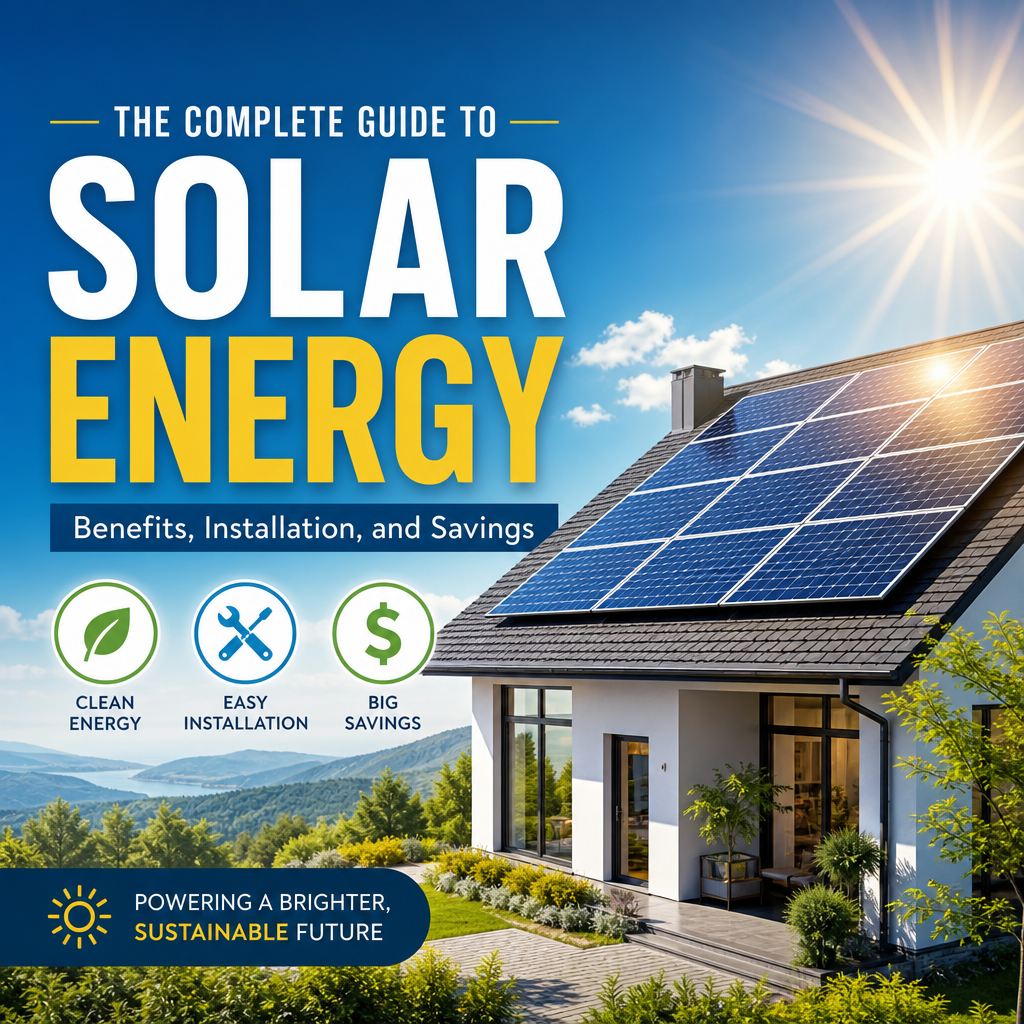
Solar energy is the energy in sunlight, which people capture as electricity or heat. Solar panels turn light straight into electricity using semiconductor cells, while solar thermal systems use the sun’s heat to warm water, air or a fluid that drives a turbine. Sunlight is renewable and free, and making power from it releases no air pollution.
You already use solar energy every day. It grows your food, dries the laundry on the line and warms the car you parked in the sun. The question for most homeowners is simpler: can the sunlight that hits my roof, balcony or backyard cut my power bill or keep the lights on in an outage? This guide explains how solar works, what it really costs in 2026, and what makes sense for your home.
Solar energy at a glance
- What it is: energy from sunlight, used as electricity (photovoltaic panels) or as heat (solar thermal).
- Where it comes from: nuclear fusion in the sun’s core; the energy reaches Earth as light and heat.
- Renewable? Yes. The sun rises every day, and using its light does not use it up.
- Share of U.S. electricity: about 7% of utility-scale generation in 2025, plus about 93 billion kWh from rooftop and other small systems (U.S. EIA).
- Main upside: no fuel to buy and no emissions while it runs; panels work at any scale, from a phone charger to a power plant.
- Main downside: output follows the sun, so it drops at night, in winter and under clouds, and storing it costs extra.
How solar energy works
Sunlight is a stream of tiny packets of energy called photons. When they hit something, they can bounce off, pass through or be absorbed. Solar technology is all about absorbing as many as possible and putting that energy to work. There are two main ways to do it.
Solar panels (photovoltaics, or PV)
- Light hits the cell. A solar cell is a thin wafer of semiconductor, usually silicon. When it absorbs enough sunlight, electrons are knocked loose from their atoms.
- Electrons move one way. The cell is built in two layers with a built-in electric field between them, so the loose electrons drift toward the front surface. That creates a voltage between front and back, like the two ends of a battery.
- Current flows. Metal contacts collect the electrons and send them through a wire as direct current (DC).
- Cells become panels, panels become arrays. Dozens of cells are wired into a panel (also called a module), and panels are grouped into an array on a roof, a rack in the yard or many acres of land.
- An inverter makes it usable. Your outlets use alternating current (AC), so an inverter converts the DC. Grid-tied systems then feed your home first and send any extra to the grid.
How much of the sunlight becomes electricity is called efficiency. The U.S. Energy Information Administration (EIA) says typical PV modules were under 10% efficient in the mid-1980s, around 15% by 2015, and state-of-the-art modules now approach 25%. Experimental cells in labs have come close to 50%.
Solar thermal (using the sun’s heat)
The older and simpler idea is to use sunlight as heat. Solar water heaters run water or another fluid through dark collectors on the roof and store the warm water in an insulated tank, with a regular water heater as backup for cloudy days. On a much larger scale, concentrating solar-thermal power (CSP) plants use mirrors to focus sunlight onto a receiver, heat a fluid, make steam and spin a turbine, the same way a coal or gas plant makes power. Solar power towers use fields of sun-tracking mirrors that concentrate sunlight as much as 1,500 times. Because heat can be stored, some CSP plants keep producing after sunset.
Sunlight itself is a form of radiant energy. A PV panel turns it into electrical energy; a solar water heater turns it into thermal energy.
A short history of solar power
- 1830s: British astronomer John Herschel cooked food in a solar oven during an expedition to Africa.
- 1839: French physicist Alexandre-Edmond Becquerel noticed that light could produce a small electric current, the photovoltaic effect.
- 1883: American inventor Charles Fritts made the first selenium solar cells, which turned less than 1% of sunlight into electricity.
- April 25, 1954: Daryl Chapin, Calvin Fuller and Gerald Pearson at Bell Labs announced the first practical silicon solar cell, about 6% efficient. They showed it off by running a toy Ferris wheel and a radio transmitter.
- March 1958: Vanguard 1, the first solar-powered spacecraft, launched and sent data for about six years. Satellites became solar’s first big market.
- Late 1970s: PV started powering remote places far from power lines.
- 2004 onward: most new PV in the U.S. has been connected to the grid rather than standing alone.
- 2025: wind and solar together made a record 17% of U.S. utility-scale electricity, and utility-scale solar output has grown every year since 2006 (EIA).
Types of solar energy systems
| System | What it does | Typical size and use |
|---|---|---|
| Rooftop PV (grid-tied) | Panels on a home or business, connected to the utility grid | A few kW for a house; the most common home system |
| PV with a battery | Rooftop panels plus a home battery that stores daytime power | Backup in outages and evening use; costs more |
| Portable solar and power stations | Folding panels charge a battery box with outlets | Camping, RVs, short outages; renters can use them |
| Community solar | You subscribe to a share of a nearby solar farm and get bill credits | Renters and homes with shady or unsuitable roofs |
| Utility-scale PV | Large arrays covering many acres, selling power to the grid | 1 MW and up (EIA’s definition); most U.S. solar output |
| Solar water heating | Collectors heat water stored in a tank | Homes, pools; needs a backup heater |
| Concentrating solar power (CSP) | Mirrors focus sunlight to make steam and spin a turbine | Large desert plants, such as the 393 MW Ivanpah plant in California (2013) |
Where solar energy is used today
In the United States. The U.S. generated about 4.43 trillion kilowatt-hours (kWh) of utility-scale electricity in 2025, and solar plants supplied about 7% of it, according to the EIA. Utility-scale solar produced about 296 billion kWh, 34% more than in 2024. Small systems, mostly home rooftops, added another 93 billion kWh, 11% more than the year before. Counting those small systems, wind and solar together made about 19% of the country’s electricity. For scale, solar made only about 5 million kWh in 1984.
Solar is concentrated in the sunniest, biggest states. In 2023, California produced 25% of U.S. utility-scale solar power and Texas 17%; California also made nearly 40% of all small-scale solar electricity (EIA, latest state breakdown).
Around the world. Solar is now the largest kind of renewable power capacity on Earth. The International Renewable Energy Agency (IRENA) counted 2,392 gigawatts (GW) of solar capacity at the end of 2025, after a record 511 GW was added that year. China alone added about 315 GW; the U.S. added 34 GW. Because panels only produce while the sun is up, capacity overstates output: the energy think tank Ember estimates solar made about 8.7% of the world’s electricity in 2025.
Solar energy at home: what you can actually do
A typical U.S. home bought about 10,791 kWh of electricity in 2022, roughly 899 kWh a month (EIA). How much of that solar can cover depends on your roof, your climate and your budget. Here are the realistic options, from biggest to smallest.
- Rooftop panels. The U.S. Department of Energy (DOE) says panels perform best on south-facing roofs with a slope between 15 and 40 degrees, though other directions can work. Shade from trees or neighbors matters more than you might think. If your roof will need replacing in a few years, do that first. Get at least two or three quotes, and have a licensed installer handle the design, permits and wiring.
- Add a battery, or not. DOE explains that grid-tied inverters disconnect from the grid and shut down during a longer outage, so panels without a battery usually leave you in the dark like everyone else. A home battery keeps critical circuits running and lets you use daytime solar at night, but it adds real cost. See our energy storage guides.
- Community solar. DOE estimates nearly half of U.S. households and businesses cannot host rooftop solar, because they rent, lack the money upfront or have an unsuitable roof. Community solar lets you subscribe to a share of a local project and receive monthly bill credits. It is only offered in some states and utility areas.
- Portable solar and a power station. A folding panel and a battery power station will not run your whole house, but they can keep a fridge, lights, phones, a CPAP or a Wi-Fi router going through an outage, and they move with you. This is the most practical solar setup for renters.
- Small solar helpers. Solar path lights, a solar phone charger or a solar attic fan are cheap ways to put sunlight to work without any wiring.
- Use less first. Every kWh you do not use is one you do not need panels for. LED lighting, a smart thermostat and sealing air leaks are cheaper first steps. Start with our energy-saving tips.
What happens to the extra power? When panels make more than you use, a grid-tied system sends the extra to the utility. Many states have “net metering” or similar rules that credit you for it, but DOE notes the credit depends on the policies of your state and your utility. Ask your utility before you sign a contract.
Products that put solar energy to work at home
You do not need a roof of your own to start using the sun. These portable picks charge from sunlight and keep the basics running when the grid goes down. Prices change often; the prices below are what we saw on Amazon in October 2026. Check the current price before you buy.
Jackery Solar Generator 1000 v2 with 100W Solar Panel
- 1,070 Wh LiFePO4 battery
- 1,500 W AC output, 3 AC outlets
- Includes one 100 W solar panel
FlexSolar 100W Portable Solar Panel
- 100 W foldable, 8.4 lb
- IP67 water resistance
- 4-in-1 connector for most power stations
Jackery Solar Generator 1000 v2 (about $619, seen October 2026). This bundle pairs the Explorer 1000 v2 power station with a 100-watt folding panel. Jackery lists 1,070 watt-hours of storage, 1,500 watts of AC output (3,000 W surge), three AC outlets, two USB-C ports and a lithium iron phosphate (LFP) battery that it says keeps over 70% of its capacity after 4,000 cycles. It weighs 23.8 lb. One 100 W panel refills it slowly, so plan on wall charging when you can and solar as the backup. The panel and power station ship separately.
Check the Jackery Solar Generator 1000 v2 price on Amazon
FlexSolar 100W Portable Solar Panel (about $87, seen October 2026). A second panel is the cheapest way to charge a power station faster. This one folds to about 23 by 23 inches, weighs 8.4 lb, has built-in kickstands and comes with adapters (XT60, Anderson, DC7909 and DC5521) that fit most brands. It also has USB ports to charge a phone directly. Like every panel, it reaches its rated 100 W only in strong, direct sun.
Pros and cons of solar energy
| Pros | Cons |
|---|---|
| No fuel cost: sunlight is free once the equipment is paid for | High upfront cost for a home system, and no federal tax credit for homeowners after 2025 |
| No air pollution or greenhouse gases while it runs | Output changes with time of day, season, weather and shade |
| Works at any scale, from a calculator to a power plant | Needs a large surface area to collect meaningful energy |
| Few moving parts and little maintenance for PV | Batteries for night or outage use add significant cost |
| Can lower your bill and keep power on in outages (with storage) | Savings depend on local rates and net-metering rules, which can change |
| Among the cheapest new sources of power at utility scale | Manufacturing uses hazardous chemicals; end-of-life recycling is still developing |
Environmental and safety impact
Solar panels produce no air pollution or greenhouse gases while they operate, and rooftop systems have very little effect on the land around them. That does not make solar impact-free. The EIA notes that making PV cells involves hazardous chemicals, and some cell types contain heavy metals that need special handling when they are retired. DOE funds research on recycling old panels.
Energy payback is quick: a PV system produces as much energy as was used to make it within about 1 to 4 years, according to the EIA. Large solar farms can disturb habitat when land is cleared, which is why developers increasingly use land that is poor for farming. Some solar-thermal plants use water to clean mirrors or cool equipment, a concern in deserts, and the intense beams at solar power towers can kill birds and insects that fly through them.
At home, the main safety issue is electrical. Rooftop and battery systems carry high DC voltages, so wiring, permits and the connection to your panel should be done by a licensed electrician or installer. Portable power stations are plug-and-play, but follow the maker’s limits on what you plug in.
How much does solar energy cost?
Home systems. Prices are quoted in dollars per watt of panel capacity. Lawrence Berkeley National Laboratory’s Tracking the Sun report found that among the 100 largest residential installers in 2023, median prices before incentives ranged from about $2.60 to $5.90 per watt, with roughly a third under $4 per watt. Adding a battery raised prices by about $1.40 per watt in its analysis. As a rough estimate only, a 7-kilowatt system at $3 to $5 per watt works out to about $21,000 to $35,000 before incentives. DOE says a 7 kW system makes about 20 to 35 kWh a day depending on climate. Your quote can be higher or lower; size, roof type, state and installer all move the price.
Tax credits in 2026. The federal 30% residential clean energy credit (Section 25D), which covered solar panels and batteries, ended under the One Big Beautiful Bill Act signed July 4, 2025. The IRS says it is not allowed for expenditures made after December 31, 2025. There is no federal solar tax credit for homeowners in 2026. Some states, utilities and cities still offer rebates or incentives; search your ZIP code at DSIRE (dsireusa.org) and see our tax credits and rebates section. Lease and power-purchase deals are different contracts, so read them closely.
Utility-scale power. Big solar farms are among the cheapest new sources of electricity. Lazard’s 2026 Levelized Cost of Energy+ report puts unsubsidized utility-scale solar at about $40 to $98 per megawatt-hour, compared with $51 to $129 for a new gas combined-cycle plant. Community and commercial-sized solar was higher, at $88 to $197. These are estimates of lifetime cost per unit of power, not your retail rate.
The future of solar energy
Solar is the fastest-growing source of electricity in the U.S. In January 2026 the EIA reported that almost 70 GW of new solar capacity was scheduled to come online in 2026 and 2027, and it expected utility-scale solar output to reach about 424 billion kWh in 2027.
In the lab, the next step is higher efficiency. NASA notes that experimental perovskite-silicon “tandem” cells, which stack two materials to catch more of the spectrum, were approaching 50% efficiency in 2023, compared with 15% to 23% for typical commercial panels. Turning those lab results into durable, affordable panels is still a work in progress. For homeowners, the near-term change is less exciting but more useful: cheaper home batteries and more states allowing community solar.
Solar energy compared with other energy sources
| Source | Share of U.S. utility-scale electricity, 2025 | Capacity factor, 2025 | Renewable? | Best home option |
|---|---|---|---|---|
| Solar (PV) | About 7% | 24.4% | Yes | Rooftop, community or portable solar |
| Wind | About 10.5% | 34.2% | Yes | Only with land and steady wind |
| Hydropower | About 6% | 35.3% | Yes | Rarely practical (needs a stream with a drop) |
| Natural gas | About 41% | Not compared here | No | Heating, cooking, generators |
Capacity factor is how much a plant actually produces compared with running flat out all year (EIA Electric Power Monthly). Solar’s is lower than wind or hydro because of night and weather, which is why storage matters so much for solar.
Solar energy FAQs
Is there a federal solar tax credit in 2026?
No, not for homeowners. The 30% residential clean energy credit (Section 25D) ended under the One Big Beautiful Bill Act of July 4, 2025, and the IRS does not allow it for expenditures made after December 31, 2025. Some states, utilities and cities still offer solar rebates or incentives, so check DSIRE (dsireusa.org) and your utility before you sign a contract.
Do solar panels work on cloudy days and in winter?
Yes, but they make less power. Output depends on the time of day, season, weather and location, so a panel under heavy clouds or a short winter day produces only a fraction of its rating. Cold itself is not a problem; DOE says panels work in both hot and cold climates.
How much does it cost to put solar on a house?
It varies widely. Berkeley Lab found median residential prices from about $2.60 to $5.90 per watt among the top 100 installers in 2023, before incentives. As a rough estimate, a 7 kW system at $3 to $5 per watt costs about $21,000 to $35,000. A battery adds more. Get several quotes and compare the price per watt.
Do solar panels work during a power outage?
Usually not on their own. DOE explains that grid-tied inverters disconnect from the grid and shut down during longer outages, so a standard system without a battery stops supplying your home. To keep power on, you need a home battery or a system designed for backup. A portable power station with a folding panel is a smaller, cheaper way to run essentials during an outage.
Can renters use solar energy?
Yes. Community solar, where it is offered, lets renters subscribe to a share of a nearby solar farm and get credits on their electric bill, with no panels on their building. Renters can also use portable panels with a power station for outages, camping and small loads. Some utilities also sell renewable electricity plans.
How much of U.S. electricity comes from solar?
About 7% of U.S. utility-scale electricity came from solar in 2025, according to the EIA. Utility-scale plants made about 296 billion kWh and small systems such as home rooftops made another 93 billion kWh. Together with wind, solar supplied about 19% of the country’s electricity that year, counting small-scale systems.
What is the difference between solar PV and solar thermal?
Solar PV panels turn sunlight directly into electricity using semiconductor cells. Solar thermal systems collect the sun’s heat instead, either to warm water and air in a home or, in large concentrating plants, to make steam that spins a turbine. Most home systems today are PV; solar water heaters are the main home use of solar thermal.
Keep exploring
Solar is one piece of the bigger picture in our guide to the types of energy. See how it fits with other renewable energy sources, how people live on sunlight alone with off-grid energy, or browse our solar energy articles and the basics in Energy 101.