This article contains affiliate links: if you buy through them we may earn a commission, at no extra cost to you. Learn more.
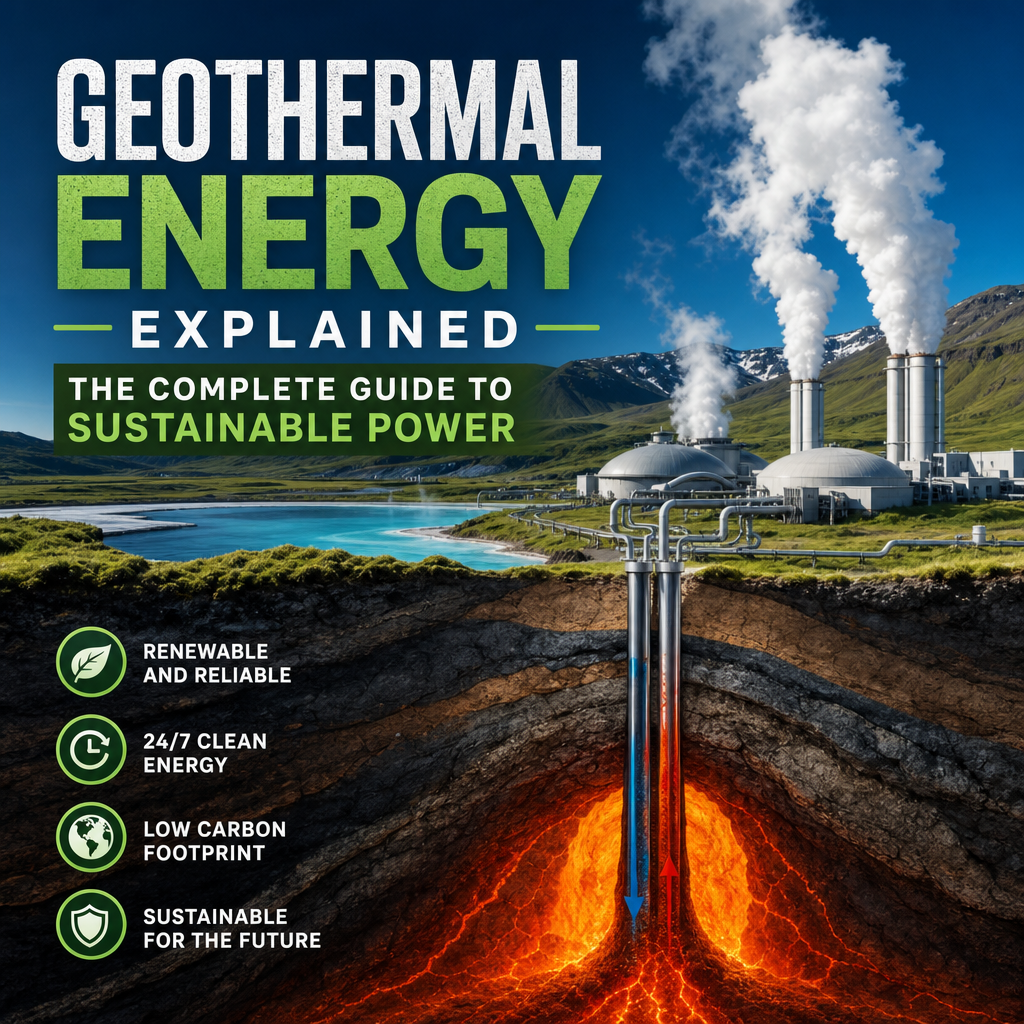
Geothermal energy is heat from inside the Earth. It comes mostly from the slow decay of radioactive elements deep underground, and people use it three ways: to make electricity with steam or hot water from wells, to heat buildings and greenhouses directly, and to heat and cool homes with ground-source (geothermal) heat pumps.
You don’t need to live near a volcano to use it. A few feet under your lawn, the soil stays at a steady temperature all year, cooler than the summer air and warmer than the winter air. That quiet, constant warmth is the same resource that powers big plants in California and Nevada, and it is the one a homeowner can actually tap. This guide explains how geothermal energy works, where it is used, what it costs, and what it can and can’t do for your house.
Geothermal energy at a glance
- What it is: heat stored in rock and water below the Earth’s surface. The name comes from the Greek geo (earth) and therme (heat).
- Where it comes from: mostly the slow breakdown of radioactive particles deep inside the planet, whose inner core is about 10,800°F.
- Renewable? Yes. The Earth’s heat is constantly replenished, though a single reservoir must be managed so it isn’t cooled or drained faster than it recovers.
- U.S. share: geothermal plants made about 16 billion kilowatthours in 2025, roughly 0.4% of U.S. utility-scale electricity (U.S. EIA).
- Main upside: steady power around the clock, in any weather, with very low emissions.
- Main downside: good hot-rock sites are rare and drilling is expensive, both for power plants and for home ground loops.
How geothermal energy works
Think of the Earth as layers. At the center is a solid iron inner core, then a molten outer core, then the mantle of hot rock and magma, and finally the thin crust we live on: about 15 to 35 miles thick under the continents and only 3 to 5 miles under the oceans. Heat flows steadily outward from the hot interior toward the cool surface.
Where tectonic plates meet, near volcanoes, magma comes closer to the surface. There, water trapped in hot, porous rock forms a natural underground boiler called a hydrothermal reservoir; hot springs and geysers are the visible signs.
Using that heat follows the same simple steps whatever the scale:
- Reach the heat. Drill a well (for a power plant, sometimes as deep as 2 miles) or bury a loop of pipe (for a home heat pump, usually a few feet to a few hundred feet).
- Move the heat. Bring hot water or steam up, or circulate a fluid through buried pipe so it picks up (or dumps) heat.
- Use the heat. Spin a turbine to make electricity, run hot water through radiators or pipes in a greenhouse, or let a heat pump concentrate it to warm a house.
- Send it back. Most power plants inject the cooled water back underground to keep the reservoir going and to cut emissions.
Making electricity: three kinds of plants
Geothermal power plants need very hot water or steam, roughly 300°F to 700°F. The U.S. Energy Information Administration (EIA) describes three designs:
- Dry steam plants pipe steam straight from the reservoir into a turbine. It is the oldest and simplest design.
- Flash steam plants are the most common. Very hot water under high pressure comes up the well; as the pressure drops at the surface, part of it “flashes” into steam that drives the turbine. The leftover water goes back underground.
- Binary-cycle plants pass the geothermal water through a heat exchanger that boils a second fluid with a lower boiling point, and that fluid spins the turbine. The geothermal water never touches the turbine and stays in a closed loop, so these plants produce no air emissions and can use cooler resources.
Because the heat doesn’t depend on sun or wind, the U.S. Department of Energy (DOE) notes that geothermal plants can run at close to full output nearly all the time, with a typical capacity factor of about 90%. That makes it “firm” power that doesn’t fade at night or in still weather.
Heating and cooling: geothermal heat pumps
This is the part that matters most for homeowners, and it works almost anywhere. According to EIA, the ground about 10 feet down stays between roughly 50°F and 60°F all year in most of the country. A geothermal heat pump (also called a ground-source heat pump) circulates water or an antifreeze mix through buried pipe called a ground loop. In winter, the fluid picks up the ground’s warmth and the heat pump concentrates it to heat your home. In summer it runs in reverse, pulling heat out of the house and pushing it into the cooler ground. Many systems can also make hot water.
The trick is that a heat pump moves heat rather than making it from fuel. DOE’s consumer guide says geothermal heat pumps move three to five times as much energy as they use, reach efficiencies of 300% to 600% even on the coldest winter nights, and can cut energy use 25% to 50% compared with air-source heat pumps, because the ground is a far steadier source than winter air.
A short history of geothermal energy
Long before power plants, people used hot springs for bathing and warmth. The modern story starts in Tuscany, Italy:
- 1904: at Larderello, Prince Piero Ginori Conti used natural steam to drive a small generator that lit five light bulbs, the first electricity made from geothermal heat. EIA counts Larderello as the world’s first geothermal power plant, a dry steam design.
- 1913: the first commercial geothermal power plant started at Larderello, supplying local industry. The field still produces power today.
- 1960: Pacific Gas & Electric opened the first commercial geothermal power plant in the United States at The Geysers, north of San Francisco. By the 1980s, more than two dozen plants there produced about 2,000 megawatts.
- 2026: Fervo Energy announced that its Cape Station project in Beaver County, Utah, sent its first power to the grid, the first time a new “enhanced” geothermal project has done so, according to the company.
Types of geothermal energy systems
It helps to sort geothermal by how hot the resource is and how deep you go:
- Hydrothermal power uses natural reservoirs of hot water and steam, the classic power plants described above. In the U.S. they sit almost entirely in the West.
- Direct use and district heating pipes moderately hot water straight into buildings, greenhouses, fish farms, spas and industrial processes, with no electricity step at all.
- Geothermal heat pumps use the shallow, steady ground temperature found almost everywhere for heating and cooling. Closed loops come in three layouts: horizontal (pipe in trenches at least 4 feet deep, usually cheapest when there’s land), vertical (pipe in drilled boreholes, for small lots or rocky ground) and pond or lake (coils sunk at least 8 feet under a suitable body of water). Open-loop systems pump well water through the unit and return it, where local rules and water quality allow.
- Enhanced geothermal systems (EGS) create a reservoir where hot rock exists but water or natural cracks don’t, by pumping fluid down to open fractures. DOE says EGS could someday power the equivalent of more than 65 million American homes and businesses. It is the technology behind most of today’s geothermal excitement.
Where geothermal energy is used today
In the United States, EIA reports that geothermal power plants in seven states produced about 16 billion kilowatthours in 2025, around 0.4% of utility-scale electricity. California made 68.6% of that and Nevada 24.7%, followed by Utah, Hawaii, Oregon, Idaho and New Mexico. In Nevada, geothermal supplied 8.6% of the state’s electricity; in California, 5.2%. For the whole country, all renewables together supplied about 24% of utility-scale electricity in 2025, so geothermal is a small but steady slice.
Around the world, EIA counts 25 countries that generated about 92 billion kilowatthours of geothermal electricity in 2022. Indonesia was the largest producer at about 17 billion kilowatthours, and Kenya got 43% of its electricity from geothermal, the highest share of any country. The International Renewable Energy Agency (IRENA) put global geothermal power capacity at about 16 gigawatts at the end of 2025, a small slice of the world’s renewable power capacity.
Geothermal energy at home: what you can actually do
You won’t make electricity from geothermal heat at home, but you can heat and cool your home with the ground.
A geothermal heat pump (homeowners)
A ground-source heat pump replaces your furnace and air conditioner with one system. DOE says it is a particularly good fit when you are building a new home or replacing your HVAC system during a major renovation, because the yard is already being dug up. Expect a site survey, a heat-loss calculation for your house, and a loop design based on your soil, lot size and climate. Installation involves trenching or drilling, permits and refrigerant work, so it is always a job for a licensed, experienced geothermal installer. Get more than one quote.
It tends to pay off best with room for a horizontal loop, a well-insulated house (so a smaller system will do), high current heating costs, and plans to stay long enough to earn back the extra cost.
If geothermal doesn’t fit (renters and small lots)
An air-source heat pump uses the same refrigeration cycle but trades heat with the outdoor air instead of the ground. It is less efficient than geothermal in deep cold, but it costs far less and needs no drilling. DOE also describes “dual-source” systems that combine the two. Wiring and refrigerant work belong to a licensed pro. Renters can’t install either without the owner’s say-so, but can still cut bills with the ideas in our energy-saving tips.
Money in 2026: no federal credit
The 30% federal Residential Clean Energy Credit (Section 25D) covered geothermal heat pumps, but under the One Big Beautiful Bill Act of July 4, 2025, it does not apply to systems installed after December 31, 2025. For a 2026 project, look instead for state, utility and local rebates in the DSIRE database (dsireusa.org); some utilities offer generous geothermal incentives. Our tax credits and grants section keeps track of what changed.
Products that put geothermal thinking to work at home
A ground loop is a contractor job, not something you order online. What you can add today is good control: a smart thermostat that runs a heat pump efficiently and heats only when you need it. These are real products sold on Amazon; prices are what we saw in October 2026 and change often.
ecobee Smart Thermostat Premium
- ENERGY STAR certified
- SmartSensor room sensor included
- Kit for homes without a C-wire
Google Nest Thermostat
- ENERGY STAR certified
- Schedules in the Google Home app
- Heat pumps need a C-wire or power accessory
Whatever heats your home, a geothermal heat pump, an air-source heat pump or a furnace, it only saves money if it is controlled well. The ecobee Smart Thermostat Premium (about $210, seen October 2026) lists heat pumps among the systems it controls and comes with a SmartSensor that reads the rooms you actually use. The Google Nest Thermostat (about $79) is the budget pick; Google notes that heat pump systems need a C-wire or compatible power accessory. If your wiring is unclear or you are adding a new system, have a licensed HVAC technician or electrician install it.
Check the ecobee Smart Thermostat Premium price on Amazon
Geothermal energy pros and cons
| Pros | Cons |
|---|---|
| Runs day and night in any weather; plants operate at about 90% capacity factor (DOE) | Power plants only work where hot rock and water are near the surface, mostly in the West |
| Very low emissions: about 99% less carbon dioxide than fossil-fuel plants of the same size (EIA) | High upfront cost; drilling is expensive and a dry well is a costly risk |
| Small land footprint and no fuel to buy or import | Some plants release hydrogen sulfide and other natural gases unless scrubbed |
| Home heat pumps work almost anywhere and use 25%–50% less energy than air-source units (DOE) | Home ground loops need yard space or drilling, permits and a specialist installer |
| Ground loops last 25 to 50 years; quieter and lower-maintenance than air-source units (DOE) | Federal home credit ended for 2026 installs; payback depends on local rebates and energy prices |
Environmental and safety impact
Geothermal plants don’t burn fuel. EIA says they emit about 97% less of the sulfur compounds that cause acid rain and about 99% less carbon dioxide than fossil-fuel plants of similar size. Steam from some reservoirs carries hydrogen sulfide (the rotten-egg smell) and a little carbon dioxide; plants use scrubbers to remove the hydrogen sulfide, and binary plants keep the geothermal fluid sealed in a loop with no air emissions at all. Reinjecting the used water back underground helps keep reservoirs productive.
The main safety concern is induced earthquakes. Pumping fluid into deep rock can trigger small quakes. In December 2006, an enhanced geothermal test under the city of Basel, Switzerland, set off a magnitude 3.4 earthquake that damaged buildings and led to the project being shut down. DOE has since published a protocol for studying and managing induced seismicity at geothermal sites, and developers now monitor and limit injection pressures. Most geothermal projects never cause a quake people can feel, but it is a real risk that regulators watch.
Home geothermal heat pumps have a light footprint: sealed plastic pipe in the ground and an indoor unit. They run on electricity, so their emissions depend on your grid, and as the grid gets cleaner, so does your heating. A 2024 study by Oak Ridge National Laboratory with NREL estimated that putting geothermal heat pumps in 68% of U.S. building floor space, together with better insulation, could avoid more than 7 billion metric tons of carbon dioxide through 2050 and cut the nation’s electricity generation needs by up to 11%.
How much does geothermal energy cost?
For power plants, the investment bank Lazard’s 2025 analysis put the unsubsidized cost of electricity from new geothermal plants at about $66 to $109 per megawatthour, a range. That is more than new utility-scale solar ($38–$78) or onshore wind ($37–$86) in the same report, and similar to new gas combined-cycle plants ($48–$109). Geothermal’s selling point isn’t being the cheapest kilowatthour; it is delivering power around the clock without fuel.
For homes, the big cost is the ground loop. DOE’s consumer guide gives an example: the heat pump equipment averages about $2,500 per ton of capacity, so a typical 3-ton home unit runs about $7,500 before installation and drilling, compared with about $4,000 for a comparable air-source system with air conditioning. Total installed prices vary widely with soil, rock, lot size and region, so treat any single number as an estimate and get several written quotes. DOE says the extra cost can often be recovered through lower energy bills in 5 to 10 years, depending on energy prices and incentives in your area. It also says the indoor heat pump typically lasts 20-plus years and the underground loop 25 to 50 years, so a future replacement usually reuses the loop.
The future of geothermal energy
Here is what is real, not hype. DOE’s 2019 GeoVision study laid out a path to 60 gigawatts of U.S. geothermal power by 2050, and in 2022 its Enhanced Geothermal Shot analysis raised the potential for U.S. geothermal power to about 90 gigawatts by 2050, if enhanced geothermal costs fall sharply. Those are targets, not forecasts. The first commercial steps are now visible: on September 24, 2026, Fervo Energy announced first power from a 33-megawatt block of the 100-megawatt first phase of Cape Station in Utah, with the rest of that phase expected around the start of 2027 and a further 400-megawatt phase under construction for 2028, according to the company.
Another thread to watch is pulling lithium for batteries out of geothermal brines, which DOE highlights as a possible bonus of geothermal development. For homeowners, DOE’s GeoVision goal of 28 million geothermal-heated homes by 2050 is the long-term picture; the near-term question is simply whether a ground loop makes sense for your house.
How geothermal compares with other energy sources
| Source | Renewable? | Runs 24/7? | U.S. utility-scale electricity, 2025 (EIA) | New-plant cost, $/MWh (Lazard 2025, unsubsidized) |
|---|---|---|---|---|
| Geothermal | Yes | Yes | About 0.4% | $66–$109 |
| Solar (utility) | Yes | No, daytime only | About 7% | $38–$78 |
| Wind (onshore) | Yes | No, depends on wind | About 11% | $37–$86 |
| Natural gas (combined cycle) | No | Yes | About 41% | $48–$109 |
Like hydroelectric power and nuclear energy, geothermal gives steady output that pairs well with solar and wind. For the physics of heat itself, see thermal energy.
Geothermal energy FAQs
Is geothermal energy renewable?
Yes. The Earth’s internal heat comes from the slow decay of radioactive elements and will last for billions of years. An individual reservoir can cool or lose pressure if it is overused, which is why plants reinject water and manage output. Home ground loops simply borrow heat from the shallow ground, which the sun and the Earth’s interior keep replenishing.
Can I use geothermal energy at my house?
Almost certainly for heating and cooling, through a geothermal heat pump, because the ground a few feet down stays around 50°F to 60°F nearly everywhere in the U.S. You need room for a horizontal loop or a budget for drilling, plus a licensed installer. Making your own electricity from geothermal heat isn’t practical for a home.
How much does a geothermal heat pump cost?
DOE’s example puts the equipment at about $2,500 per ton, or roughly $7,500 for a 3-ton home system, before drilling and installation, which often cost more than the unit. Final prices vary widely by soil, lot and region, so get several quotes. DOE says energy savings can repay the extra cost over an air-source system in about 5 to 10 years.
Is there still a tax credit for geothermal heat pumps?
Not a federal one for new installs. The 30% Residential Clean Energy Credit ended for systems installed after December 31, 2025, under the One Big Beautiful Bill Act. In 2026, check state programs and your electric or gas utility; the DSIRE database at dsireusa.org lists rebates by state and ZIP code.
What are the disadvantages of geothermal energy?
Power plants are limited to places with hot rock near the surface, drilling is costly and risky, and some reservoirs release hydrogen sulfide that must be scrubbed. Injecting fluid deep underground can trigger small earthquakes. For homes, the main drawback is the high upfront cost of the ground loop.
Which states use the most geothermal energy?
California and Nevada, by far. In 2025, California produced 68.6% of U.S. geothermal electricity and Nevada 24.7%, according to EIA. Utah, Hawaii, Oregon, Idaho and New Mexico make the rest. Geothermal heat pumps, on the other hand, are installed in every region, because they only need the shallow ground.
Keep exploring
Geothermal is one piece of the bigger picture. See how it fits among all the types of energy, compare it with other renewable energy sources, read the basics in Energy 101, or start lowering your heating and cooling bill now with our energy-saving tips.