This article contains affiliate links: if you buy through them we may earn a commission, at no extra cost to you. Learn more.
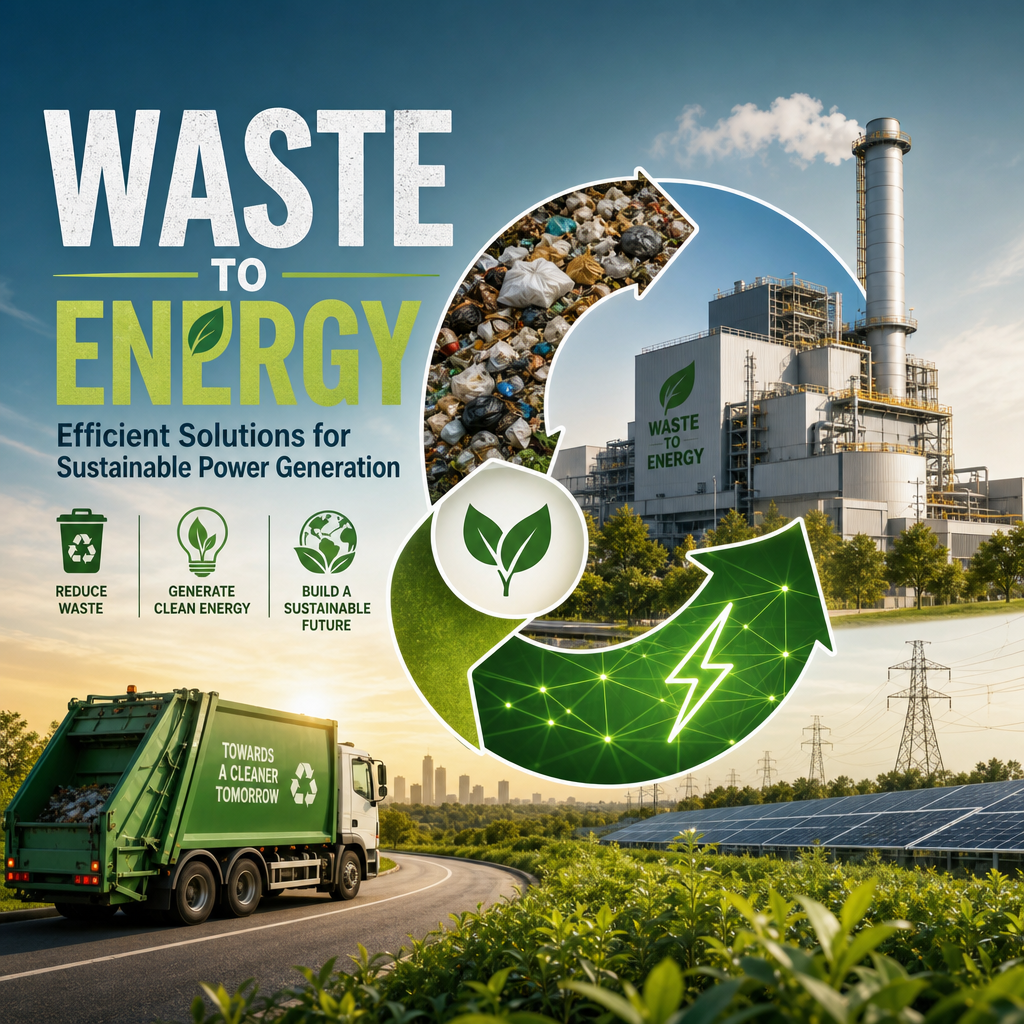
Waste-to-energy is the process of turning garbage into usable energy, most often by burning household trash in special power plants that use the heat to make steam for electricity or building heat. It also includes capturing methane gas from landfills and digesting food scraps into biogas. It shrinks trash by about 87% while producing power.
Every week you roll a bin to the curb, and it disappears. Where it goes next decides whether it just takes up space for centuries or does something useful on the way out. In some towns, last week’s pizza boxes and coffee grounds help light up the neighborhood. This guide explains how that works, how much power it really makes, the honest pros and cons, and what you can do with your own household waste.
Waste-to-energy at a glance
- What it is: making electricity, heat or fuel from municipal solid waste (household and business trash), mainly by burning it or by collecting the gas it gives off as it rots.
- Where it comes from: the energy stored in paper, food, wood, yard waste and plastics. About 61% of the weight of the trash burned in U.S. plants is biomass such as paper and food (U.S. EIA).
- Renewable? Partly. EIA counts the biomass part of trash as renewable; plastics are made from fossil fuels, so that part is not.
- Share of U.S. electricity: small. EIA reports that 57 U.S. waste-to-energy power plants generated about 12.8 billion kWh from about 26.6 million tons of trash (figures as of May 2026), well under 1% of U.S. electricity.
- How much trash it handles: in 2018, about 11.8% of the 292.4 million tons of U.S. municipal waste was burned with energy recovery (U.S. EPA).
- Main upside: it cuts the volume of trash going to landfills by about 87% and makes power at the same time.
- Main downside: plants cost hundreds of millions of dollars, release air pollutants that need strict controls, and leave ash that must be managed.
How waste-to-energy works
In simple words, a waste-to-energy plant is a steam power plant whose fuel is garbage. Most of the energy in trash comes from things that were once plants (paper, cardboard, food, wood, leaves) plus plastics made from oil and gas. Burn them and you release that stored chemical energy as heat.
Here is what happens at a typical combustion plant, step by step:
- Delivery: garbage trucks unload into a large storage bunker. An overhead crane sorts the trash and lifts it into the furnace.
- Burning: the furnace runs at about 1,800°F to 2,000°F. EIA notes that temperatures this high break many chemicals in the trash down into less harmful compounds.
- Steam: the heat boils water in a boiler. The steam spins a turbine connected to a generator, or it is piped out to heat nearby buildings.
- Cleaning the exhaust: scrubbers spray liquid into the hot gases to neutralize acids, and fabric filters and electrostatic precipitators catch fine particles called fly ash. EPA says modern filters remove more than 99% of particulate matter.
- Handling the ash: what’s left is ash: 15%–25% of the original weight and 5%–15% of the volume, according to EPA. Metals are often pulled out for recycling, and the ash is tested before it goes to a landfill or is reused.
How much power is that? EPA puts it at roughly 550 kilowatt-hours per ton of trash burned. For a sense of scale, the average U.S. home bought about 899 kWh of electricity a month in 2022 (EIA), so a ton and a half of trash covers about one household for a month. EIA describes the shrinkage this way: 2,000 pounds of garbage become 300 to 600 pounds of ash.
Types of waste-to-energy technology
“Waste-to-energy” is an umbrella term. EPA lists combustion along with several other ways to get energy out of waste:
- Combustion (incineration with energy recovery): the main type in the United States, described above. EPA says “mass burn” plants, which burn trash in a single chamber on a moving grate, are the most common. Refuse-derived fuel plants first shred the trash and remove things that won’t burn.
- Landfill gas recovery: buried trash rots without air and makes landfill gas, which EPA says is roughly 50% methane and 50% carbon dioxide. Wells and pipes collect it to burn in engines or turbines for electricity, to use directly as fuel, or to clean up into renewable natural gas (RNG). As of September 2024, EPA counted 542 operating landfill gas energy projects in the United States.
- Anaerobic digestion: food scraps, manure or sewage sludge go into sealed tanks where microbes break them down into biogas and a nutrient-rich leftover called digestate, which can be used as fertilizer. EIA says raw biogas is about 45%–65% methane, depending on what goes in.
- Gasification and pyrolysis: these heat waste with little or no oxygen to turn it into a gas or oil that can be burned or refined. EPA lists them as conversion technologies; they are far less common than combustion.
Waste-to-energy overlaps with biomass energy, since most of what burns or rots is plant-based, and with biofuels, since cleaned-up landfill gas and biogas can fuel vehicles.
A short history of turning trash into energy
- 1885: the first U.S. garbage incinerator is built on Governors Island in New York (EPA).
- Mid-1900s: hundreds of incinerators operate across the country, but little is known about their air and water pollution until the 1960s.
- 1970: the Clean Air Act takes effect, and many old incinerators shut down or add pollution controls.
- Early 1990s: combustion handles more than 15% of all U.S. municipal waste, its high point (EPA).
- 1990s: EPA sets stricter “maximum achievable control technology” (MACT) rules aimed at emissions such as mercury and dioxins.
- 2015: a new waste-to-energy plant opens in Palm Beach County, Florida, the newest U.S. plant listed by EPA.
Where waste-to-energy is used today
In the United States, most trash still goes to landfills. EPA’s latest national breakdown (2018) looks like this:
| Where U.S. trash went (2018) | Million tons | Share |
|---|---|---|
| Landfilled | 146.1 | 50% |
| Recycled | 69.0 | 23.6% |
| Burned with energy recovery | 34.6 | 11.8% |
| Composted | 25.0 | 8.6% |
Source: U.S. EPA, Facts and Figures about Materials, Waste and Recycling. Total generated: 292.4 million tons, or 4.9 pounds per person per day.
EPA counts about 75 waste-to-energy facilities in 25 states, mostly in the Northeast, where land for landfills is scarce and expensive. EIA counts 57 of them as power plants feeding electricity to the grid. Many large landfills also generate electricity from their gas: EPA reports that about 63% of operating landfill gas projects make electricity, about 17% use the gas directly as fuel, and about 20% clean it into renewable natural gas.
Even so, waste is a minor power source. Burning trash produced about 12.8 billion kWh in EIA’s latest figures, compared with about 4.43 trillion kWh of total U.S. utility-scale generation in 2025, roughly 0.3% (our calculation). All biomass, including the biomass in trash, supplied about 1% of U.S. utility-scale electricity in 2025.
Around the world, the waste keeps growing. The World Bank’s What a Waste 3.0 report says the world produced 2.56 billion tonnes of municipal solid waste in 2022 and could reach 3.86 billion tonnes by 2050 if nothing changes. In many low-income regions, most waste is still dumped in the open, so collecting it at all comes before turning it into energy.
Waste-to-energy at home: what you can actually do
You can’t run a trash-burning power plant in your yard, and you shouldn’t burn household garbage yourself; backyard burning has no pollution controls at all. But you can make a real difference in what your waste does, and a few households can even turn food scraps into cooking gas.
- Find out where your trash goes. Your city or hauler can tell you whether your garbage goes to a landfill, a landfill with gas capture, or a waste-to-energy plant. It helps you judge which local programs matter most.
- Start with less waste. EPA ranks energy recovery below reducing waste and recycling, but above landfilling. Paper and cardboard (23.1%) and food (21.6%) were the two biggest parts of U.S. trash in 2018, and both are easy to cut.
- Compost your food scraps. Composting doesn’t make electricity, but it keeps food out of landfills, which EPA says are the third-largest human-related source of methane in the country (about 14.4% in 2022). Methane traps at least 28 times more heat than CO2 over 100 years. A countertop pail plus a backyard tumbler is the simplest setup.
- Keep batteries and fluorescent bulbs out of the trash. EIA notes that metals such as lead and cadmium from items like batteries end up concentrated in waste-to-energy ash. Take them to a household hazardous waste drop-off or a store take-back bin.
- Consider a home biogas digester, honestly. Small digesters turn food scraps, and in some setups manure, into gas you can cook with and liquid fertilizer for the garden. They need space, steady feeding and warm weather to work well, and anything involving a gas line and a burner should follow local codes. Check with your local building or fire department first, and have a licensed professional handle any gas connection to your home.
- Cut the energy you buy. For most households, the bigger win is using less power in the first place. Our energy-saving tips go through the biggest easy savings.
Products that turn your waste into something useful
Two picks for the two realistic paths at home: a backyard biogas digester if you have the space and climate for it, and a compost tumbler if you simply want your food scraps out of the landfill.
Prices change often. The prices below are what we saw at a major retailer in October 2026; check the current price before you buy.
PUXIN Home Biogas Digester PX-2.65
- DIY backyard digester
- Food scraps, manure, grass
- Maker: up to 1,800 L gas, ~3 hours cooking
VIVOSUN Dual Chamber Compost Tumbler
- 43 gallons, two chambers
- 360° tumbling, air vents
- Metal frame, PP plastic body
The PUXIN PX-2.65 (about $990, seen October 2026) is a do-it-yourself home digester, about 59 by 59 inches, that takes food waste, kitchen leftovers, animal manure and grass. The maker says it can produce up to 1,800 liters of gas, enough for up to about three hours of cooking, plus liquid fertilizer for plants. It is a real commitment: it suits rural homes, homesteads and warm climates better than a small city yard, and you should confirm local rules on gas equipment before you buy.
Check the PUXIN biogas digester price on Amazon
The VIVOSUN tumbler (about $68, seen October 2026) is the easy, low-cost route. It has two chambers, so one side can finish while you keep adding fresh scraps to the other, and you turn the whole drum instead of digging with a fork. It makes compost, not energy, but it keeps methane-making food waste out of the landfill.
Pros and cons of waste-to-energy
| Pros | Cons |
|---|---|
| Shrinks trash volume by about 87%, saving landfill space | Plants are expensive: at least $100 million, and $200–300 million for larger ones (EPA) |
| Makes electricity or heat around the clock from a fuel that keeps arriving | Burning releases air pollutants that need scrubbers and filters to control |
| Most of the fuel (paper, food, wood) is biomass that EIA counts as renewable | Plastics in the trash are fossil-based, so part of the power is not renewable |
| Recovers metals from the ash for recycling | Ash can hold metals such as lead and cadmium and must be tested and managed |
| Landfill gas projects capture methane that would otherwise escape | Can compete with recycling and composting for the same materials |
| Works well where land is scarce, near the cities that make the waste | Small share of power; neighbors often oppose new plants |
Environmental and safety impact
Air: burning trash produces air pollution. Federal rules require plants to use control equipment such as scrubbers, fabric filters and electrostatic precipitators. The 1990s MACT rules targeted mercury and dioxins, the pollutants that gave old incinerators their bad name. A modern, well-run plant is a very different machine from the open-burning incinerators of the mid-1900s, but it still has a stack, and living near one is a fair concern to raise with local officials.
Ash: EIA notes that ash can contain high concentrations of metals that were in the trash, such as lead and cadmium from batteries, textile dyes and ceramics. EPA requires testing to make sure ash isn’t hazardous before disposal. Some ash that passes is used as landfill cover or to make concrete blocks and bricks.
Climate: the comparison that matters is usually with landfilling. Landfilled food and paper slowly make methane, and landfills were the third-largest human-related methane source in the United States in 2022 (EPA). Waste-to-energy plants avoid that methane and make power, but burning plastics releases fossil carbon dioxide. Capturing gas at landfills, composting and recycling all reduce methane too, which is why EPA places reducing and recycling waste above energy recovery.
At home: never burn household trash in a barrel or fire pit, and treat any biogas system like the fuel gas it is: keep it outdoors, ventilated and away from ignition sources, follow the maker’s instructions, and keep a working carbon monoxide alarm inside your home if you cook with any gas.
How much does waste-to-energy cost?
Waste-to-energy plants are paid for in two ways: by selling electricity and by charging “tipping fees” to accept garbage. EPA’s figures give the picture:
- Building a plant: usually at least $100 million; larger plants may cost $200 million to $300 million.
- Power output: about 550 kWh per ton of trash.
- Power income: at around 4 cents per kWh, that is only about $20–$30 per ton, so tipping fees carry much of the cost.
These are EPA’s general estimates, not a quote for a particular plant. The basic economics explain why waste-to-energy is common where landfill space is costly and rare where cheap land is plentiful. For a household, the cost side is simpler: a compost pail costs a few dollars, a tumbler under $100, and a backyard digester around $1,000 as of October 2026.
The future of waste-to-energy
- More landfill gas projects: beyond the 542 operating projects, EPA lists 444 more U.S. landfills as good candidates for landfill gas energy (September 2024).
- Renewable natural gas: about one in five landfill gas projects now upgrades the gas to pipeline-quality RNG. EIA says RNG injected into pipelines is 96%–98% methane, so it can substitute for fossil natural gas in pipelines and vehicles.
- Food waste digesters: as more cities collect food scraps separately, more of that material can go to anaerobic digesters instead of landfills.
- Global growth: with world waste heading toward 3.86 billion tonnes a year by 2050 (World Bank), countries that are short on land will keep looking at energy recovery, ideally after recycling and composting.
EPA describes the growth of trash burning in the United States as slow, held back by cheap landfills, high up-front costs and public opposition, and the share of trash burned has fallen since the early 1990s. The growth is in capturing gas, from landfills and from digesters, rather than in burning more garbage.
How waste-to-energy compares
| Waste-to-energy (burning) | Landfill gas | Biomass power | Solar PV | |
|---|---|---|---|---|
| Fuel | Mixed household trash | Methane from rotting waste | Wood, crop and other plant waste | Sunlight |
| Renewable? | Partly (biomass share) | Yes, counted as biogas | Yes, if regrown | Yes |
| Runs at night? | Yes | Yes | Yes | No, needs storage |
| U.S. scale | 57 power plants, about 12.8 billion kWh | 542 projects (Sept 2024) | All biomass: about 1% of utility-scale power (2025) | About 7% of utility-scale power (2025) |
| Can a homeowner use it? | No | No | Yes, wood or pellet stoves | Yes, rooftop or portable panels |
Sources: EIA (waste-to-energy, biomass and solar shares), EPA (landfill gas).
Waste-to-energy FAQs
How does waste-to-energy work?
Most waste-to-energy plants burn household trash in a furnace at about 1,800°F to 2,000°F. The heat boils water into steam, and the steam spins a turbine that drives a generator or heats nearby buildings. Scrubbers and filters clean the exhaust, and the leftover ash is tested and landfilled or reused. Other methods capture methane from landfills or digest food waste into biogas.
Is waste-to-energy renewable?
Partly. The U.S. Energy Information Administration counts the biomass part of trash (paper, cardboard, food, yard waste and wood) as renewable. That part made up about 61% of the weight of trash burned for power and about 45% of the electricity. Plastics and synthetic materials come from fossil fuels, so the power from burning them is not renewable.
How much electricity does one ton of trash make?
About 550 kilowatt-hours, according to EPA. The average U.S. home bought about 899 kWh of electricity a month in 2022, so it takes roughly a ton and a half of trash to power one home for a month. The average American made 4.9 pounds of trash a day in 2018, so one person’s garbage alone covers only a small part of a home’s power use.
Is waste-to-energy bad for the environment?
It has real trade-offs. Plants release air pollutants and leave ash with metals, so they rely on strict federal controls and ash testing. On the plus side, they shrink trash by about 87%, recover metals and avoid the methane that landfilled food and paper would make. EPA ranks it below reducing and recycling waste, but above landfilling.
How many waste-to-energy plants are in the United States?
EPA counts about 75 waste-to-energy facilities in 25 states, mostly in the Northeast. EIA counts 57 of them as power plants generating electricity, about 12.8 billion kilowatt-hours a year in its latest figures. On top of these, EPA counted 542 landfill gas energy projects operating as of September 2024.
Can I turn my food waste into energy at home?
Yes, with a home biogas digester, which turns food scraps into cooking gas and liquid fertilizer. It needs outdoor space, regular feeding and warm weather, and gas equipment should follow local codes, so check with your local authorities and use a licensed professional for any gas connection. For most homes, composting is the simpler choice: no energy, but no landfill methane either.
What is the difference between waste-to-energy and recycling?
Recycling turns materials back into new products, saving the energy and raw materials needed to make them from scratch. Waste-to-energy recovers only the heat stored in materials that weren’t recycled. EPA puts recycling and waste reduction first, then energy recovery, then landfilling. In 2018, Americans recycled 23.6% of their trash and burned 11.8% with energy recovery.
Keep exploring
Waste-to-energy sits between several other sources. See how plant-based fuels work in our guides to biomass energy and biofuel energy, compare landfill gas with fossil natural gas, and learn how steam turbines turn heat into electricity in our page on steam power. For the full picture of where energy comes from, start at types of energy.