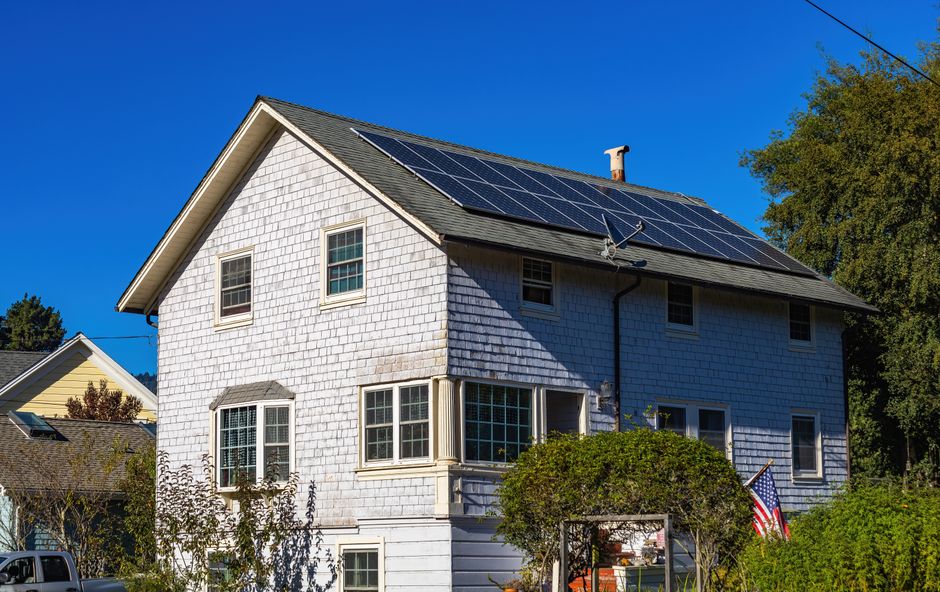
In short: Rhode Island pays some of the highest electricity prices in the country, 28.29¢/kWh in July 2026 (EIA), while its grid is among the most reliable: about 104 outage minutes per customer in 2024. So the case here is mostly about the bill. State grants and a solar payment tariff make solar worth pricing.
Rhode Island flips the usual order. Where many states start with storms and backup, here the numbers start with price: about 55% above the U.S. average, with one utility serving almost every home. This page uses Rhode Island’s own data, with sources and dates, to show what that means for solar, batteries, backup and EV charging.
Rhode Island at a glance
- Home electricity price: 28.29¢/kWh in July 2026 (26.18¢ a year earlier) vs 18.31¢ U.S. average; 29.22¢ for January to July 2026 (EIA, preliminary).
- Outages: about 104 minutes per customer in 2024 including major events, 61 minutes without them; about 0.9 interruptions per customer (EIA-861, 2024).
- Sun: 3.99 kWh/m² a day in Providence; roughly 1,170 kWh a year per kW of panels (our estimate from NASA POWER data).
- Net metering: statewide, with credits close to retail for power that offsets your use; a 2025 law changed how some excess credits are valued.
- Plug-in (balcony) solar: no state law.
- Electric cars: 9,800 battery-electric cars (2025) and 889 public charging ports, 151 of them DC fast (AFDC, October 2026).
- Main utilities: Rhode Island Energy (The Narragansett Electric Co., about 99% of customers), Pascoag Utility District, Block Island Utility District (EIA-861, 2024).
- Top weather hazards: all rated relatively low or very low, including hurricanes, winter weather and ice storms; overall expected losses very low (FEMA National Risk Index, December 2025).
- Wildfire power shutoffs: no Rhode Island Energy program found.
Backup power in Rhode Island
By national standards, outages in Rhode Island are short and rare. In 2024 the average customer lost power for about an hour on ordinary days and about 1 hour 44 minutes including major events. FEMA’s National Risk Index rates every weather hazard it scores for the state as relatively low or very low. That does not mean never: coastal storms and nor’easters still cause outages, and a single long one matters a lot if someone at home uses medical equipment or you have a sump pump. But for most households, backup is a matter of matching the tool to a modest risk rather than buying the biggest system.
- A portable power station covers a typical Rhode Island outage for phones, internet, lights and a CPAP, with no fuel and no installation. See portable power stations.
- A home battery makes most sense here when paired with solar and the state’s storage adder (below). Estimate the size with the battery backup calculator and read home batteries.
- A generator suits homes with wells, sump pumps or medical needs that cannot risk even a rare long outage. See home generators and the generator sizing calculator.
If you use a generator, run it outdoors only, at least 20 feet from the house, exhaust pointed away from windows, doors and vents, and never in a garage, even with the door open (CPSC). Put battery or battery-backup carbon monoxide alarms on every level. A licensed electrician should install the transfer switch or interlock, with a permit.
Solar in Rhode Island
Rhode Island’s sun is typical for New England, about 1,170 kWh a year per kilowatt of panels by our rough estimate. Its prices are not typical. A 6 kW system would make roughly 7,000 kWh a year, worth up to about $1,990 at the July 2026 rate of 28.29¢, or about $2,050 at the January to July average of 29.22¢, if every kilowatt-hour offsets power you would have bought. Prices rose about 8% between July 2025 and July 2026. These are estimates, not promises. Check your roof with the solar potential calculator and installed prices in the solar cost guide.
Homeowners usually choose between two paths, because the state grant cannot be combined with the payment tariff:
- Net metering plus a grant. Rhode Island’s net metering law (R.I.G.L. 39-26.4) credits solar that offsets your use at close to the retail rate. A 2025 law changed the value of excess credits above your own use (in the band of 100% to 125% of consumption) to the ISO New England wholesale clearing price instead of avoided cost, and the Public Utilities Commission is implementing it in 2026 (docket 25-50-EL). Size the system to your use. Paired with this path, the Renewable Energy Fund Small Scale Solar grant from Rhode Island Commerce helps with the cost of net-metered home systems, with a storage adder available; 2026 rounds opened May 1, July 17 and October 16. Rhode Island Commerce.
- The Renewable Energy Growth (REG) program. Rhode Island Energy pays a set rate for the output of small systems under state law. For program year 2026, the small-scale solar rate is about 31.55¢ per kWh for 15 years for systems up to 15 kW, and about 28.65¢ for 20 years for 15 to 25 kW, with open enrollment from April 1, 2026 until the cap is reached. By our estimate, 7,000 kWh a year at 31.55¢ would be about $2,200 a year. Rhode Island Energy 2026 REG rates.
Also confirmed: a sales tax exemption on solar panels, wind turbines and related renewable equipment, which saves the 7% state sales tax (R.I.G.L. 44-18-30). Check each program page before you sign; amounts and rounds change. The federal 25D credit ended for systems completed after December 31, 2025. See net metering explained, energy incentives and the solar guide. Rhode Island has no plug-in (balcony) solar law; utility interconnection rules apply.
Home batteries in Rhode Island
Rhode Island solar owners add batteries more often than most: of about 17,300 net-metered home solar systems counted by EIA in 2024 (about 106 MW), about 1,150, roughly 7%, were paired with a battery, one of the ten highest shares in the country. The Renewable Energy Fund’s storage adder may be part of the reason a battery can make sense here even with a reliable grid. With outages short and rare, think of a battery mainly as a way to keep essentials running through the occasional storm, and check whether the adder’s terms fit your system. Prices and sizing: home battery cost.
EV charging in Rhode Island
Rhode Island had 9,800 battery-electric cars and 6,300 plug-in hybrids at the end of 2025, and 889 public ports at 357 locations: 718 Level 2 and 151 DC fast (AFDC). That is about 11 electric cars per public port, a relatively well-served ratio for a small state.
Drive on another fuel? See every alternative fuel station in Rhode Island: hydrogen, propane, natural gas, E85 ethanol, biodiesel and renewable diesel.
High electricity prices narrow, but do not erase, the savings over gas. Our estimate at 28.29¢ and about 30 kWh per 100 miles (a fueleconomy.gov-style assumption) is about $8.49 per 100 miles, roughly $85 for 1,000 miles a month. A 30-mpg gas car at the U.S. average of $4.465 a gallon (EIA, late September 2026) costs about $14.88 per 100 miles. Charging from your own solar improves the EV number. Use the EV charging cost calculator and see home EV charging. A Level 2 charger needs a 240 V circuit installed by a licensed electrician with a permit. The federal 30C charger credit ended for chargers placed in service after June 30, 2026.
Off-grid, small wind and micro-hydro
In a state this small and densely settled, off-grid systems are mostly for boathouses, sheds and seasonal cottages; see off-grid power systems and the off-grid planner. Wind is fair but site-dependent: NASA data shows about 5.8 m/s at 50 m near the center of the state and 4.7 m/s around Providence, but only about 3.8 m/s at 10 m, below the 4.5 m/s DOE suggests at hub height for a grid-tied turbine. Open coastal sites with tall towers are the candidates; the REG program and the sales tax exemption also cover small wind. Read wind energy and hydroelectric power; we have not checked state micro-hydro sources.
Licensing and permits in Rhode Island
Electricians are licensed statewide by the Department of Labor and Training, Professional Regulation (Board of Examiners of Electricians); look one up by trade, license number or name in the DLT license search. Contractors must also register with the Contractors’ Registration and Licensing Board. Permits come from your city or town, and Rhode Island Energy (or your municipal utility) must approve interconnection before solar or a grid-tied battery is switched on.
Local guides in Rhode Island
Utilities, rates, outage records, permit offices and local programs for each area:
Where we cover in Rhode Island
- Providence: Providence, Cranston, Pawtucket, East Providence, Cumberland, Lincoln
- Kent County: Warwick, Coventry
- South County: North Kingstown, South Kingstown
- Newport: Newport
Local pages will follow as we verify local information and installers.
Get quotes in Rhode Island
Are you a licensed installer in Rhode Island? Join SolutionEnergy and get requests from homeowners and businesses →
Tell us about your project and we will connect you with a licensed, independent installer who serves Rhode Island. It is free, there is no obligation, and only the installer you choose gets your details. See how it works.
Rhode Island energy FAQ
Does Rhode Island have net metering?
Yes, statewide under R.I.G.L. 39-26.4. Solar that offsets your own use is credited close to the retail rate. A 2025 law revalued excess credits between 100% and 125% of your use at the ISO New England wholesale price, and the PUC is putting that in place in 2026. Size your system to your use.
What is the Rhode Island REG program?
The Renewable Energy Growth program pays a fixed rate for a small system’s output. For 2026, home solar up to 15 kW earns about 31.55¢ per kWh for 15 years. Enrollment opened April 1, 2026 and runs until the cap is reached. It cannot be combined with the Renewable Energy Fund grant.
Is there a solar grant in Rhode Island?
Yes. Rhode Island Commerce’s Renewable Energy Fund Small Scale Solar grant supports net-metered home systems, with a storage adder. 2026 rounds opened May 1, July 17 and October 16. Check the program page for the current amount and deadlines.
Do I need backup power in Rhode Island?
Many households can manage with a portable power station, because outages averaged under two hours in 2024 and FEMA rates the state’s weather hazards low. Homes with medical equipment, sump pumps or wells should plan for a longer storm outage with a battery or a generator.
Why is electricity so expensive in Rhode Island?
We do not have a breakdown of the causes, but the numbers are clear: 28.29¢ per kWh in July 2026 and 29.22¢ on average from January to July, against an 18.31¢ U.S. average (EIA). At those prices, every kilowatt-hour saved or made at home is worth more than in most states.
Sources
Electricity prices: EIA Electric Power Monthly, Tables 5.6.A and 5.6.B (July 2026, preliminary). Outages, utilities, solar and battery counts: EIA-861 (2024). Sun and wind: NASA POWER climatology 2001–2020. Hazards: FEMA National Risk Index (December 2025). Electric cars and charging: AFDC (registrations 2025; stations read October 3, 2026). Net metering: Rhode Island Public Utilities Commission (docket 25-50-EL). Incentives: Rhode Island Commerce, Rhode Island Energy, Rhode Island General Laws. Licensing: RI Department of Labor and Training. Generator safety: CPSC. Checked October 2026.