This article contains affiliate links: if you buy through them we may earn a commission, at no extra cost to you. Learn more.
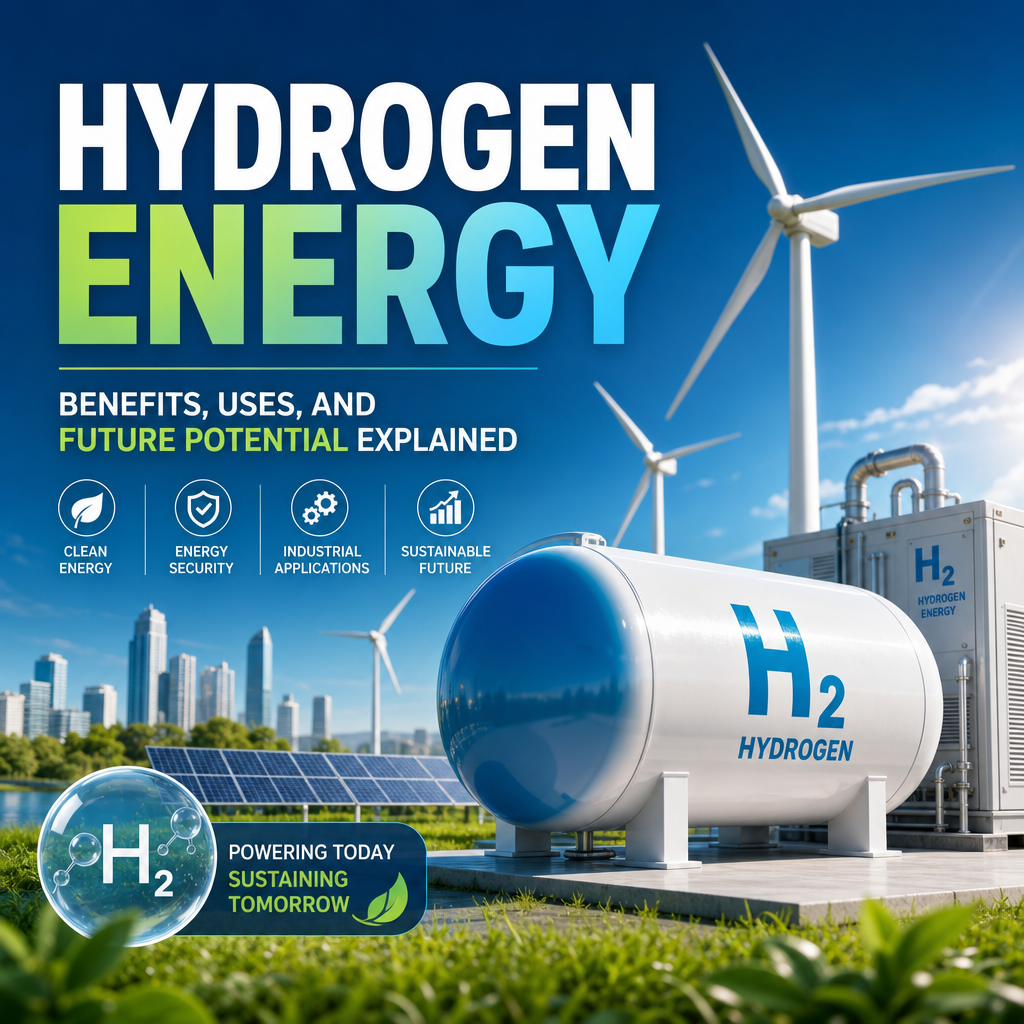
Hydrogen energy is the energy we get from using hydrogen as a fuel. Hydrogen can be burned, or combined with oxygen in a fuel cell to make electricity, heat and water. Because pure hydrogen hardly exists on Earth, it has to be made from water, natural gas or biomass, so it is an energy carrier rather than an energy source.
You already rely on hydrogen without knowing it. It helps refine the gasoline and diesel in your car and makes the fertilizer that grows much of your food. What you most likely do not have is a hydrogen car in the driveway or a hydrogen furnace in the basement, and there are good reasons for that. This guide explains how hydrogen energy works, where it really stands in 2026, and what it means for you and your home.
Hydrogen energy at a glance
- What it is: energy stored in hydrogen gas (H2), released by burning it or by running it through a fuel cell. The only by-product at the point of use is water and heat.
- Where it comes from: about 95% of U.S. hydrogen is made from natural gas, according to the U.S. Department of Energy (DOE). A small share is made by splitting water with electricity.
- Renewable? Only when it is made with renewable electricity or biomass. Hydrogen made from natural gas or coal is not renewable.
- How much is used: the U.S. produces about 10 million metric tons a year (DOE), mostly for oil refining and ammonia. World demand was almost 100 million tonnes in 2024 (IEA).
- Share of U.S. electricity: tiny. In December 2025 the U.S. had about 186 fuel cell power generators with about 364 megawatts of capacity in total (EIA).
- Main upside: it carries the most energy per pound of any common fuel, about three times more than gasoline, and it emits no carbon where it is used.
- Main downside: making it takes more energy than you get back, it is bulky to store, and the clean kind still costs several times more than hydrogen from natural gas.
How hydrogen energy works
The simplest way to think about hydrogen is as a rechargeable battery you can pour into a tank. You spend energy to pull hydrogen out of something that contains it (water or natural gas, for example). You store or ship the hydrogen. Later you get most of that energy back by letting the hydrogen join up with oxygen again. Hydrogen is the simplest element (one proton and one electron) and the most common one in the universe, but on Earth it is almost always locked inside other molecules, such as water (H2O) and the methane in natural gas (CH4).
Here is the chain, step by step:
- Make it. A plant splits hydrogen away from natural gas with high-temperature steam, or splits water into hydrogen and oxygen with electricity (electrolysis).
- Store and move it. Hydrogen is the lightest gas there is, so it is squeezed into tanks at 5,000 to 10,000 psi or chilled into a liquid at about −423°F (−253°C).
- Use it. A fuel cell turns it straight into electricity, or a burner, engine or turbine burns it for heat or motion.
Inside a fuel cell
A fuel cell is where hydrogen energy gets interesting. In the type used in cars, hydrogen gas flows to one side of a thin plastic membrane (the anode), where a catalyst splits each hydrogen molecule into protons and electrons. The protons pass through the membrane. The electrons cannot, so they travel around through a wire, and that flow of electrons is the electric current that runs a motor or lights a bulb. On the other side (the cathode), the protons, electrons and oxygen from the air meet and form water. A fuel cell car’s tailpipe gives off only water vapor and warm air. The DOE’s Energy Information Administration (EIA) notes that a fuel cell can be two to three times more efficient than a gasoline engine. For the chemistry behind this, see our guide to chemical energy; for what that current actually is, see electrical energy.
Light but bulky
Hydrogen’s strength and weakness are the same fact: it is extremely light. By weight it holds about 120 megajoules per kilogram, versus about 44 for gasoline. The energy in 1 kilogram (2.2 pounds) of hydrogen is about the same as in a gallon of gasoline, which weighs 6.2 pounds. By volume it is the opposite story. Even as a super-cold liquid, hydrogen holds about 8 megajoules per liter, a quarter of gasoline’s 32. That is why hydrogen needs heavy high-pressure tanks, and why a car needs roughly 5 to 13 kilograms of it on board to go 300 miles (DOE figures).
How hydrogen is made: the main methods
How clean hydrogen energy is depends almost entirely on how the hydrogen was made. People often use colors as shorthand: “gray” for hydrogen from natural gas, “blue” when the carbon dioxide is captured, and “green” for hydrogen from renewable electricity. These labels are informal.
- Steam-methane reforming (natural gas). Steam at 700–1,000°C reacts with methane to release hydrogen, plus carbon monoxide that is then converted to more hydrogen and carbon dioxide. This is how about 95% of U.S. hydrogen is made, in large central plants (DOE).
- Electrolysis (water). Electricity splits water into hydrogen and oxygen, with no other by-products. It is only as clean as the electricity behind it: wind, solar, hydro or nuclear power make low-carbon hydrogen; power from a coal plant does not.
- Gasification (coal or biomass). Heat and controlled amounts of oxygen or steam turn solid fuels into a gas mix that contains hydrogen. With biomass, the carbon came from plants, which changes the climate math.
One rule applies to every method: you always put in more energy to make hydrogen than you get back when you use it. Hydrogen makes sense when its other strengths (storing energy for a long time, high-heat industry, heavy vehicles, places batteries cannot reach) are worth that loss.
A short history of hydrogen energy
- 1766: English scientist Henry Cavendish identifies hydrogen as a distinct gas and calls it “inflammable air.”
- 1783: French chemist Antoine Lavoisier shows that water is a compound of hydrogen and oxygen.
- 1839: Sir William Grove demonstrates the first fuel cell. In 1842 he links 50 cells into what he calls a “gaseous voltaic battery.”
- 1960s: NASA’s Gemini and Apollo spacecraft are powered by fuel cells running on pure hydrogen and oxygen. Hydrogen is also used as rocket fuel.
- 1992: the Energy Policy Act lists hydrogen as an alternative vehicle fuel in the United States.
- June 2021: the DOE launches the “Hydrogen Shot,” a goal to cut the cost of clean hydrogen by 80%, to $1 per kilogram, within a decade.
- October 2023: the DOE selects seven Regional Clean Hydrogen Hubs for up to $7 billion in federal funding.
- 2025: the One Big Beautiful Bill Act (July 4, 2025) moves up the end of the federal clean hydrogen production credit (45V), and in October 2025 the DOE cancels about $2.2 billion for the California and Pacific Northwest hubs.
Where hydrogen is used today
In the United States, nearly all hydrogen goes to industry: refining petroleum (refineries use it to strip sulfur out of fuels), making fertilizer, treating metals, producing chemicals and processing foods (EIA). Of the roughly 10 million metric tons made each year, very little is used as an energy source in its own right.
For electricity, the EIA counted about 186 fuel cell power generators in the U.S. as of December 2025, with about 364 megawatts of capacity combined.
For driving, the DOE’s Alternative Fuels Data Center reports 54 retail hydrogen stations in the U.S. in 2024, almost all in California, with one in Hawaii. California had about 15,000 fuel cell cars on the road. Hyundai and Toyota offer fuel cell models for sale or lease, mainly in California.
Around the world, hydrogen demand reached almost 100 million tonnes in 2024, according to the International Energy Agency (IEA). Refining, ammonia, methanol and steelmaking use almost all of it; new uses such as transport and power make up less than 1%. Low-emissions hydrogen grew about 10% in 2024 but is still under 1% of production, and the IEA expects it to reach about 1 million tonnes in 2025. China has about 95% of the world’s fuel cell trucks and buses.
Hydrogen energy at home: what is real
Let’s be straight: in 2026 there is no practical hydrogen system that a typical American homeowner or renter can buy to heat a house or run the lights. Here is where hydrogen does and does not touch home life.
- Fuel cell cars. They refuel in about five minutes and go more than 300 miles per tank, but only make sense if you live near the stations in California. Pump prices there have been steep: the California Energy Commission reported an all-time high of $36 per kilogram in August 2023, up to about $180 to fill an empty tank. The federal clean vehicle credit (30D) ended for vehicles acquired after September 30, 2025, so do not count on federal help for 2026.
- Hydrogen in your gas line. Some utilities are testing small blends of hydrogen in natural gas. Research reviewed by the National Renewable Energy Laboratory (NREL) suggests blends below about 5–15% by volume should not raise the risks for household appliances or pipelines much, but each system must be checked. Hawaii Gas has run a 12–15% blend for years. If your utility announces a blend, it handles the testing; never modify gas appliances yourself, and call a licensed gas technician with questions.
- Home fuel cells and hydrogen storage. Systems that store solar power as hydrogen are not a mainstream home product in the U.S. For backup power and storing your own solar energy, a battery is far simpler and more efficient today. Our energy storage guides cover home batteries and portable power stations.
- Learning at home. This is where hydrogen shines for families: a small fuel cell kit splits water with electricity and runs a model car on the hydrogen. It makes the whole idea click in an afternoon.
If your real goal is cleaner, cheaper energy at home, the steps that pay off now are the ones hydrogen depends on anyway: clean electricity and using less of it. Start with solar energy and our energy saving tips. Federal home energy credits ended for projects finished after December 31, 2025, so check state, utility and local rebates on DSIRE and in our tax credits and rebates section.
Products that put hydrogen energy to work at home
Hydrogen at home is mostly a learning project for now, and these two kits do it well. Prices change often. The prices below are what we saw on Amazon in October 2026; check the current price before you buy.
Horizon DIY Fuel Cell Science Kit
- Reversible fuel cell splits water, then makes power
- Design your own hydrogen car
- About $79
Thames & Kosmos Renewable Energy Lab
- Solar panel, wind turbine and hand-crank generator
- 24 experiments, ages 8+
- About $174
The Horizon DIY Fuel Cell Science Kit comes from Horizon Fuel Cell Technologies, a maker of educational fuel cells. Its reversible fuel cell works both ways: run current through it and it splits water into hydrogen and oxygen, which you collect in syringes; then it turns that hydrogen back into electricity to power a small motor or LEDs. Kids design their own car around it, and the kit touches on electrolysis, redox reactions and efficiency. It is sold as friendly for elementary and middle school.
Check the Horizon DIY Fuel Cell Kit price on Amazon
The Thames & Kosmos Renewable Energy Lab covers the other half of the clean hydrogen story: making clean electricity. It includes a solar panel, wind turbine parts and a voltage/current meter, with 24 experiments and a 32-page manual, and is aimed at ages 8 and up.
Hydrogen energy pros and cons
| Pros | Cons |
|---|---|
| No carbon dioxide or smog at the point of use; a fuel cell gives off only water and heat | About 95% of U.S. hydrogen comes from natural gas, which releases carbon dioxide when it is made |
| Most energy per pound of any common fuel, about three times gasoline | Very little energy per gallon; needs 5,000–10,000 psi tanks or −423°F liquid storage |
| Can store energy for weeks or months, longer than batteries | You lose energy at every step: making, compressing and converting it back |
| Fuel cells are quiet and can be two to three times more efficient than gasoline engines | Clean hydrogen costs about $6–8 per kilogram to make from electricity (DOE estimate) |
| Fast refueling (about five minutes) and 300+ mile range for cars | Only about 54 U.S. retail stations, almost all in California (2024) |
| Can be made from water, natural gas, biomass or waste gas almost anywhere | Ignites easily and leaks through small gaps; needs careful engineering |
Environmental and safety impact
Climate. Hydrogen burns clean, but its footprint is set upstream. Hydrogen from natural gas releases carbon dioxide at the plant, and any methane that leaks along the way adds more warming. Even so, the DOE says fuel cell cars running on hydrogen from natural gas cut greenhouse gas emissions roughly in half compared with gasoline cars and cut petroleum use by over 90%. Hydrogen made by electrolysis with wind, solar, hydro or nuclear power can be close to carbon-free. Federal law defines “clean” hydrogen as no more than 2 kilograms of carbon dioxide-equivalent per kilogram of hydrogen at the production site.
Air and water. A fuel cell emits no tailpipe pollutants, which matters most in cities and near ports and highways.
Safety. Hydrogen is non-toxic and, because it is much lighter than air, it rises and spreads out quickly when released, unlike gasoline vapor, which pools. On the other hand, it needs less energy to ignite than gasoline or natural gas and is flammable across a wide range of mixtures with air. That is why the DOE stresses good ventilation, leak detection and proper engineering. Hydrogen stations, tanks and fuel cells are built to codes for exactly these reasons. Any hydrogen or gas work at home belongs with a licensed professional.
How much does hydrogen energy cost?
- Making clean hydrogen: the DOE’s December 2024 assessment put the cost of hydrogen from today’s electrolyzers at roughly $6 to $8 per kilogram (an estimate, using grid electricity prices). Hydrogen from natural gas is much cheaper, which is why it dominates.
- The goal: the Hydrogen Shot aims for $1 per kilogram of clean hydrogen by about 2031. That is a target, not a forecast.
- At the pump: California’s retail price rose from an average of about $14.95 per kilogram in spring 2022 to an all-time high of $36 in August 2023 (California Energy Commission). Because fuel cell cars are about 2.5 times as efficient as gasoline cars, the Commission says $36 per kilogram is like paying about $14.40 for a gallon of gasoline.
- Tax credits: the federal clean hydrogen production credit (45V) now only covers plants that begin construction before January 1, 2028. There is no federal credit for homeowners tied to hydrogen in 2026.
The future of hydrogen energy
Hydrogen has been called “the fuel of the future” for decades, so it helps to look at what is actually happening. The IEA’s Global Hydrogen Review 2025 found that, for the first time, the pipeline of announced low-emissions hydrogen projects shrank: projects that could be running by 2030 add up to about 37 million tonnes a year, down from 49 million tonnes a year earlier, because of cancellations and delays.
In the U.S., the seven hydrogen hubs announced in 2023 were meant to produce about 3 million metric tons of clean hydrogen a year. In October 2025 the DOE cancelled about $2.2 billion for the two West Coast hubs, which were built around renewable power, and put the others under review. Their future depends on federal decisions still being made.
The likeliest early wins are where hydrogen is already used, such as cleaner fertilizer and refinery hydrogen, plus hard cases like steelmaking, heavy trucks and long-term storage. For homes and passenger cars, batteries and heat pumps have a big head start.
Hydrogen compared with other energy options
| Hydrogen | Natural gas | Batteries (stored electricity) | |
|---|---|---|---|
| Source or carrier? | Carrier: must be made | Source: drilled from the ground | Carrier: stores electricity |
| Emissions at use | Water vapor and heat | Carbon dioxide | None |
| Energy lost in the round trip | A lot (making, compressing, converting) | Not applicable | Little |
| Long-term storage | Good: weeks to months | Good | Best for hours to a few days |
| Ready for homes in 2026? | No, except kits and small trials | Yes, widely | Yes: home batteries and power stations |
Learn more about the fuel most hydrogen comes from in our natural gas energy guide,; the sun itself runs on hydrogen through fusion energy.
Hydrogen energy FAQs
Is hydrogen energy renewable?
It depends on how the hydrogen is made. Hydrogen is a carrier, not a source, so it is only as renewable as the energy used to produce it. Hydrogen made by splitting water with wind or solar power, or from biomass, counts as renewable. About 95% of U.S. hydrogen is made from natural gas, which is a fossil fuel, so most hydrogen today is not renewable.
Is hydrogen a clean fuel?
At the point of use, yes: a fuel cell produces only electricity, water and heat. The full picture depends on production. Hydrogen from natural gas releases carbon dioxide at the plant, although the DOE says fuel cell cars on that hydrogen still cut greenhouse gases about in half versus gasoline cars. Hydrogen from renewable or nuclear electricity can be close to carbon-free.
Why don’t we use hydrogen more?
Three reasons: cost, energy losses and infrastructure. Clean hydrogen from electrolysis costs roughly $6 to $8 per kilogram to make (DOE estimate), every conversion step loses energy, and hydrogen needs special high-pressure tanks, pipelines and stations. In 2024 the U.S. had only about 54 retail hydrogen stations, almost all in California, while batteries can charge anywhere there is an outlet.
Can I power my house with hydrogen?
Not practically in the U.S. in 2026. Home systems that store solar power as hydrogen are not a mainstream product, and converting electricity to hydrogen and back loses much more energy than a battery does. For backup power or storing solar, a home battery or portable power station is simpler and more efficient. Some gas utilities are testing small hydrogen blends in their pipes; they handle that safety work, not you.
Is hydrogen more dangerous than gasoline?
It is different rather than simply more dangerous. Hydrogen is non-toxic and so light that it rises and spreads out quickly in a leak, while gasoline vapor pools near the ground. But hydrogen ignites with less energy and burns across a wide range of mixtures with air, so it needs good ventilation, leak detectors and equipment built to safety codes. The DOE says it can be produced, stored and dispensed safely.
How much hydrogen equals a gallon of gas?
About 1 kilogram. The DOE says the energy in 1 kilogram (2.2 pounds) of hydrogen is about the same as in 1 gallon of gasoline, which weighs 6.2 pounds. Because fuel cell cars use energy more efficiently, a kilogram of hydrogen takes them farther than a gallon of gasoline takes a typical gas car.
Keep exploring
Hydrogen is one piece of a bigger puzzle. See how it fits with every other source in our types of energy overview, read how renewable energy and clean energy differ, and explore the electricity that clean hydrogen needs from wind energy. For plain-English basics on how energy works, browse Energy 101.