This article contains affiliate links: if you buy through them we may earn a commission, at no extra cost to you. Learn more.
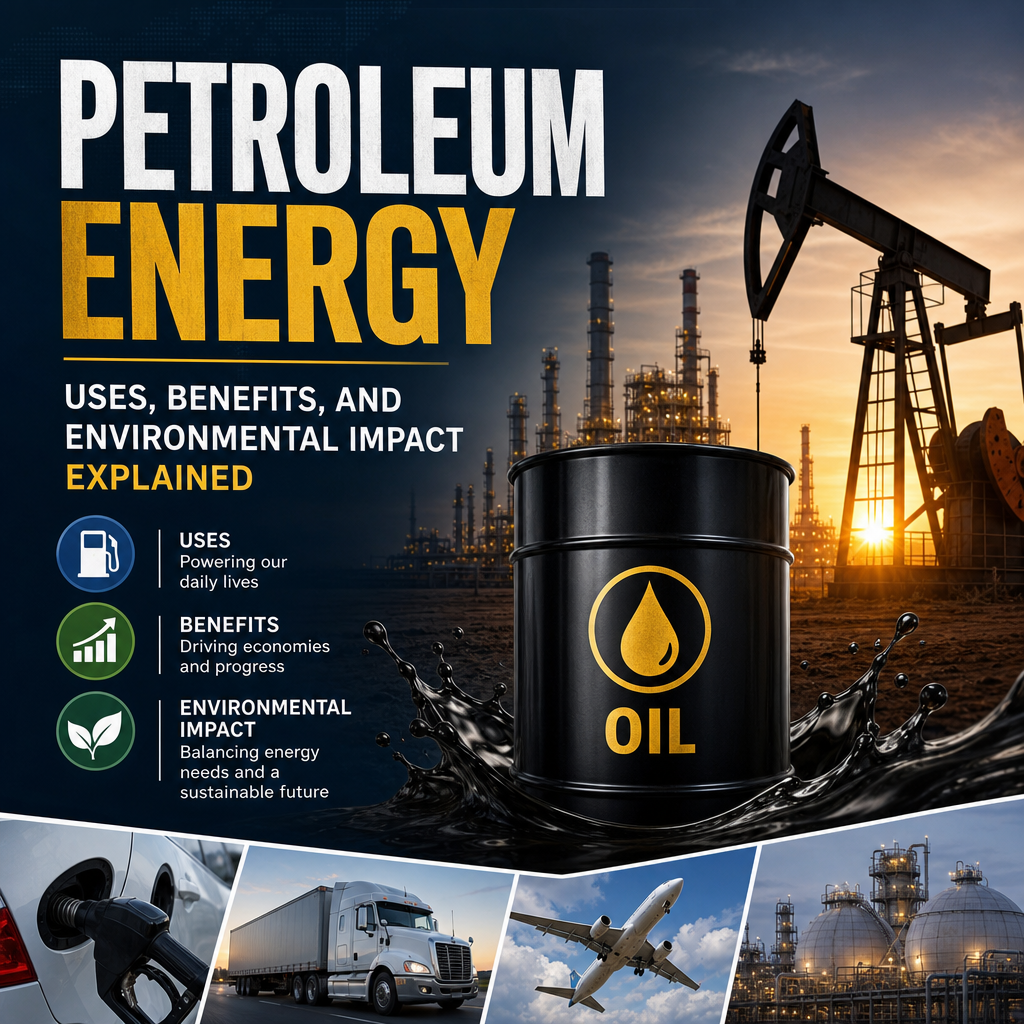
Petroleum energy is the energy we get from crude oil and the fuels refined from it, such as gasoline, diesel, jet fuel, heating oil and propane. Petroleum is a fossil fuel formed from ancient marine life buried for millions of years. It is the largest energy source in the United States, mainly because it powers nearly all cars, trucks, ships and planes.
Every time you fill the tank, take a flight or get a package delivered, you are using petroleum. Some homes, especially in the Northeast, burn heating oil in the basement all winter. And petroleum hides in everyday things too, from the asphalt on your street to plastic containers in your kitchen. This guide explains what petroleum is, how it becomes energy, what it costs, its real downsides, and what it means for your home and your car.
Petroleum at a glance
- What it is: crude oil and the products refined from it: gasoline, diesel, jet fuel, heating oil, propane and more.
- Where it comes from: wells on land and offshore; in 2025 the U.S. produced a record 13.6 million barrels of crude oil a day, nearly half of it from the Permian Basin (EIA).
- Renewable? No. It formed over millions of years.
- Share of U.S. energy: about 38% of all U.S. primary energy in 2025, the largest single source (EIA).
- Share of U.S. electricity: less than 1% in 2025 (EIA). Petroleum is a transportation fuel, not a power-plant fuel.
- Main upside: energy-dense liquid that is easy to store and move; powers almost all transportation.
- Main downside: the largest source of U.S. energy-related CO2 (47% in 2023, EIA), plus spills, air pollution and price swings.
How petroleum energy works
In simple words: millions of years ago, tiny plants and animals in ancient seas died and sank into the mud. Layers of rock piled on top, and heat and pressure slowly turned that material into oil and gas trapped in underground rock. The energy in oil is chemical energy stored in chains of carbon and hydrogen atoms. When a fuel such as gasoline burns, those chains break apart, combine with oxygen and release heat.
Here is how oil gets from rock to your gas tank:
- Exploration and drilling. Geologists use seismic surveys to find oil-bearing rock. Companies drill wells, many of them turning sideways through shale and using hydraulic fracturing to let the oil flow.
- Transport. Pipelines, tankers, trains and trucks carry crude oil to refineries.
- Refining. Refineries heat crude oil and separate it by boiling point, then “crack” and reshape heavier molecules into more valuable fuels. EIA says a 42-gallon barrel of crude yields, on average, about 19 to 20 gallons of gasoline, 11 to 13 gallons of distillate fuel (mostly diesel) and 3 to 5 gallons of jet fuel, plus other products.
- Distribution. Products move by pipeline and truck to gas stations, airports, heating oil dealers and factories.
- Burning. An engine burns fuel in its cylinders; the expanding hot gases push pistons, which turn the wheels. That is chemical energy becoming heat and then mechanical energy. A heating oil furnace or boiler simply burns the oil to heat air or water.
A bit deeper on energy content: according to EIA, a gallon of gasoline holds about 120,214 Btu, and a gallon of heating oil about 138,500 Btu. That high energy in a small, easy-to-pour liquid is the main reason oil has dominated transportation for more than a century.
A short history of petroleum
- August 27, 1859: Edwin Drake strikes oil at about 69 feet near Titusville, Pennsylvania. Britannica calls it the first productive oil well in the United States, and it set off the first American oil boom.
- 1989: The Exxon Valdez spills oil in Alaska’s Prince William Sound. The Oil Pollution Act of 1990 follows and requires new tankers to have double hulls (EIA).
- 2010: The Deepwater Horizon blowout in the Gulf leads government and industry to review offshore drilling technology and rules (EIA).
- 2018: The United States becomes the world’s largest crude oil producer, a lead it has kept since (EIA).
- 2025: U.S. crude production hits a record 13.6 million barrels per day, about 40% more than either Russia or Saudi Arabia (EIA).
Types of petroleum products
“Petroleum” covers crude oil and everything made from it. The main energy products are:
- Gasoline: the most-used petroleum product in the U.S., about 8.78 million barrels a day in 2022, or roughly 43% of all petroleum use (EIA). Most of it fuels cars, SUVs and light trucks.
- Distillate fuel oil: diesel for trucks, trains, farm equipment and generators, and heating oil for homes. Diesel and heating oil are close cousins from the same part of the barrel (EIA).
- Jet fuel: kerosene-type fuel for airplanes.
- Hydrocarbon gas liquids: propane, butane and ethane, from oil refining and natural gas processing. They made up about 17% of U.S. petroleum use in 2022 (EIA).
- Residual fuel oil, petroleum coke and asphalt: heavy products for ships, industry and roads.
- Petrochemical feedstocks: raw materials for plastics and other chemicals.
Where petroleum is used today
The U.S. consumed about 20.6 million barrels of petroleum a day in 2025, or about 7.52 billion barrels for the year (EIA). Transportation is by far the largest user:
| Sector | Share of U.S. petroleum use (2022) | Main fuels |
|---|---|---|
| Transportation | About 67% | Gasoline, diesel, jet fuel |
| Industrial | About 28% | Feedstocks for chemicals and plastics, diesel, asphalt |
| Residential | About 3% | Heating oil, propane, kerosene |
| Commercial | About 2.5% | Heating oil, diesel |
| Electric power | Under 1% | Fuel oil in a small number of plants |
Oil is the largest piece of the U.S. energy mix at about 38% in 2025, just ahead of natural gas at about 36% (EIA). Production is concentrated: the Permian Basin of west Texas and southeast New Mexico produced about 6.6 million barrels a day in 2025, roughly 48% of U.S. crude (EIA). Worldwide, the U.S. has been the top crude producer since 2018.
Petroleum at home: what you can actually do
For most households, petroleum shows up in three places: the car, the furnace (in some regions) and the backup generator. Here is the practical side of each.
If you heat with oil
About 4.79 million U.S. households used heating oil in winter 2023–24, and about 82% of them were in the Northeast (EIA). EIA estimated that a typical heating oil home would burn about 400 gallons and spend about $1,390 in winter 2025–26.
- Get a yearly tune-up. CDC and NFPA both recommend having your heating system and chimney checked and cleaned every year by a qualified technician.
- Install CO alarms. CDC lists oil furnaces among the household sources of carbon monoxide. Put alarms on every level and outside sleeping areas, as CPSC recommends.
- Ask about cleaner oil. All six New England states, New York, New Jersey and Delaware now require ultra-low sulfur heating oil (15 parts per million). Many dealers also sell “bioheat” blends, often about 5% biofuel (EIA).
- Shop delivery plans. Compare cash prices, budget plans and price caps from several dealers before winter.
- Consider a heat pump. Oil-heated homes often save the most by switching. ENERGY STAR says an air-source heat pump can deliver up to three times more heat than the electricity it uses. Many families keep the oil boiler as backup for the coldest days. The federal 25C heat pump credit ended for installs completed after December 31, 2025, so look for state and utility rebates on DSIRE and in our tax credits and grants section. Tank removal and new wiring are jobs for licensed contractors.
Your car
For most families, the car is where the biggest share of petroleum use happens. Simple steps help: keep tires inflated, combine trips, and drive smoothly. If you are shopping for a car, a hybrid, plug-in hybrid or fully electric car cuts gasoline use sharply. Note that the federal EV tax credit (30D) ended September 30, 2025, and the home EV charger credit (30C) ends for chargers placed in service after June 30, 2026. Our electric vehicles section covers charging at home and what it costs.
Generators and stored fuel
Most portable generators run on gasoline. CPSC says portable generators cause about 100 carbon monoxide deaths a year in the U.S., and one can make as much CO as hundreds of cars. Run a generator outside only, at least 20 feet from the house with the exhaust pointed away, never in a garage, basement or carport. Have a licensed electrician install a transfer switch or interlock if you want to power household circuits. Or skip the fumes entirely with a battery power station or solar charging.
Products for petroleum-powered homes
Prices change often. The prices below are what we saw on Amazon in October 2026; check the current price before you buy.
First Alert CO605 Plug-in Carbon Monoxide Alarm
- Plug-in with battery backup
- Electrochemical CO sensor, 85 dB alarm
- About $24
Champion 4500-Watt Dual Fuel Inverter Generator
- 3,500 running watts on gasoline
- CO Shield auto shutoff
- About $900
STA-BIL Storage Fuel Stabilizer, 8 oz
- 1 oz per 2.5 gallons
- Keeps gas fresh up to 24 months (maker)
- About $7
The First Alert CO605 plugs into a standard outlet with battery backup, uses an electrochemical CO sensor and sounds an 85-decibel alarm. If you have an oil furnace or boiler, an attached garage, or a generator for outages, a CO alarm on each level of the home is the single most important safety purchase.
Check the First Alert CO605 price on Amazon
The Champion 4500-Watt Dual Fuel inverter generator runs on gasoline (3,500 running watts, up to 14 hours) or propane (3,150 running watts, up to 21 hours), according to Champion. Being able to switch to propane is handy when gas stations are closed after a storm. Its CO Shield system shuts the engine off if carbon monoxide builds up, but it still belongs outdoors, 20 feet or more from the house.
Gasoline does not keep forever. STA-BIL Storage is a fuel stabilizer you add to the gas in a generator, mower or stored car. The maker says it keeps gasoline fresh for up to 24 months; the dose is 1 ounce per 2.5 gallons, then run the engine for five minutes so treated fuel reaches the carburetor.
Pros and cons of petroleum
| Pros | Cons |
|---|---|
| Very energy-dense liquid, easy to store and pour | Nonrenewable; reserves took millions of years to form |
| Powers almost all cars, trucks, ships and planes | Largest source of U.S. energy-related CO2 (47% in 2023) |
| Huge existing network of pipelines, refineries and stations | Spills harm oceans, coasts and wildlife |
| Record U.S. production in 2025 adds supply security | Exhaust adds smog-forming and harmful air pollutants |
| Raw material for plastics and chemicals | Prices swing with world events and OPEC+ decisions |
| Heating oil works where there is no gas pipeline | Heating oil is among the costlier and higher-CO2 ways to heat a home |
Environmental and safety impact
Climate. Petroleum was about 38% of U.S. energy use in 2023 but the source of 47% of U.S. energy-related CO2 emissions, according to EIA, more than natural gas (37%) or coal (16%). Burning a gallon of gasoline releases about 18.7 pounds of CO2, and a gallon of diesel or heating oil about 22.5 pounds (EIA).
Spills. EIA notes that most oil spills come from accidents at wells or on the pipelines, ships, trains and trucks that carry oil. Big disasters such as the Exxon Valdez (1989) and Deepwater Horizon (2010) changed laws and drilling rules, but smaller spills still happen.
Land and wildlife. Exploration and drilling can disturb land and marine habitats, and seismic surveys can harm fish and marine mammals (EIA). Modern techniques such as horizontal and directional drilling let one site reach a larger area, which reduces the surface footprint.
Carbon monoxide at home. Oil furnaces, gasoline generators and car engines all make CO. CDC reports more than 400 U.S. deaths, more than 100,000 emergency visits and more than 14,000 hospital stays a year from unintentional CO poisoning not linked to fires. Never run a car or generator in an attached garage, even with the door open, and keep CO alarms near bedrooms.
How much does petroleum cost?
Oil is priced by the barrel (42 gallons) on world markets. Brent crude, the main international benchmark, averaged $69 per barrel in 2025, its lowest since 2020, falling from $79 in January to $63 in December amid oversupply (EIA). U.S. regular gasoline averaged about $3.10 a gallon in 2025, down from $3.30 in 2024 and $3.95 in 2022 (EIA).
For home heating, EIA expected heating oil to average about $3.50 a gallon in winter 2025–26, 4% less than the winter before. On a heat basis that is roughly $25 per million Btu, compared with roughly $15 for natural gas at 2025 home prices and roughly $27 for propane at EIA’s winter forecast. These are national averages and forecasts; your dealer’s price is what counts.
Why do prices jump so fast? Crude oil is traded worldwide, so a conflict, a hurricane near Gulf Coast refineries, or a production decision by OPEC+ countries can move prices at your local station within days.
The future of petroleum
The International Energy Agency’s Oil 2025 report expects world oil demand to keep growing slowly and then plateau around 105.5 million barrels a day by the end of the decade. It says demand for oil as a fuel, leaving out petrochemicals, could peak as early as 2027. Electric vehicles are the main reason: the IEA expects EVs to displace about 5.4 million barrels a day of oil demand by 2030, with EV sales topping 20 million in 2025, about a quarter of all new cars sold worldwide.
Supply is moving the other way. The IEA expects global production capacity to grow faster than demand through 2030, which points to ample supply. In the U.S., EIA’s January 2026 outlook expected crude production to stay near the 2025 record in 2026, then dip 2% to 13.3 million barrels a day in 2027. Petrochemicals, plastics, aviation and heavy trucking are likely to keep oil in heavy use for decades, even as cars and home heating shift toward electricity.
How petroleum compares
| Energy source | Share of U.S. energy (2025) | CO2 per million Btu | Main use |
|---|---|---|---|
| Petroleum | About 38% | About 156 lb (gasoline) to 163 lb (diesel, heating oil) | Transportation |
| Natural gas | About 36% | About 117 lb | Electricity, industry, home heating |
| Coal | About 8% | About 212 lb | Electricity |
| Renewables | About 9% | None from burning (biomass aside) | Electricity, biofuels |
Petroleum FAQs
What is the difference between petroleum and crude oil?
Crude oil is the raw liquid pumped from underground. Petroleum is the broader term: it covers crude oil plus all the products refined from it, such as gasoline, diesel, jet fuel, heating oil, propane and asphalt. In everyday use people often say “oil” for both, but EIA’s petroleum statistics include refined products and some liquids from natural gas.
Is petroleum renewable or nonrenewable?
Petroleum is nonrenewable. It formed from ancient marine plants and animals buried and heated over millions of years, so we use it far faster than nature replaces it. Biofuels such as ethanol, biodiesel and renewable diesel, made from crops and waste fats, can replace some petroleum fuels; our biofuel energy page explains how.
What is petroleum mostly used for?
Transportation. About two-thirds of U.S. petroleum goes into cars, trucks, planes, ships and trains as gasoline, diesel and jet fuel, according to EIA. Most of the rest is used by industry, including as raw material for plastics and chemicals. Homes and businesses use a small share for heating, and less than 1% goes to making electricity.
How many gallons of gasoline come from a barrel of oil?
About 19 to 20 gallons. EIA says U.S. refineries turn one 42-gallon barrel of crude into roughly 19 to 20 gallons of gasoline, 11 to 13 gallons of diesel and other distillates, and 3 to 5 gallons of jet fuel.
Who produces the most oil in the world?
The United States. It has been the world’s largest crude oil producer since 2018 and set a record of 13.6 million barrels per day in 2025, according to EIA. That was about 40% more than Russia (about 9.9 million) or Saudi Arabia (about 9.6 million). The Permian Basin in Texas and New Mexico supplied nearly half of U.S. output.
Is heating oil more expensive than natural gas?
Usually, yes. Using EIA’s numbers, heating oil at about $3.50 a gallon (winter 2025–26 forecast) works out to roughly $25 per million Btu, while natural gas at 2025 average home prices was roughly $15. Oil also emits more CO2 per unit of heat. That is why many oil-heated homes look at heat pumps or, where a gas line is available, natural gas.
Keep exploring
Petroleum is one of several fossil fuels. Compare it with natural gas, propane and coal, read about plant-based biofuels that can replace some of it, or see the full map of types of energy. Ready to drive on electricity instead? Start with our electric vehicles guides.