This article contains affiliate links: if you buy through them we may earn a commission, at no extra cost to you. Learn more.
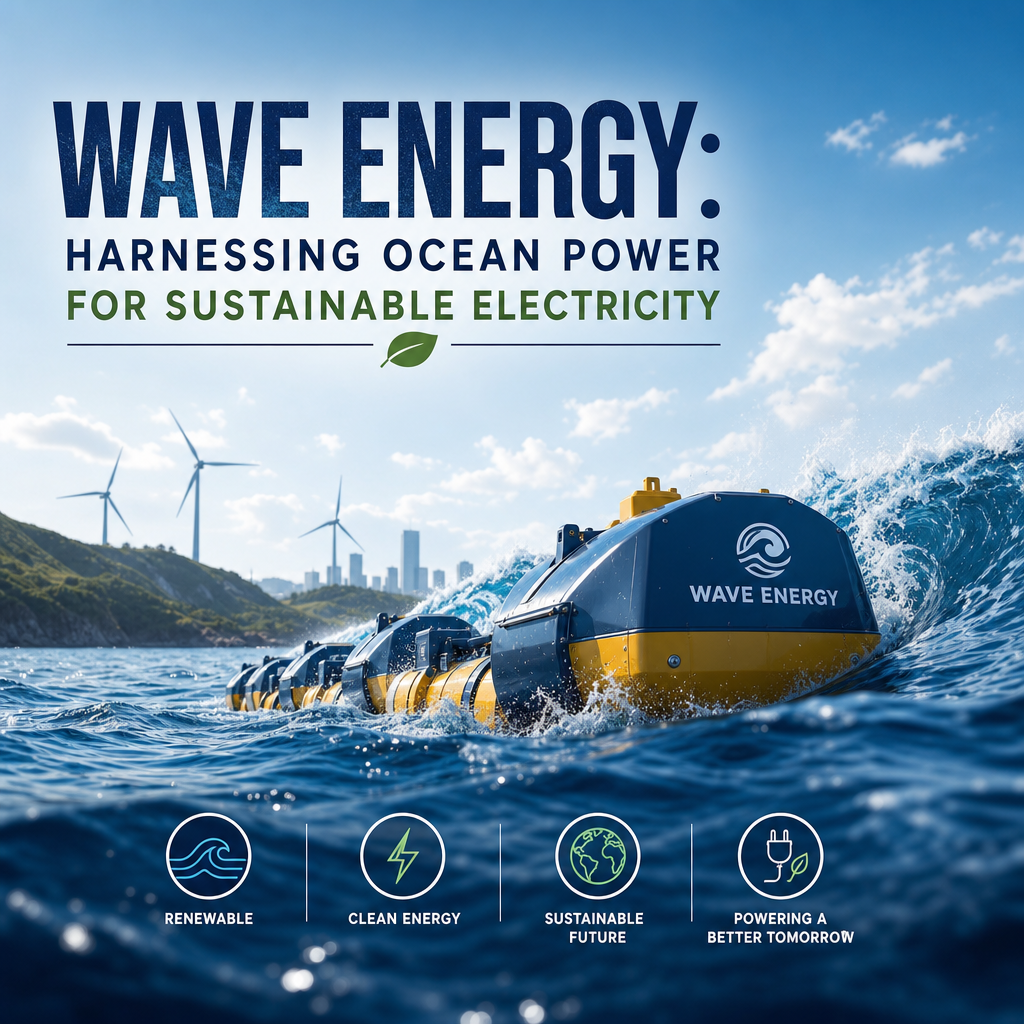
Wave energy is renewable power captured from ocean waves, which are made by wind blowing across the sea. Floating buoys, hinged rafts, seabed flaps and air chambers built into breakwaters turn the up-and-down or back-and-forth motion of waves into electricity. The resource is huge, but the technology is still at the test stage.
Stand on a beach on a windy day and you can feel the power of waves through your feet as they crash in. Much of that energy was picked up by wind far out at sea, sometimes thousands of miles away, and carried across the ocean to your shore. Engineers have spent decades trying to catch it reliably. This guide explains how wave power works, where it stands in 2026, what it costs, and what it means for your home.
Wave energy at a glance
- What it is: electricity made from the motion of ocean waves on or just below the surface.
- Where it comes from: wind blowing over the water, which gets its energy from the sun heating Earth unevenly. So wave power is a form of stored solar and wind energy.
- Renewable? Yes. As long as wind blows over the oceans, waves will keep coming.
- Share of U.S. electricity: effectively zero. The U.S. has no commercial wave energy projects, only research and test sites (EIA, 2024).
- Potential: about 1,400 terawatt-hours a year of U.S. wave energy could be captured with today’s technology, equal to about 34% of the country’s 2019 electricity generation (NREL, 2021).
- Main upside: a very large, steady-ish resource right off the West Coast, Alaska and Hawaii, close to where people live.
- Main downside: storms batter the equipment, no single design has won out, and costs are still several times those of wind or solar.
How wave energy works
Where waves get their energy
Most ocean waves are made by friction between the wind and the water’s surface, NOAA explains. The wind pushes on the water and passes some of its energy along. Here is the surprising part: a wave moves energy, not water. As a wave passes, the water itself mostly moves in circles and stays roughly where it is, which is why a floating ball bobs up and down instead of racing to shore. With nothing in the way, wind-made waves can travel across an entire ocean basin, so a distant storm can send swells to a faraway coast.
Because the sun drives the wind, wave energy is really solar energy that has been passed along twice: from sunlight to wind energy, then from wind to waves. The motion of the water is kinetic energy, and the lift of each crest is potential energy. A wave energy device’s job is to grab both and turn them into electrical energy.
From wave to wall socket, step by step
- A device is anchored at sea or built into the shoreline where waves are strong.
- Passing waves move part of the device: a buoy rises and falls, hinged sections flex, a flap swings, or water pushes air in and out of a chamber.
- That motion drives a power take-off: a hydraulic pump, a direct-drive generator, or an air turbine.
- The electricity is smoothed out and sent ashore through an undersea cable to the grid.
The hard part is that waves come in all sizes. A device has to collect energy efficiently from ordinary waves, then survive the giant ones in winter storms. A 2025 study prepared for the DOE’s Water Power Technologies Office notes that wave machines face a bigger gap between normal and extreme loads than tidal turbines do, and that every component must resist salt water and corrosion.
Types of wave energy devices
Unlike wind power, which settled on the three-bladed turbine, wave energy has not converged on one design. The DOE study lists five main families:
- Point absorbers. Floating buoys that capture energy from waves coming from any direction as they bob up and down.
- Attenuators. Long floating machines made of several segments, lined up with the direction of the waves. Energy is captured as the segments flex against each other. The best-known was Pelamis, whose second-generation machine was 180 meters long.
- Oscillating water columns. A chamber open to the sea below, with air trapped above. Waves push the water level up and down, which pushes air back and forth through a turbine. These can be built into breakwaters and harbor walls.
- Overtopping devices. Waves spill over a wall into a raised reservoir; the water drains back to sea through a low-head turbine, much like a small hydro dam.
- Oscillating wave surge converters. An arm with a float or flap swings like a pendulum on a pivot as wave surges push it back and forth.
A short history of wave power
- 2003: the European Marine Energy Centre (EMEC) opens in Orkney, Scotland, the world’s first test center for wave and tidal machines.
- 2004: the Pelamis P1 prototype at EMEC becomes the world’s first offshore wave power converter to send electricity into a national grid.
- 2010: a larger 750-kilowatt Pelamis P2, bought by the utility E.ON, goes into the water off Orkney, the first wave machine purchased by a utility.
- July 8, 2011: Spain’s Mutriku wave plant opens, with 16 air chambers and turbines built into a harbor breakwater in the Basque Country (296 kW).
- November 2014: Pelamis Wave Power goes into administration, a reminder of how hard the business is; Wave Energy Scotland takes over its technology.
- March 2021: U.S. regulators issue a 25-year license for PacWave South, a grid-connected wave test site off Newport, Oregon.
- 2024: a 500 kW oscillating water column from OceanEnergy is deployed off Oahu, Hawaii, the only full-scale wave device installed outside Europe that year.
- August 2026: PacWave South opens as the first grid-connected wave energy test site in the continental U.S.
Where wave energy is used today
In Europe, 13.5 MW of wave energy capacity have been installed since 2010, according to Ocean Energy Europe, but only about 830 kW were in the water at the end of 2024. The rest was removed after test programs ended. In 2024, two full-scale devices went in: a 30 kW unit in Spain’s Canary Islands and a 100 kW unit off Aberdeen, Scotland. Mutriku is one of the few wave plants that has run for years, sending about 2.4 gigawatt-hours to the grid between 2011 and November 2021.
In the United States, the EIA says there are no commercial wave energy projects, but research is active. The U.S. committed a record $141 million in public support to ocean energy in 2024, most of it focused on wave energy (Ocean Energy Europe). Key sites include:
- PacWave South, Oregon: four cabled test berths off Newport that can host up to 20 wave energy converters and up to 20 MW combined. Construction finished in early 2025, and the site opened in August 2026. The DOE has invested nearly $150 million since 2016, but no devices had arrived yet when it opened, as developers waited on federal funding (OPB).
- Hawaii: OceanEnergy’s 500 kW OE-35 buoy was deployed off Oahu in 2024.
- Washington State: Panthalassa tested a one-tenth-scale device in the Strait of Juan de Fuca in 2024.
Worldwide, 2024 was the first year since 2015 that wave devices installed outside Europe slightly outnumbered those in Europe, thanks to projects in the U.S. and Australia. Viable wave sites are found along the west coasts of the U.S. and Europe and off Japan and New Zealand (EIA).
Where America’s wave energy is
NREL’s 2021 national assessment found the strongest waves along the Pacific: California, Oregon, Washington, Alaska and Hawaii. Alaska alone holds about 890 TWh a year of technical wave resource. The West Coast is especially attractive because about 240 TWh a year reaches close to shore, where it is easier to connect. NREL estimates that capturing 10% of the West Coast resource would take roughly 9 gigawatts of wave devices. Hawaii, with about 250 TWh a year and some of the highest electricity prices in the country, is seen as a promising early market. The East Coast resource is much smaller, about 55 TWh a year.
Wave energy at home: what you can actually do
There is no wave power system you can buy for a house in 2026, even an oceanfront one. Wave devices are large marine machines that need ocean leases, permits, moorings, undersea cables and boats for maintenance. That does not mean wave energy is irrelevant to you:
- If you live on the Pacific coast or in Hawaii or Alaska, wave projects may eventually appear in your utility’s plans. Public comment periods for ocean energy projects are a real chance to have a say.
- Get renewable power now another way. Rooftop solar energy with a battery is the practical path for most homes; renters can look at plug-in balcony solar and portable power stations. See our solar guides and energy storage guides.
- Look for rebates, not federal credits. The federal residential clean energy credit (25D) ended for systems finished after December 31, 2025. Check state, utility and local programs on DSIRE and in our rebates section.
- Cut what you use. The cheapest clean kilowatt-hour is the one you never need. Our energy saving tips start with the big users: heating, cooling and hot water.
- Make it a science project. A water-power kit lets kids build a small turbine and generator and see moving water light an LED.
Products that bring wave energy home
Since nobody sells home wave power, these picks help you and your kids understand how ocean and renewable power are made. Prices change often. The prices below are what we saw on Amazon in October 2026; check the current price before you buy.
Thames & Kosmos Hydropower Science Kit
- 12 experiments and building projects
- Covers energy in waves, tides and rivers
- About $50
Ocean, Tidal, and Wave Energy: Power from the Sea
- Energy Revolution series
- Explains wave, tidal and ocean power
- From about $7
Thames & Kosmos Renewable Energy Lab
- Solar panel, wind turbine and hand-crank generator
- 24 experiments, ages 8+
- About $174
The Thames & Kosmos Hydropower Science Kit uses moving water to do work and generate electricity, with 12 experiments and building projects and a 32-page manual that explains where the energy in ocean waves, tides and rivers comes from. It is a hands-on way to see the turbine-and-generator idea at the heart of many wave machines.
Check the Thames & Kosmos Hydropower Kit price on Amazon
For a broader set, the Thames & Kosmos Renewable Energy Lab adds solar, wind and a hand-crank generator, with 24 experiments and a voltage/current meter, so kids can compare how different renewables make power.
Wave energy pros and cons
| Pros | Cons |
|---|---|
| Huge resource: about 1,400 TWh a year technically available in the U.S. | No commercial projects yet in the U.S. and very few anywhere |
| Renewable, with no fuel and no emissions while running | Costs about $0.38–$1.05 per kWh today, versus about $0.03–$0.12 for most other renewables (estimates) |
| Strongest on the Pacific coast, Alaska and Hawaii, near large populations | Storms can damage or sink devices; surviving years at sea is still a challenge |
| Waves travel across whole oceans, so energy can arrive even when local winds are calm | Output varies with the weather and the seasons |
| Devices can be low on the water and far offshore, or built into breakwaters | Needs moorings, undersea cables and boats for repairs |
| Could power remote islands that now burn imported diesel | Possible effects on marine life, fishing areas and shipping must be studied site by site |
Environmental and safety impact
Wave energy burns no fuel and emits no carbon dioxide or air pollution while running. Its environmental questions are about what happens in the water. The international OES-Environmental 2024 State of the Science report tracks how ocean energy devices may affect marine life and the ocean: underwater noise, electromagnetic fields from power cables, entanglement with mooring lines, changes to seabed and open-water habitats, animals being attracted or displaced, and changes to waves and currents. Because so few devices have been in the water for long, these effects are studied project by project, which is one reason permitted test sites like PacWave matter: they are pre-permitted for most wave technologies, so each new device does not start from scratch.
Shore-based designs avoid some of these questions. Mutriku’s turbines sit inside a harbor breakwater, so the plant shares a structure that was built to protect the harbor anyway.
How much does wave energy cost?
Wave power is one of the most expensive forms of electricity today, mainly because so few devices have been built and each one must be engineered for storms. The 2025 DOE study collected these estimates of the levelized cost of electricity (average cost per kilowatt-hour over a project’s life):
- Today: about $0.43 to $1.05 per kWh (NREL, 2022) and $0.38 to $0.69 per kWh (IRENA, 2021).
- Targets: about $0.30 per kWh around 2029–2033 and $0.07 to $0.13 by 2050 (NREL); IRENA had projected $0.17 per kWh by 2030. These are goals that depend on many more devices being built.
- For comparison: most other renewable technologies now cost about $0.03 to $0.12 per kWh (IRENA, 2024).
The same study points out that cost estimates for wave energy rest on limited real-world data, so they should be read as ranges, not firm numbers.
The future of wave energy
The next milestone is the first small wave farms. In Europe, about 13 MW of wave projects have public funding, two-thirds of it for farms, with major projects planned in Portugal and Ireland, according to Ocean Energy Europe. The EU’s Horizon Europe program awarded €19 million to the ONDEP wave project in 2024, and developer CorPower Ocean has EU funding for two farm projects.
In the U.S., PacWave South is the big test. With four berths ready for up to 20 MW of devices and a power purchase agreement with the Bonneville Power Administration, it can show how different designs perform in real Pacific waves, once developers get their machines and funding in place. Early commercial uses are likely to be niche: powering ocean sensors and research equipment, island communities and remote coastal towns where electricity is expensive. Large wave farms feeding the mainland grid are a longer-term prospect.
How wave energy compares
| Wave energy | Tidal energy | Solar energy | |
|---|---|---|---|
| Driven by | Wind over the ocean | Moon and sun gravity | Sunlight |
| Timing | Varies with weather and season | Predictable years ahead | Daytime, varies with clouds |
| Cost today (per kWh, estimates) | About $0.38–$1.05 | About $0.25–$0.57 | Within $0.03–$0.12 range for most renewables |
| Commercial status | Test and demonstration | A few plants worldwide | Mature, widely used |
| Can a homeowner use it? | No | No | Yes: rooftop, balcony or portable panels |
Go deeper with our guides to tidal energy, ocean thermal energy and hydroelectric power.
Wave energy FAQs
Is wave energy renewable?
Yes. Waves are made by wind blowing across the ocean, and the wind is driven by the sun heating Earth. As long as the sun shines and the wind blows, waves will keep forming. A wave energy device burns no fuel and produces no carbon dioxide while it runs, so wave power counts as both renewable and clean.
Does the U.S. use wave energy?
Not commercially yet. The EIA says the U.S. has no commercial wave energy projects, but several research projects are underway. PacWave South off Newport, Oregon, opened in August 2026 as the first grid-connected wave test site in the continental U.S., and a 500 kW wave device was deployed off Oahu, Hawaii, in 2024.
How much power can waves produce?
A lot in theory. NREL estimates the technically recoverable U.S. wave resource at about 1,400 terawatt-hours a year, equal to about 34% of U.S. electricity generation in 2019. The EIA puts the theoretical total higher, at 2.64 trillion kilowatt-hours a year. Only part of that will ever be practical, once costs, environmental rules and other ocean uses such as shipping and fishing are counted.
Why is wave energy not used more?
Cost and survival. Wave machines must capture energy from everyday waves yet survive violent storms, and they need moorings, cables and boats for repairs. No single design has won out, so each project is still a prototype. Estimated costs are about $0.38 to $1.05 per kWh today, many times more than wind or solar power.
Where is the best place for wave energy?
Coasts that face long stretches of open ocean and steady winds. In the U.S., NREL ranks the Pacific shorelines highest: Alaska, California, Oregon, Washington and Hawaii. Worldwide, the EIA points to the west coasts of the U.S. and Europe and the coasts of Japan and New Zealand. The U.S. East and Gulf coasts have much smaller wave resources.
Can I put a wave generator at my beach house?
No, not in a practical or legal way. Wave devices are large marine machines that need ocean leases, permits, moorings and undersea cables, which only developers and utilities can arrange. For clean power at a coastal home, rooftop solar with a battery is the realistic choice; talk to a licensed installer, and check state and utility rebates first.
Keep exploring
Wave power is one of several ocean energies, and one of many ways to make clean electricity. See them all side by side in our types of energy overview, learn how renewable energy and clean energy differ, and explore the source that waves come from in wind energy. For the basics, browse Energy 101.