This article contains affiliate links: if you buy through them we may earn a commission, at no extra cost to you. Learn more.
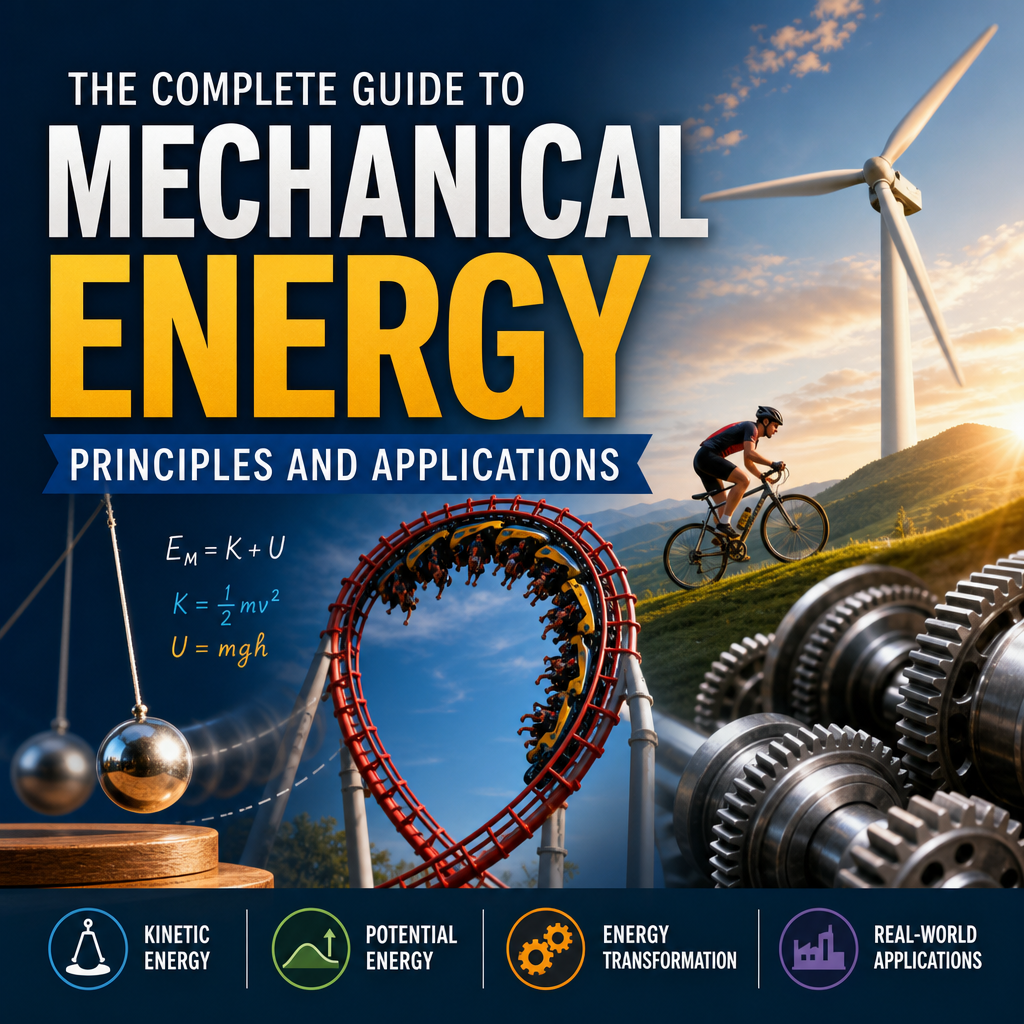
Mechanical energy is the energy an object or system has because of its motion and its position: the sum of its kinetic energy and its potential energy (ME = KE + PE). A swinging pendulum, a turning wind turbine and water behind a dam all have it, and with no friction the total stays constant.
Mechanical energy is the kind you can see: the washer drum spinning, the garage door rising, a kid pumping higher on a swing, a ceiling fan turning on a summer night. It is also how almost all of your electricity is made, because something spins a generator. Understand it, and much of your home, from the furnace blower to the fridge compressor, starts to make sense.
Mechanical energy at a glance
- What it is: the total of kinetic energy (motion) and potential energy (position or shape) in an object or system.
- The formula: ME = KE + PE = ½mv² + mgh (add ½kx² if a spring is involved).
- Where it comes from: work done by a force: an engine, a motor, your muscles, wind, falling water.
- Renewable? It is a form of energy, not a source. Wind and hydropower are renewable sources of it.
- U.S. electricity: the EIA says generators driven by spinning machines produce nearly all U.S. electricity. In 2025 wind made about 11% and hydropower about 6% of utility-scale generation.
- Main upside: it converts to electricity, and back again, very efficiently with generators and motors.
- Main downside: friction slowly turns it into heat, so real machines always lose some.
What is mechanical energy, in plain words?
Picture a child on a swing. At the top of each arc the swing stops for an instant: all its energy is stored as height (potential energy). On the way down it speeds up, trading height for speed (kinetic energy). At the bottom it is moving fastest and is lowest. Mechanical energy is the total of those two, and on a good swing that total barely changes from one side to the other.
In physics terms, the OpenStax university textbook defines mechanical energy as the sum of the kinetic and potential energies of a particle or system, E = K + U. It stays constant unless outside forces or non-conservative forces, like friction and air resistance, do work on the system. That rule is called the conservation of mechanical energy, and it lets you solve problems that would be very hard to work out with forces alone.
One naming note so you are not confused: the U.S. Energy Information Administration uses “mechanical energy” in a narrower way, for energy stored by tension, like compressed springs and stretched rubber bands. Physics textbooks call that elastic potential energy and use “mechanical energy” for the full kinetic-plus-potential total. This page follows the textbook meaning.
The mechanical energy formula
ME = KE + PE
- KE = ½mv²: mass (kg) times speed (m/s) squared, halved
- PE = mgh for gravity: mass times 9.81 m/s² times height (m)
- PE = ½kx² for a spring: stiffness (N/m) times stretch (m) squared, halved
With no friction, ME at the start equals ME at the end: ½mv₁² + mgh₁ = ½mv₂² + mgh₂. With friction, the textbook version becomes Wnc = ΔE: the work done by non-conservative forces equals the change in mechanical energy. In everyday terms, whatever friction takes shows up as heat.
A useful shortcut comes out of this. Anything that drops from height h without friction reaches a speed of v = √(2gh), no matter its mass. A bowling ball and a tennis ball rolled down the same smooth ramp reach the bottom at the same speed; the bowling ball just carries more energy.
Units: joules, and watts for power
Mechanical energy is measured in joules (J); one joule is one newton of force acting over one meter. The rate of delivering it is power, measured in watts (1 W = 1 J per second). Engines and motors are often rated in horsepower: NIST gives one mechanical horsepower as about 745.7 W, and one electric horsepower as exactly 746 W. For home bills, 1 kilowatt-hour = 3,600,000 J.
Worked examples
1. A backyard swing. A 25 kg child swings up to 1 m above the lowest point. At the top: PE = 25 × 9.81 × 1 ≈ 245 J and KE = 0. At the bottom, ignoring friction, all 245 J is kinetic: v = √(2 × 9.81 × 1) ≈ 4.4 m/s, about 10 mph. The mechanical energy stayed 245 J the whole way.
2. A pendulum (from OpenStax). A 1.0 m pendulum released at 30° from vertical drops about 0.13 m. Using conservation of mechanical energy, the textbook finds it passes the lowest point at 1.62 m/s, without ever solving the complicated motion in between.
3. When air resistance wins (also OpenStax). A 15 kg panel falls 1 km and hits the ground at 45 m/s. With no air, it would start with about 147 kJ of potential energy and land with all of it as kinetic energy. It actually lands with only about 15 kJ, so about 130 kJ of mechanical energy went into the air as heat. That is non-conservative work in action.
4. A skateboard ramp. From the top of a 2 m ramp, ignoring friction, a skater reaches v = √(2 × 9.81 × 2) ≈ 6.3 m/s (about 14 mph). Wheels and air take a share, so without pushing the skater can’t roll back up to the same height.
Types of mechanical energy
- Translational kinetic: things moving from place to place, such as a car, a ball, wind or a river.
- Rotational kinetic: things spinning, such as fans, drills, turbines, flywheels and washer drums.
- Gravitational potential: height, such as water in a reservoir or a raised garage door.
- Elastic potential: springs, bands, compressed air in a tank (see compressed air energy).
What mechanical energy does not include: thermal energy (the random jiggling of molecules), chemical energy in fuels and batteries, electrical energy and light. Those are other forms, though machines constantly convert them into mechanical energy and back.
A short history
- Ancient times: water wheels turned by flowing water ground grain thousands of years ago, as the EIA notes, one of the first machines to harness mechanical energy.
- 1656: Christiaan Huygens patented the first pendulum clock, a machine built on a steady exchange of kinetic and potential energy.
- Late 1600s: Gottfried Wilhelm Leibniz worked with what are effectively kinetic energy, potential energy and momentum while criticizing Descartes’ mechanics.
- 1829: Gaspard-Gustave de Coriolis introduced “work” and “kinetic energy” in their modern scientific meaning in his book on calculating the effect of machines.
- 1850: James Prescott Joule published his paddle-wheel experiment: falling weights churned water, and the water warmed. He measured about 772.7 foot-pounds of work per Btu of heat, within about 0.7% of today’s 778. Mechanical energy and heat were proven to be two faces of the same thing.
- 1853: William Rankine coined “potential energy,” and William Thomson (Lord Kelvin) developed the idea further, setting it against “kinetic energy.”
- 1882: the first U.S. hydroelectric plant opened near Appleton, Wisconsin, on September 30, turning the mechanical energy of the Fox River into electricity (EIA).
Energy conversions: the heart of every machine
- Mechanical to electrical (generators): Michael Faraday found that moving a magnet inside a coil of wire makes current flow. Every power plant generator uses that idea: the EIA says the generator converts the rotor’s mechanical energy into electrical energy.
- Electrical to mechanical (motors): the same idea in reverse runs your fridge compressor, furnace blower, washer, dishwasher pump and every fan. See electrical energy.
- Thermal to mechanical (engines and turbines): steam pushing turbine blades or burning gas pushing pistons. The EIA reports steam turbines made about 42% of U.S. electricity in 2022. More on our steam power page.
- Chemical to mechanical (muscles): food powers your legs on a bike or your arms on a crank. See human power.
- Mechanical to thermal (friction): brakes, bearings and the air itself slowly take mechanical energy and turn it into heat.
Where mechanical energy powers the U.S. today
Electricity. According to the EIA, electromagnetic generators driven by turbines, engines and other spinning machines account for nearly all U.S. electricity generation. Solar panels are the main exception: they turn light into electricity with no moving parts.
Wind and water. These sources deliver mechanical energy directly. In 2025, the EIA reports, wind supplied about 11% of U.S. utility-scale electricity and hydropower about 5.6%; all renewables together reached about 24%. Wind turbine blades work like airplane wings, producing lift that spins the rotor and a generator (DOE). Read more on our wind energy and hydroelectric power pages.
Storage. Pumped-storage hydro stores electricity as the mechanical energy of water lifted uphill. The EIA counted about 23,156 MW of it in 18 states in 2025.
Transportation. Fueleconomy.gov estimates only about 12% to 30% of the fuel energy in a gasoline car becomes mechanical energy moving it down the road; most is lost as engine heat. Electric vehicles convert over 77% of the electrical energy from the grid to power at the wheels. See our electric vehicles section.
Mechanical energy at home: what it means for you
Most of the electricity your home uses ends up as mechanical energy somewhere. Motors run compressors, pumps, fans and drums. According to the EIA, air conditioning, which depends on a motor-driven compressor and fans, was the biggest single use of home electricity in 2020 at 19%. A few practical takeaways:
- Keep moving parts clean and free. Dirty filters, clogged coils and dusty fan blades make motors work harder for the same airflow. Changing the HVAC filter on schedule is the easy win. More in energy saving tips.
- Use fans first. Moving air with a ceiling or box fan takes much less power than cooling it, and on mild days that can be enough.
- Look at motor-heavy appliances when upgrading. Heat pumps, variable-speed blowers and newer refrigerators get more work out of each kilowatt-hour. The federal 25C tax credit for heat pumps ended for installs completed after December 31, 2025, so look for state and utility rebates at DSIRE (dsireusa.org) instead.
- Make electricity the old-fashioned way, in a pinch. Hand-crank radios and flashlights turn the mechanical energy of your arm into enough electricity for light and weather alerts during an outage. For real backup, look at batteries in our energy storage section.
- Be realistic about backyard generation. Small wind turbines and micro-hydro need a strong, steady wind site or a stream with real drop, plus permits. Most homes do better with solar. Anything tied into your home’s wiring is a job for a licensed electrician.
Try it at home
The bowling-ball pendulum (safely). Hang a heavy ball (a filled water bottle works) from a doorframe on a string. Stand with your back to the wall, pull the weight to the tip of your nose, and let go without pushing. It swings out and comes back, but never quite reaches your nose again: with no push, it can’t gain mechanical energy, and air friction takes a little each swing.
Ramp race. Lean a board on a couch to make a ramp and release a marble and a larger ball side by side. They reach the bottom at about the same speed, showing that v = √(2gh) does not depend on mass. (Rolling shape matters a little, a fun extra lesson.)
Joule’s experiment, kitchen version. Put sand in a sealed jar, take its temperature with a cooking thermometer, then shake the jar hard for five minutes and measure again. The small rise is mechanical energy turned into heat, the same discovery Joule made with falling weights in 1850.
Strengths and limits of mechanical energy
| Strengths | Limits |
|---|---|
| Converts to and from electricity efficiently (generators, motors) | Friction always turns some of it into waste heat |
| Wind and water supply it renewably and without fuel | Moving parts wear out and need maintenance |
| Can be stored (pumped hydro, springs, flywheels) | Storing large amounts takes large reservoirs or heavy hardware |
| Easy to see, measure and calculate | Fast-moving or tightly wound parts can injure people |
| Muscle power can produce it anywhere, no grid needed | Human-powered output is small compared with home needs |
Safety around mechanical energy
The energy that does useful work can also hurt. Unplug tools before changing blades, let mowers and fans stop fully before reaching in, and keep sleeves and hair away from spinning parts. Wound springs, like those on a garage door, store a lot of energy; leave spring and cable repairs to a trained technician.
Mechanical energy compared with related forms
| Form | What it includes | Formula | Home example |
|---|---|---|---|
| Mechanical | Kinetic plus potential | ½mv² + mgh | A garage door opening |
| Kinetic | Motion only | ½mv² | A spinning fan blade |
| Potential | Position or shape only | mgh, ½kx² | Water in a raised tank |
| Thermal | Random motion of molecules | Q = mcΔT (heat added) | Hot water in the heater |
Products that put mechanical energy to work at home
Prices change often. The prices below are what we saw on Amazon in October 2026; check the current price before you buy.
Two building sets that make mechanical energy visible for kids, and one tiny gadget that turns your hand’s motion into light.
Thames & Kosmos Mechanical Engineering: Machines & Vehicles
- 20 builds, 22 extra experiments
- Storing and converting energy
- Ages 8-14+, 80-page manual
Thames & Kosmos Simple Machines
- 26 model-building exercises
- Levers, pulleys, ramps, gears
- Spring scale included
Coghlan's Dynamo Flashlight
- 1 minute cranking, up to 7 minutes light
- Two 10-lumen LEDs
- No batteries to replace
The Thames & Kosmos Mechanical Engineering: Machines & Vehicles set is the most complete of the three: the maker lists 20 building projects, including a windmill, an elevator and a crane, plus 22 extra experiments on forces, gravity, simple machines and storing and converting energy, with an 80-page manual. It was about $45 on Amazon in October 2026.
Check the Mechanical Engineering kit price on Amazon
The Simple Machines set (about $28) is a gentler start with 26 model-building exercises and a spring scale for measuring forces. The Coghlan’s Dynamo Flashlight (about $14) is mechanical-to-electrical conversion you can hold: the maker says a minute of cranking gives up to 7 minutes of light.
Keep exploring: see where mechanical energy fits among all the types of energy, dig into its two halves on our kinetic energy and potential energy pages, see how a spinning rotor makes power on the wind energy page, or browse the basics in Energy 101.
Mechanical energy FAQs
What is mechanical energy in simple terms?
Mechanical energy is the energy something has because it is moving, because of where it is, or both. It is the total of kinetic energy (motion) and potential energy (height or shape). A ball thrown in the air, a spinning fan and water behind a dam all have mechanical energy, measured in joules.
What is the formula for mechanical energy?
ME = KE + PE. For gravity near the ground, that is ME = ½mv² + mgh, with mass in kilograms, speed in meters per second, g = 9.81 m/s² and height in meters. For example, a 2 kg ball moving at 3 m/s, 1 m above the floor, has 9 J + 19.6 J ≈ 28.6 J of mechanical energy.
What are 5 examples of mechanical energy?
A wind turbine’s spinning blades, water flowing out of a dam, a child on a swing, a moving car, and a wound-up spring in a clock or toy. At home you’ll also find it in washing machine drums, ceiling fans, the garage door opener and the compressor humming in your refrigerator.
Is mechanical energy always conserved?
Only when friction, air resistance and other outside forces do no work. In real life they always take a little, turning mechanical energy into heat, which is why a swing slowly stops. Total energy is still conserved; it just moves out of the mechanical column and into thermal energy.
Is mechanical energy kinetic or potential?
Both. Mechanical energy is the sum of the two. A pendulum at the top of its swing is all potential, at the bottom it is all kinetic, and in between it is a mix. Note that the U.S. EIA uses “mechanical energy” only for energy stored in springs and tension, a narrower meaning than physics textbooks use.
How is mechanical energy turned into electricity?
With a generator. A turbine or engine spins magnets past coils of wire (or coils past magnets), and that motion pushes current through the wire, the effect Michael Faraday discovered. The EIA says generators driven this way make nearly all U.S. electricity, from wind turbines and dams to gas, coal and nuclear plants.