This article contains affiliate links: if you buy through them we may earn a commission, at no extra cost to you. Learn more.
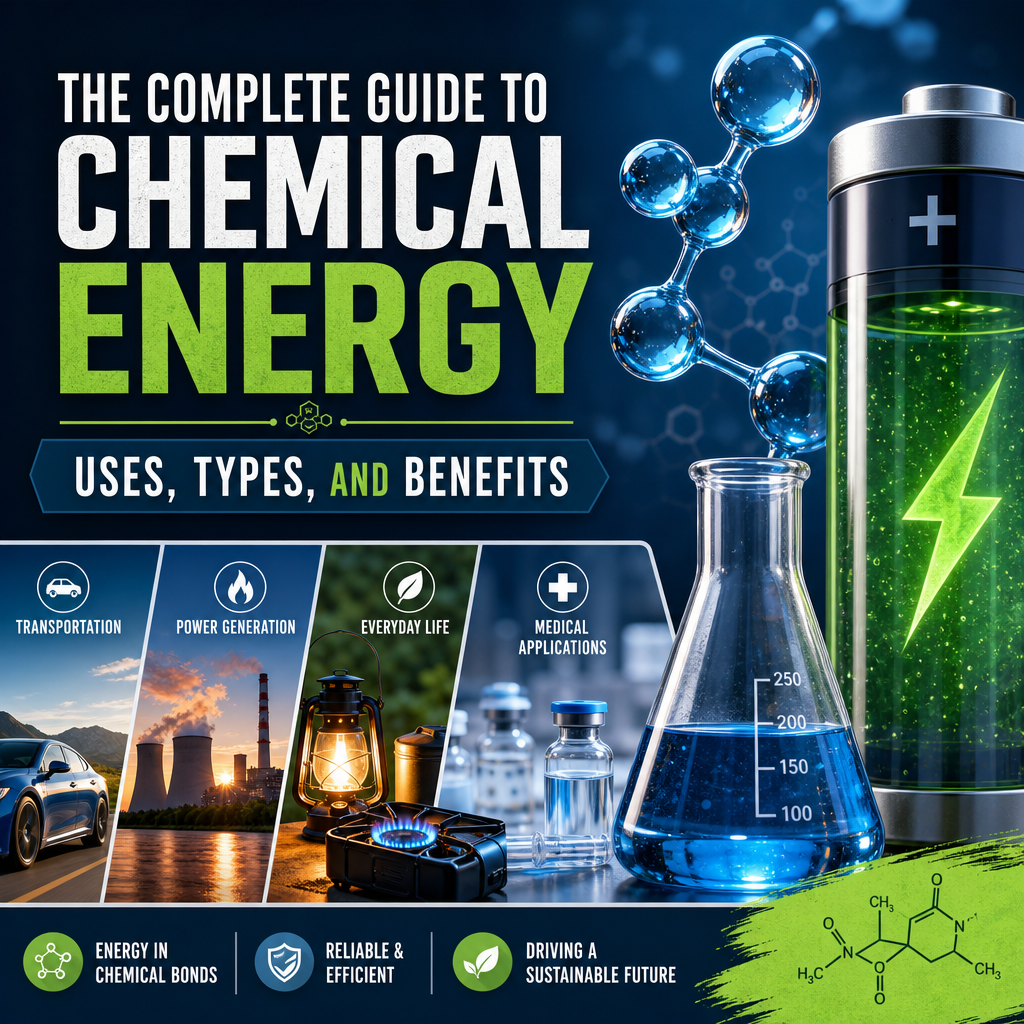
Chemical energy is energy stored in the bonds that hold atoms and molecules together. It is released when a chemical reaction rearranges those bonds, as when fuel burns, food is digested or a battery powers a device. Natural gas, gasoline, wood, food and batteries are all stores of chemical energy.
Most of the energy you use in a day starts out as chemical energy: breakfast, the gas in the car, the propane in the grill, the battery in your phone and, very often, the fuel burned at the power plant that makes your electricity. Knowing how it works helps you choose batteries wisely, burn fuel safely and see where your home could switch to something cleaner.
Chemical energy at a glance
- What it is: energy stored in the bonds of atoms and molecules (U.S. EIA).
- Where it comes from: mostly the sun. Plants turn sunlight into chemical energy through photosynthesis, and fossil fuels are the remains of ancient plants and organisms.
- Renewable or not: both kinds exist. Wood and other biomass regrow; petroleum, natural gas and coal do not.
- Share of U.S. energy: petroleum (38%), natural gas (36%) and coal (8%), all chemical fuels, supplied about 82% of U.S. primary energy in 2025, and biomass about 5% more (EIA).
- Main upside: packs a lot of energy into a small space and stores it for a long time.
- Main downside: burning carbon-based fuels releases carbon dioxide and can produce deadly carbon monoxide.
How chemical energy works
Atoms link up into molecules by sharing or trading electrons. Those links, called chemical bonds, hold energy, a bit like a stretched spring holds energy. A chemical reaction breaks some bonds and makes new ones. Breaking a bond takes energy; forming one gives energy off. If the new bonds are more stable than the old ones, the reaction releases the difference, usually as heat and light. If they are less stable, the reaction soaks energy up instead.
Burning natural gas on your stove is the classic example. Methane (CH4) reacts with oxygen from the air to make carbon dioxide and water vapor:
CH4 + 2 O2 → CO2 + 2 H2O + energy (heat and light)
The bonds in carbon dioxide and water hold less energy than the bonds in methane and oxygen did, so the extra comes out as the blue flame under your pot. Your body does a slow, controlled version of the same thing: it combines food with the oxygen you breathe and uses the energy released to power muscles, the brain and body heat.
Batteries are cleverer. Instead of letting the reaction happen all at once, a battery keeps the two reacting materials apart, at the negative and positive ends, and forces the electrons to travel through your device to get from one side to the other. That flow of electrons is electrical energy. In a rechargeable battery, plugging in pushes the reaction backward and stores the energy again.
The formula and the units
Chemists write the energy of a reaction as the energy needed to break the old bonds minus the energy released by forming the new ones. When the result is negative, the reaction gives off energy (exothermic: burning, digesting, a battery discharging). When it is positive, it absorbs energy (endothermic: photosynthesis, charging a battery, an instant cold pack).
For everyday use, the units are what matter:
| Store of chemical energy | Usual unit | Energy content |
|---|---|---|
| Food | Calorie (kilocalorie) | Fat 9, carbohydrate 4, protein 4 Calories per gram (USDA) |
| Gasoline | Gallon | About 120,214 Btu, or 33.7 kWh (EIA, EPA) |
| Propane | Gallon | About 91,452 Btu (EIA) |
| Natural gas | Cubic foot or therm | About 1,036 Btu per cubic foot; 100,000 Btu per therm (EIA) |
| Firewood | Cord | About 20 million Btu (EIA) |
| Batteries | Watt-hours or kWh | Printed on the battery or power station |
One food Calorie (capital C) is a kilocalorie, equal to 4,184 joules, according to NIST. One kWh is 3.6 million joules.
Worked example: a snack, a gallon and a day at home
- A 250-Calorie snack bar holds 250 × 4,184 = about 1.05 million joules, which is about 0.29 kWh.
- One gallon of gasoline holds 33.7 kWh (EPA), about the same as roughly 116 of those snack bars.
- The average U.S. home bought about 899 kWh of electricity a month in 2022 (EIA), or about 30 kWh a day.
So a single gallon of gasoline holds about as much energy as a typical American home buys in electricity in a day. That density is why fuels have been so hard to replace. The catch is efficiency: according to FuelEconomy.gov, only about 12% to 30% of the energy in the fuel you put in a conventional car actually moves it down the road. The rest is mostly lost as heat.
A short history of chemical energy
- Prehistory: people learn to control fire, the first use of chemical energy beyond food.
- 1800: Alessandro Volta announces the voltaic pile, the first battery, which made electricity from a chemical reaction. Soon after, William Nicholson and Anthony Carlisle used one to split water into hydrogen and oxygen.
- 1859: French physicist Gaston Planté invents the lead-acid battery, the first rechargeable battery. Its descendant is the 12-volt battery in most cars.
- 1970s–1985: Stanley Whittingham builds the first working lithium battery; in 1980 John Goodenough doubles its voltage to four volts with a cobalt oxide cathode; in 1985 Akira Yoshino makes a safer version based entirely on lithium ions.
- 1991: the first lithium-ion batteries go on sale, opening the way for laptops, smartphones and EVs.
- 2019: Whittingham, Goodenough and Yoshino share the Nobel Prize in Chemistry.
Types of chemical energy you meet every day
- Fossil fuels: natural gas, petroleum products like gasoline and heating oil, propane and coal. They are ancient sunlight stored by plants and tiny sea creatures millions of years ago.
- Biomass: wood, crop waste and biofuels like ethanol. EIA describes how plants turn radiant energy from the sun into chemical energy in the form of glucose, or sugar.
- Food: the fuel for your body, measured in Calories.
- Batteries: alkaline AAs, nickel-metal hydride rechargeables, lead-acid car batteries and the lithium-ion cells in phones, laptops, EVs, home batteries and portable power stations.
- Hydrogen: a fuel cell combines hydrogen and oxygen to make electricity and water, with no flame. See hydrogen energy.
Where chemical energy is used today
Chemical fuels still run most of the U.S. economy. In 2025, the United States used about 95.3 quadrillion Btu of primary energy, and petroleum (38%), natural gas (36%) and coal (8%) supplied about 82% of it, according to EIA estimates. Biomass added roughly 5%. Petroleum mostly goes to transportation, which used 38% of all U.S. energy in 2025. Natural gas also generated 41% of U.S. utility-scale electricity that year, so even an all-electric home runs partly on chemical energy, one step removed.
Batteries are the fast-growing part of the story. The U.S. Department of Energy estimates that the cost of an EV lithium-ion battery pack fell about 90% between 2008 and 2023, from $1,415 to $139 per kWh of usable capacity. Cheaper cells are why home batteries and portable power stations have become realistic for ordinary households.
Chemical energy at home
Walk through a typical house and you will find chemical energy everywhere: the gas furnace or water heater, the stove, the grill’s propane tank, the car in the garage, a drawer of batteries and the food in the fridge. Here is what a homeowner or renter can actually do with that:
- Protect yourself from carbon monoxide. Any appliance that burns fuel can make CO when it is not working right. Put a CO alarm on every level and near bedrooms, and have furnaces, water heaters and chimneys checked yearly.
- Switch to rechargeable batteries for remotes, toys, game controllers and flashlights. Fewer dead cells in the trash, and a charger pays for itself over time in high-use devices.
- Test before you toss. A cheap battery tester sorts the truly dead from the ones that still have life for low-drain devices like clocks.
- Recycle lithium-ion batteries properly. EPA says they should not go in household trash or curbside recycling bins, because damaged batteries can start fires. Tape the terminals and take them to a battery drop-off or household hazardous waste site.
- Store backup power in a battery, not just a gas can. A portable power station or home battery keeps lights, a fridge or medical devices running in an outage without fumes, and can be recharged by solar.
- Think about switching when equipment wears out. When a gas water heater, furnace or range reaches the end of its life, compare a heat pump or induction model. A licensed plumber, HVAC contractor or electrician should handle any gas line or new circuit.
Try it at home
Make a lemon battery with a child. Push a galvanized (zinc-coated) nail and a copper coin or strip into a lemon, a couple of inches apart. The lemon juice lets the zinc and copper react, and electrons want to flow from one metal to the other. Connect three or four lemons in a chain with wires and alligator clips and you can often light a small LED or move the needle on a multimeter: chemical energy turning into electrical energy, just as Volta’s pile did in 1800.
Products that put chemical energy to work at home
Prices change often. The prices below are what we saw on Amazon in October 2026; check the current price before you buy.
Panasonic eneloop Charger Pack with 4 AA Batteries
- Charger plus 4 AA NiMH cells
- Up to 2,100 recharges (maker)
- Charges each cell separately
Kidde Battery-Powered Carbon Monoxide Alarm
- Electrochemical CO sensor
- Runs on 2 AA batteries, no wiring
- 85-decibel alarm
Tenergy T-333 Universal Battery Tester
- LCD display
- Tests AA, AAA, C, D and 9V
- Also button and camera cells
The Panasonic eneloop charger pack (about $29, seen October 2026) comes with four AA nickel-metal hydride batteries that Panasonic rates for up to 2,100 recharges and says keep up to 70% of their charge after 10 years in storage. The Kidde carbon monoxide alarm (about $23) uses an electrochemical sensor, a small chemical cell that reacts to CO, and runs on two AA batteries, so it keeps working in a power outage, exactly when people run generators and fuel heaters. The Tenergy T-333 (about $13) checks household and specialty batteries on an LCD screen.
Check the eneloop charger pack price on Amazon
Pros and cons of chemical energy
| Pros | Cons |
|---|---|
| Very energy-dense, especially liquid fuels | Burning carbon fuels releases CO2 |
| Stores for months or years | Incomplete burning makes deadly carbon monoxide |
| Easy to transport and use on demand | Engines and furnaces lose much of it as heat |
| Batteries make electricity portable | Fossil fuels are finite and prices swing |
| Biomass and biofuels can be renewable | Batteries need mining and careful recycling |
Environmental and safety impact
Releasing chemical energy from carbon-based fuels always makes carbon dioxide. EPA puts it at about 8,887 grams of CO2 for every gallon of gasoline burned, and about 10,180 grams per gallon of diesel. That is the main reason the world is moving toward electricity from wind, sun and nuclear, and toward batteries for storage.
At home, carbon monoxide is the hazard to take seriously. Each year more than 400 Americans die from unintentional CO poisoning not linked to fires, more than 100,000 visit an emergency room and more than 14,000 are hospitalized, according to the CDC. Furnaces, portable generators, charcoal grills, gas ranges and fireplaces are common sources. Never run a generator, grill or camp stove indoors or in a garage. Lithium-ion batteries carry their own risk: use the charger that came with the device, and stop using any battery that swells, smells or gets very hot.
What chemical energy costs
Prices for fuels change constantly and vary by state, so the fairest comparison is cost per unit of energy. Take your local price per gallon, therm or kWh and divide by the energy content in the units table above. Then factor in efficiency: an electric motor or heat pump usually wastes far less than an engine or a flame. FuelEconomy.gov estimates EVs turn about 65% to 69% of their grid energy into power at the wheels. Batteries cost more up front than fuel but are cheap to refill. The federal credits for home batteries (25D) ended for systems installed after December 31, 2025, and the EV credit ended September 30, 2025, so look for state, utility and local programs in the DSIRE database (dsireusa.org) and our tax credits and grants section.
The future of chemical energy
Chemical energy is not going away; it is changing shape. Fossil fuels still dominate, but battery costs have fallen steeply, and the same lithium-ion chemistry now sits in cars, garages and backpacks. Researchers are working on cheaper and safer chemistries and on hydrogen made with clean electricity. For homeowners, the realistic near-term change is simple: more of your stored energy will live in batteries that you can recharge from the grid or your own solar panels, and less in tanks of fuel.
How chemical energy compares
| Form of energy | Where it is stored | How it is released | Home example |
|---|---|---|---|
| Chemical | Bonds between atoms | Reactions: burning, digesting, batteries | Gas stove, AA batteries |
| Nuclear | The nucleus of the atom | Splitting or fusing nuclei | Part of your grid power |
| Electrical | Moving charge (not stored easily) | Current through a circuit | Every outlet |
| Thermal | Moving atoms and molecules | Heat flowing hot to cold | Furnace, water heater |
Chemical energy FAQs
What is chemical energy in simple words?
Chemical energy is energy stored inside substances, in the bonds that hold their atoms together. It stays hidden until a chemical reaction releases it, usually as heat, light or electricity. Food, wood, gasoline, natural gas and batteries all hold chemical energy, waiting to be used.
What are 5 examples of chemical energy?
A battery powering a flashlight, natural gas burning on a stove, gasoline running a car engine, wood burning in a fireplace, and food your body digests for energy. Others include propane in a grill, coal at a power plant, and the glucose a plant makes from sunlight through photosynthesis.
Is chemical energy potential or kinetic?
Chemical energy is a form of potential energy: stored energy waiting to be released. It becomes other forms when a reaction happens: heat and light when fuel burns, motion when your muscles work, or electrical energy when a battery is connected to a circuit.
How does a battery turn chemical energy into electricity?
A battery holds two different materials that want to react, kept apart inside the cell. When you connect a device, electrons travel from one end of the battery to the other through the device’s circuit, powering it on the way. Charging a rechargeable battery pushes the reaction backward to store energy again.
Is chemical energy renewable?
Some is and some is not. Wood, crops and biofuels are renewable because plants regrow and store new sunlight. Petroleum, natural gas and coal formed over millions of years and are not renewable on a human timescale. Batteries are storage, so they are as renewable as the electricity used to charge them.
Where does the chemical energy in food come from?
From the sun. Plants use photosynthesis to turn sunlight, water and carbon dioxide into sugars that store chemical energy. When you eat plants, or animals that ate plants, your body breaks those molecules down with oxygen and uses the released energy to move, think and stay warm.
Keep exploring
Chemical energy links fuels, food and batteries. Compare every type of energy, see how batteries feed electrical energy to your devices, learn about cleaner fuels in hydrogen energy and biomass energy, or browse energy storage for home batteries and power stations.