This article contains affiliate links: if you buy through them we may earn a commission, at no extra cost to you. Learn more.
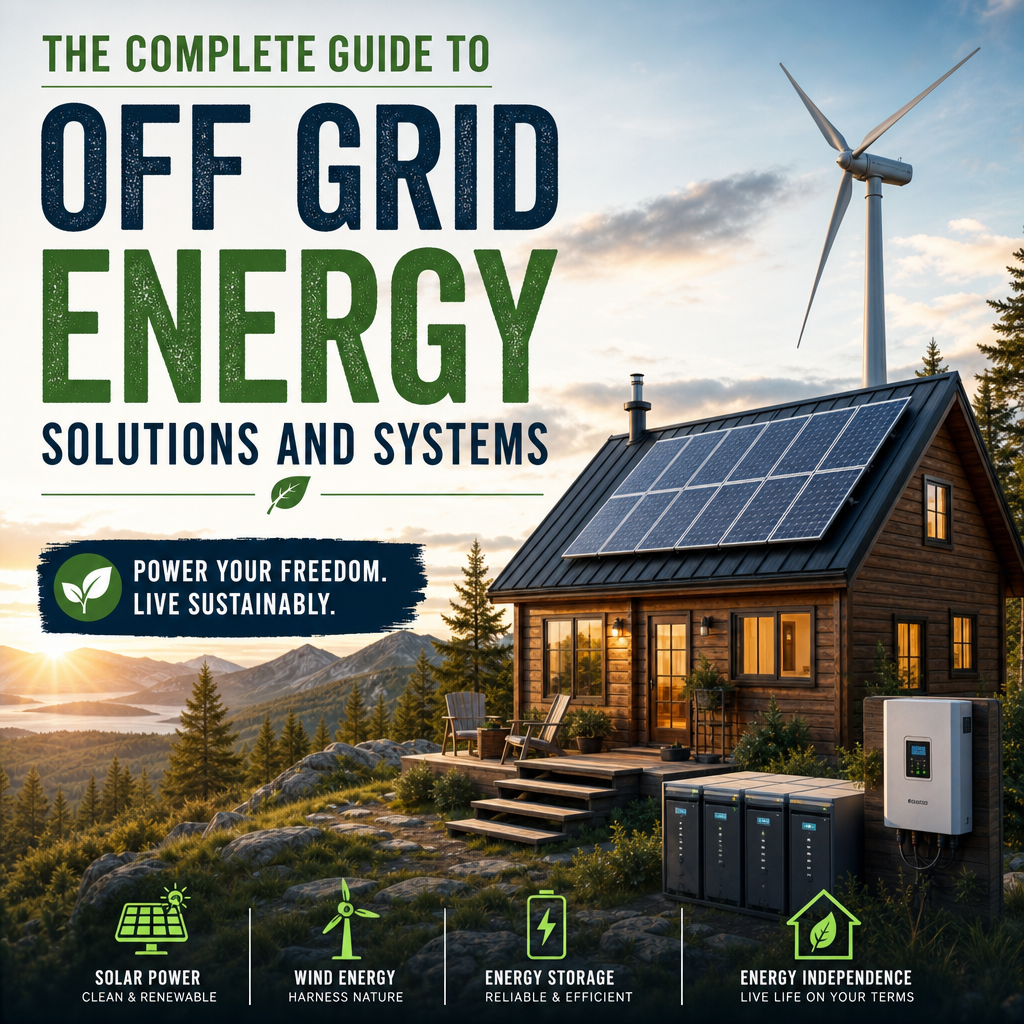
Off-grid energy means making, storing and using all of your own electricity with no connection to the utility power grid. Most off-grid systems combine solar panels, a battery bank, a charge controller and an inverter, often with a generator as backup. They power remote cabins, RVs, boats, tiny homes and some full-size houses.
Picture a cabin at the end of a dirt road: the fridge humming, the lights on, a phone charging, and no power line anywhere in sight. Or a camper parked by a lake, running a fan all night on what the roof panels collected that afternoon. That is off-grid living, and it’s more within reach than ever. It’s also more work than most people expect. This guide walks through how off-grid power works, how to size a system, what it costs, and which gear makes sense for a cabin, an RV or a home.
Off-grid energy at a glance
- What it is: a stand-alone power system that isn’t connected to the utility grid. You are your own power company.
- Where the power comes from: usually solar panels; sometimes a small wind turbine or micro-hydro; often a gas, propane or diesel generator for backup.
- Renewable? It can be. Solar, wind and hydro are renewable; a fuel generator is not.
- How common: no U.S. agency counts off-grid homes. EIA notes that since 2004 most U.S. solar systems have been grid-connected. Worldwide, off-grid and other decentralized renewable systems benefited over 561 million people in 2023 (World Bank, Tracking SDG7 2025).
- When it pays: when the grid is far away. Running a power line to a remote site costs $15,000 to more than $50,000 per mile, depending on terrain (U.S. DOE).
- Main upside: independence. No electric bill, no grid outages, power where there are no lines.
- Main downside: you have to make every kilowatt-hour you use, store enough for cloudy days, and maintain it all yourself.
How an off-grid power system works
In simple words: something makes electricity during the day, a battery stores it, and an inverter turns it into the same kind of power your wall outlets give you. Here are the parts, in the order the electricity flows:
- Power source. Solar panels are the usual choice. Each solar cell makes only 1–2 watts, so cells are wired into panels and panels into arrays (EIA). In windy places, DOE says a small wind turbine can make sense where the average wind speed is at least 9 mph, and wind and sun complement each other: winds tend to be stronger in winter, when there is less sunlight.
- Charge controller. This box sits between the panels and the battery. It feeds the battery the right voltage and current, and stops charging when it’s full.
- Battery bank. Off-grid systems need batteries to store power for night and for calm or cloudy days. DOE’s small wind guide points to deep-cycle batteries, which can be drained and recharged many times; today most new systems use lithium iron phosphate (LiFePO4, or LFP) batteries.
- Inverter. Panels and batteries make direct current (DC). The inverter converts it to alternating current (AC) for normal appliances. Small systems, like RVs and boats, also run 12-volt DC lights, pumps and fans directly.
- Backup generator. A gas, propane or dual-fuel generator recharges the batteries during long stretches of bad weather, or carries big loads like a well pump or power tools.
- Safety and monitoring. Fuses, breakers, disconnects and meters protect the wiring and show how much energy you’re making and using. DOE lists these as part of the “balance of system” every stand-alone system needs.
A bit deeper: off-grid design is a daily energy budget. Power is measured in watts (how fast you use it), and energy in watt-hours or kilowatt-hours (how much you use over time). What your panels collect in a day has to cover what you use in a day, and your batteries have to carry you through nights and cloudy stretches. A grid-connected home can lean on the utility when the sun disappears. An off-grid home can’t, which is why the battery and the backup generator matter so much. Our electrical energy guide explains watts, volts and amps in more detail.
A short history of off-grid power
- Before the grid: every home was “off-grid” and relied on wood, oil lamps and, later, small local generators.
- 1954: Bell Telephone researchers develop the first practical photovoltaic (PV) cell (EIA).
- Late 1950s: PV cells power U.S. space satellites, the ultimate off-grid application.
- Late 1970s: PV panels start supplying electricity in remote, off-grid places with no power lines.
- Mid-1980s to today: typical commercial panel efficiency rises from under 10% to about 15% by 2015, and state-of-the-art modules now approach 25% (EIA).
- Since 2004: most new U.S. PV systems are grid-connected, but off-grid solar keeps growing in RVs, cabins and the developing world.
Types of off-grid systems
- Portable power stations (“solar generators”): an all-in-one box with a battery, inverter, charge controller and outlets. Plug in folding solar panels and you have a small off-grid system in minutes. Good for camping, vans, small cabins and home backup during outages.
- 12-volt DIY systems: roof panels, a charge controller, one or more 12V batteries and an inverter. The classic setup for RVs, vans, boats and sheds.
- Whole-home off-grid systems: a large solar array, a big battery bank, a high-power inverter and usually a backup generator, designed and installed like a small power plant. This is a job for a licensed installer.
- Hybrid systems: solar plus wind or micro-hydro, with a generator. DOE notes that combining sources raises reliability because they peak at different times.
- Grid-tied with backup (not truly off-grid): a home stays on the grid but has a battery or generator that keeps critical circuits running during outages. For most homeowners, this is the practical middle ground.
Where off-grid energy is used today
In the United States, off-grid power shows up in remote cabins and ranches, RVs and vans, boats, farm pumps and fences, road signs and cell sites, and in homes whose owners simply want independence. DOE notes that stand-alone systems are used both where the grid is out of reach and by people near the grid who want independence from the utility. There is no official count of off-grid homes, so treat any number you see online with care. Rooftop solar is booming, but most of it is grid-tied: EIA estimates that small-scale solar systems generated about 0.09 trillion kWh in 2025, mostly on homes and businesses that are still connected to the grid.
Around the world, off-grid power is how millions of people get electricity for the first time. According to the World Bank’s Tracking SDG7 report (2025), 666 million people still lived without electricity in 2023, about 85% of them in Sub-Saharan Africa. Decentralized renewable systems such as solar home systems and mini-grids benefited over 561 million people in 2023 and provided 55% of new connections in Sub-Saharan Africa from 2020 to 2022. The report expects off-grid solar to be the most cost-effective option for 41% of the people still without power by 2030.
Going off-grid at home: how to size a system
Start with the honest number. In 2022, the average U.S. home bought 10,791 kWh of electricity, about 899 kWh a month or roughly 30 kWh a day (EIA). Supplying that entirely from solar and batteries, through winter and cloudy weeks, takes a large and expensive system. The biggest electricity uses in U.S. homes in 2020 were air conditioning (19%), space heating (12%) and water heating (12%), and off-grid homes usually switch heating, hot water and cooking to propane or wood to keep the electrical load manageable.
Here is the step-by-step method installers use, with an example for a small weekend cabin. The appliance numbers are examples only; use the watts on your own appliance labels or measure them with a plug-in meter.
- List every load and its daily use. Watts × hours per day = watt-hours per day. Example: LED lights, phone and laptop charging, a fan and a small efficient fridge add up to 1,500 Wh (1.5 kWh) a day.
- Size the battery for cloudy days. Multiply daily use by the number of days you want to ride through without sun. Two days × 1.5 kWh = 3 kWh. Lithium batteries are often rated for deep use (for example, Renogy rates the battery below for over 5,000 cycles at 80% depth of discharge), so divide by 0.8: about 3.75 kWh of battery. That’s about three 12V 100Ah LiFePO4 batteries.
- Size the solar array. Solar output depends on your location and season. As a reference, Renogy rates its 200-watt starter kit at about 1,000 Wh a day with 5 hours of direct sunlight. To cover 1.5 kWh a day in similar sun you’d need about 300 watts of panels, and more for winter, shade and losses.
- Size the inverter for peaks. Add up everything that might run at once, and check the start-up surge of motors such as fridges and pumps. The inverter’s continuous and surge ratings must cover both.
- Plan the backup. Decide how you’ll recharge after a week of storms: a generator, a second charging source, or simply using less.
A few honest notes before you buy:
- Cut first, then generate. Every kWh you save is one you don’t need to make and store. LED lighting, an efficient fridge and avoiding electric heat shrink an off-grid system dramatically. See our energy-saving tips.
- Permits and wiring. A plug-and-play power station needs no electrician. Anything wired into a building (panels on the roof, a battery bank, an inverter feeding circuits, a generator inlet or transfer switch) usually needs a permit and should be designed and installed by a licensed electrician or solar installer.
- Check local rules. Building codes, permits and occupancy rules for off-grid homes vary by state and county. Ask your local building department before you buy land or plan a build.
- Renters and city dwellers: you can’t cut the cord, but a portable power station with a folding panel gives you a slice of off-grid power for outages, balconies and camping. Our energy storage section compares models.
Products that put off-grid energy to work
Three building blocks cover most small off-grid setups: a portable power station for plug-and-play power, a LiFePO4 battery for a DIY 12-volt system, and a dual-fuel generator for backup. Add solar panels that match your power station or charge controller.
Prices change often. The prices below are what we saw at a major retailer in October 2026; check the current price before you buy.
Jackery Explorer 1000 v2 Portable Power Station
- 1,070 Wh LFP battery, 1,500 W AC
- 3 AC outlets, 2 USB-C, 1 USB-A
- 23.8 lb; solar panel sold separately
Renogy 12V 100Ah LiFePO4 Self-Heating Battery
- Built-in 100A BMS, self-heating
- Over 5,000 cycles at 80% DOD (maker)
- Group 22NF size, IP65 case
Champion 4500-Watt Dual Fuel Inverter Generator
- 3,500 W running on gas, 3,150 W on propane
- Up to 14 h gas, 21 h propane
- CO Shield auto shutoff
The Jackery Explorer 1000 v2 (about $499, seen October 2026) is the easiest way into off-grid power. It stores 1,070 Wh in a lithium iron phosphate battery, delivers 1,500 watts continuous (3,000 W surge) through three AC outlets, and weighs 23.8 pounds. Jackery says it keeps over 70% of its capacity after 4,000 cycles. Pair it with a folding solar panel and it runs a small cabin’s lights, phones and fan, or keeps essentials like a router and lights going in an outage. Solar panels are not included.
Check the Jackery Explorer 1000 v2 price on Amazon
The Renogy 12V 100Ah LiFePO4 (about $297, seen October 2026) is a building block for RV, van, boat and cabin systems. It has a built-in 100-amp battery management system and dual heating pads, which matters because lithium batteries shouldn’t be charged when they’re too cold. Renogy rates it to operate from -22°F to 131°F. Wire several together for a larger bank, and have a qualified person check the fusing and cable sizes.
The Champion 4500-Watt Dual Fuel Inverter Generator (about $903, seen October 2026) is the backup for the cloudy week. It runs on gasoline (3,500 running watts, up to 14 hours) or propane (3,150 running watts, up to 21 hours), is rated at 61 dBA, and has a CO Shield system that shuts it off if carbon monoxide builds up around it. Propane stores for a long time, which is handy at a remote cabin; see our propane energy guide.
Pros and cons of off-grid energy
| Pros | Cons |
|---|---|
| Power where there are no lines, without paying $15,000–$50,000+ per mile to extend them | Large up-front cost for panels, batteries, inverter and backup |
| No monthly electric bill | No net metering: extra summer power can’t be sold or banked with a utility |
| Unaffected by grid outages | Cloudy weeks can drain batteries; you need a backup plan |
| Mostly clean, quiet power when solar-based | Batteries wear out and must eventually be replaced |
| Scales from a phone charger to a whole house | You are the maintenance crew: monitoring, cleaning, fixing |
| Teaches you exactly where your energy goes | Heating, cooling and big appliances are hard to run on solar alone |
Environmental and safety impact
A solar-and-battery system produces no emissions while it runs. Its footprint comes from manufacturing the panels and batteries, and from the fuel any backup generator burns. The more of your energy comes from the sun, and the less you need in the first place, the cleaner the system.
Generators are the biggest safety risk. The U.S. Consumer Product Safety Commission says nearly 80 people die each year from carbon monoxide poisoning caused by portable generators. CPSC’s advice: run generators outside only, at least 20 feet from the house, with the exhaust pointed away from buildings; never in a home, garage, basement, shed or on a porch; and choose models with automatic CO shutoff. Put battery-powered carbon monoxide alarms inside the home too.
Batteries and wiring: large battery banks store a lot of energy and can deliver very high currents. Use proper fuses and cable sizes, follow the maker’s instructions, keep batteries in a ventilated, protected space, and never connect a generator or inverter to house wiring without a proper transfer switch or interlock installed by a licensed electrician. A back-fed connection can injure you or utility workers.
How much does off-grid energy cost?
Off-grid costs depend almost entirely on how much energy you need. Some real reference points:
| Setup | What it covers | Typical cost |
|---|---|---|
| Portable power station (about 1 kWh) | Lights, phones, laptop, fan, short fridge runs, outage backup | About $500 for the Jackery Explorer 1000 v2, plus panels (October 2026) |
| 12V DIY system for an RV or cabin | Lights, water pump, fridge, electronics | Each 100Ah LiFePO4 battery about $300, plus panels, controller, inverter and wiring |
| Backup generator | Recharging batteries, big loads, long storms | About $900 for a 4,500-watt dual-fuel inverter model (October 2026) |
| Whole-home off-grid system | A full-time household | Designed case by case; get several installer quotes |
| Extending the grid instead | Utility service to a remote site | $15,000 to more than $50,000 per mile (U.S. DOE) |
Money note: the federal residential clean energy credit (30% for solar and batteries) ended for systems completed after December 31, 2025, so don’t count on a federal credit for a 2026 project. Some states, utilities and local programs still offer rebates; search the DSIRE database (dsireusa.org) and see our tax credits and grants section. Off-grid systems usually don’t qualify for utility programs built around net metering.
The future of off-grid energy
- Better panels: state-of-the-art modules now approach 25% efficiency, up from under 10% in the mid-1980s (EIA), so the same roof makes more power.
- Longer-lasting batteries: LiFePO4 batteries now carry maker ratings in the thousands of cycles, like the 4,000 and 5,000 cycles quoted for the products above, which makes daily cycling realistic for years.
- Global electricity access: the World Bank expects off-grid solar to be the cheapest way to reach 41% of the people still without power by 2030, and estimates $95 billion in funding is needed to expand decentralized renewables.
How off-grid energy compares
| Off-grid solar + battery | Grid-tied solar | Grid-tied solar + battery | Generator only | |
|---|---|---|---|---|
| Works in a grid outage? | Yes | Usually no (shuts off for safety) | Yes, for backed-up circuits | Yes, while fuel lasts |
| Monthly electric bill | None | Lower | Lower | None, but fuel costs |
| Sells extra power? | No | Often, via net metering | Often | No |
| Fuel or emissions | None in use (backup generator aside) | None in use | None in use | Burns gasoline, propane or diesel |
| Best for | Remote sites, RVs, cabins | Lowest-cost solar on a connected home | Connected homes that want outage backup | Occasional use and short outages |
Off-grid energy FAQs
What does off-grid energy mean?
It means producing and storing all of your own electricity without any connection to the utility grid. A typical off-grid system uses solar panels to make power, a charge controller and batteries to store it, an inverter to turn it into normal household AC power, and often a generator for backup. Cabins, RVs, boats and some full-time homes run this way.
How much solar do I need to go off-grid?
It depends on your daily energy use and your sunshine. Add up the watt-hours of everything you run in a day, then size panels to replace that on a typical day, with extra for winter. As one reference, Renogy rates a 200-watt kit at about 1,000 Wh a day with 5 hours of direct sun. An average U.S. home uses about 30 kWh a day, so a full-size home needs a large array.
Can a house run completely off-grid?
Yes, but it takes planning and money. Most full-time off-grid homes pair a large solar array and battery bank with a backup generator, and they cut electrical demand by using propane or wood for heat, hot water and cooking. A licensed installer should design the system, and you should check local permit and occupancy rules first, because they vary from county to county.
What is the best battery for off-grid solar?
Most new off-grid systems use lithium iron phosphate (LiFePO4) batteries. They can be discharged deeply, last thousands of cycles (makers often quote 4,000 to 5,000 or more), and need little maintenance. They shouldn’t be charged below freezing, so self-heating models help in cold climates. Lead-acid deep-cycle batteries, like golf-cart batteries, cost less up front; DOE says they can discharge and recharge 80% of their capacity hundreds of times, far fewer cycles than LiFePO4 makers quote.
Is it cheaper to go off-grid or connect to the grid?
Near existing power lines, staying on the grid is almost always cheaper, especially for a full-size home. Far from the grid, it can flip: DOE puts the cost of running a power line to a remote site at $15,000 to more than $50,000 per mile. For a small cabin, a solar system and battery can cost less than a long line extension.
Can I run a refrigerator on a portable power station?
Usually, for a while. Check the fridge’s label for its running watts and start-up surge, and make sure the power station’s continuous and surge ratings cover them. Run time depends on the fridge’s daily energy use and the station’s capacity in watt-hours. Adding solar panels lets you recharge during the day and run longer.
Is a generator safe to use for off-grid power?
Yes, if you follow the rules. CPSC says to run generators outside only, at least 20 feet from the house, with exhaust pointed away from doors and windows, and never in a garage, basement, shed or porch. Choose a model with automatic carbon monoxide shutoff, keep CO alarms inside, and have an electrician install a transfer switch before connecting to house wiring.
Keep exploring
Off-grid systems run on the same sources as the rest of the energy world. Learn how panels work in our solar energy guide, when a small turbine makes sense in wind energy, and how a stream can power a home in hydroelectric power. For the bigger picture, see renewable energy and types of energy, or browse our solar and energy storage sections for gear comparisons.