This article contains affiliate links: if you buy through them we may earn a commission, at no extra cost to you. Learn more.
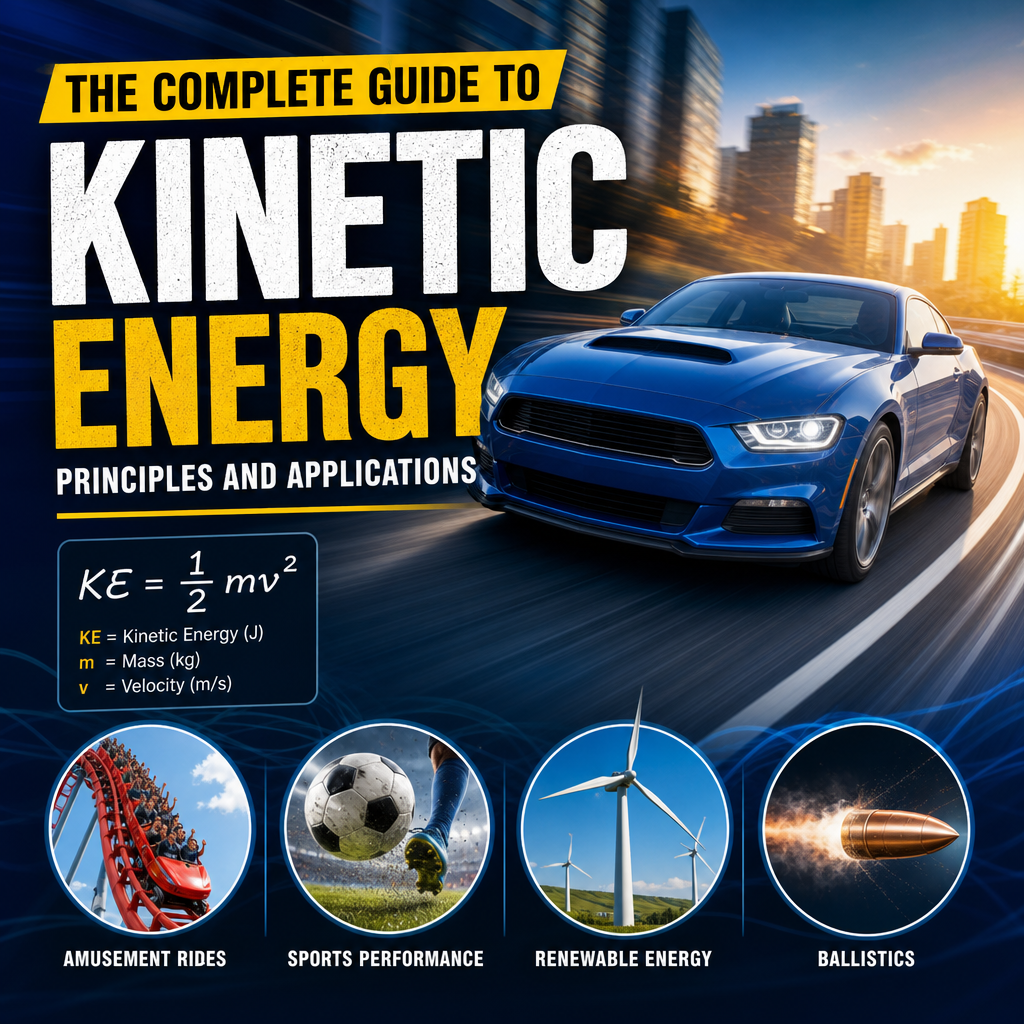
Kinetic energy is the energy an object has because it is moving. Its size depends on the object’s mass and, even more, on its speed: KE = ½mv². Double the speed and the kinetic energy goes up four times. It is measured in joules, and anything that moves, from a car to the wind, carries it.
You deal with kinetic energy all day. The breeze on the porch, the spinning washer drum, water rushing through a garden hose, a kid coasting down the driveway on a bike: all energy of motion. Understanding it explains why a car at highway speed needs so much room to stop, why wind turbines want windy hilltops, and how a hand-crank radio works when the power is out.
Kinetic energy at a glance
- What it is: the energy of motion. Any object with mass that is moving has it.
- The formula: KE = ½mv² (mass in kilograms, speed in meters per second, answer in joules).
- Where it comes from: work done on an object (a push, an engine, gravity pulling it down a hill) turns into motion.
- Renewable? It is a form of energy, not a fuel. But two big renewable sources run on it: wind and flowing water.
- U.S. electricity: in 2025, wind supplied about 11% and hydropower about 6% of U.S. utility-scale electricity generation, both by capturing kinetic energy (U.S. EIA).
- Main upside: it converts easily into electricity with a turbine or generator.
- Main downside: it is hard to store; once the motion stops, the energy has gone somewhere else, often as heat.
What is kinetic energy, in plain words?
Energy is the ability to do work: to push, lift, heat or move something. Kinetic energy is the part an object has simply because it is moving. A parked car has none; a rolling car has some, and must shed all of it (through its brakes, as heat) to stop.
Two things set how much kinetic energy something carries:
- Mass. A loaded pickup truck carries more energy than a bicycle at the same speed. Twice the mass, twice the energy.
- Speed. This one matters more, because it is squared. Twice the speed means four times the energy; three times the speed means nine times.
Going a little deeper: kinetic energy is what physicists call a scalar. It has a size but no direction, and it is never negative. A ball moving north and a ball moving south at the same speed carry exactly the same kinetic energy. Momentum (mass times velocity), by contrast, has a direction.
The kinetic energy formula
For an object moving much slower than light (everything in your house and on the road), kinetic energy is:
KE = ½ × m × v²
- KE = kinetic energy, in joules (J)
- m = mass, in kilograms (kg)
- v = speed, in meters per second (m/s)
The OpenStax university physics textbook puts it simply: the kinetic energy of a particle is one-half its mass times the square of its speed. The formula also explains the link between energy and work. If you push on a cart and it speeds up, the work you did (force times distance) shows up as the cart’s new kinetic energy. This is the work-energy theorem.
Units of kinetic energy
The SI unit of energy, kinetic or otherwise, is the joule (J). One joule equals one kilogram times one meter squared per second squared (kg·m²/s²), which is the same as one newton of force pushing over one meter. A joule is small: roughly the energy it takes to lift an apple one meter.
Other units you may see, with exact or standard conversions from the National Institute of Standards and Technology (NIST):
| Unit | Equals | Where you see it |
|---|---|---|
| Kilowatt-hour (kWh) | 3,600,000 J | Your electric bill |
| Food Calorie (kilocalorie) | 4,184 J | Nutrition labels |
| British thermal unit (Btu) | about 1,055 J | Furnaces, air conditioners |
| Foot-pound (ft·lbf) | about 1.356 J | Older U.S. engineering, firearms |
| Watt-second | 1 J | Electronics, camera flashes |
Worked examples you can check with a calculator
1. A family car in town and on the highway. Take a 1,500 kg car (about 3,300 lb). At 30 mph (13.4 m/s): KE = ½ × 1,500 × 13.4² ≈ 135,000 J, or 135 kJ. At 60 mph (26.8 m/s): KE = ½ × 1,500 × 26.8² ≈ 540,000 J. Same car, twice the speed, four times the energy. That is the reason stopping distances grow so fast with speed: the brakes have to turn all of that motion into heat.
2. The same energy in household terms. 540,000 J ÷ 3,600,000 J per kWh ≈ 0.15 kWh, roughly what a 1,500-watt hair dryer uses in six minutes. Small in bill terms; what makes it dangerous is how fast a crash releases it.
3. A snack bar versus the car. A 250-Calorie snack holds 250 × 4,184 ≈ 1,050,000 J of chemical energy, about twice the kinetic energy of that 1,500 kg car at 60 mph. Your body cannot turn all of it into motion, but it shows how much energy food really packs.
4. Wind on a turbine. Air at sea level has a density of about 1.225 kg per cubic meter (NASA’s standard atmosphere model). The power of wind flowing through one square meter is ½ × density × v³. At 10 m/s (about 22 mph) that is about 610 watts per square meter; at 5 m/s it is only about 77 watts. Half the wind speed, one-eighth the power. A University of Massachusetts wind fact sheet puts it this way: a 10% difference in wind speed makes about a 33% difference in power.
Types of kinetic energy
The U.S. Energy Information Administration (EIA) files motion, thermal energy, sound, electricity and light (radiant energy) all under kinetic energy. The main kinds:
- Translational: an object moving from one place to another, like a car, a thrown ball or a gust of wind.
- Rotational: an object spinning in place, like a ceiling fan, a washing machine drum, a flywheel or a wind turbine rotor. A rolling wheel has both kinds at once.
- Vibrational: back-and-forth motion, like a guitar string. Sound is this energy passed through the air (see acoustic energy).
- Thermal: the random motion of atoms and molecules, which you feel as heat (see thermal energy).
- Electrical: moving charged particles in a wire (see electrical energy).
A short history of kinetic energy
- 1600s: OpenStax notes that the quantity was introduced in the 17th century to explain collisions between elastic bodies. Gottfried Wilhelm Leibniz criticized René Descartes’ mechanics and worked with what we now recognize as kinetic energy, a “living force” (vis viva) that grows with the square of speed.
- 1700s: Émilie du Châtelet sided with Leibniz in her 1740 Institutions de physique. Following earlier experiments by Willem ‘s Gravesande, she dropped heavy balls into clay: balls hitting at twice the speed sank four times as deep, and at three times the speed, nine times as deep. Energy grows with speed squared, not simply with speed.
- 1829: French engineer Gaspard-Gustave de Coriolis, in his book Du calcul de l’effet des machines, introduced the terms “work” and “kinetic energy” with their modern scientific meaning.
- 1850s: William Rankine coined “potential energy” in 1853, and William Thomson (later Lord Kelvin) developed the idea further, setting potential energy against kinetic energy: the pair of names we still use.
Energy conversions: where kinetic energy comes from and goes
Energy is never created or destroyed; it changes form, often with kinetic energy as the middle step:
- Potential to kinetic: water falling through a dam, a skier going downhill, a cyclist coasting. The EIA uses the downhill bike as its example of gravitational energy turning into motion. More on the other half of this pair on our potential energy page.
- Chemical to kinetic: engines burning fuel; muscles burning food.
- Electrical to kinetic: every motor in your home, from the fridge compressor to the blender.
- Kinetic to electrical: a generator. Wind turbines, hydro turbines, and the little dynamo in a hand-crank flashlight all do this.
- Kinetic to thermal: friction. Car brakes, a sanding block, rubbing your hands together on a cold morning.
The sum of an object’s kinetic and potential energy is its mechanical energy, which stays constant when friction and air resistance are small enough to ignore.
Where kinetic energy powers the U.S. today
Two of the biggest U.S. renewable sources harvest kinetic energy. Wind turbine blades work like airplane wings: wind creates lift, the rotor spins, and a shaft turns a generator, as the U.S. Department of Energy explains. Read more on our wind energy page. Hydropower plants let water flow through a turbine that spins a generator; see hydroelectric power.
According to the EIA, in 2025 wind produced about 11% of U.S. utility-scale electricity and hydropower about 5.6%. Together they made up roughly two-thirds of the country’s renewable electricity that year (wind 43% of the renewable total, hydro 23%).
Transportation is the other big story. Fueleconomy.gov (DOE and EPA) estimates only about 12% to 30% of a gasoline car’s fuel energy moves it down the road, while EVs turn over 77% of their grid energy into power at the wheels. Hybrids and EVs also use regenerative braking: the wheels’ forward motion turns the motor, recapturing energy ordinary brakes waste as heat. More in our electric vehicles section.
Kinetic energy at home: what you can actually do
Honestly, you won’t power your house from motion in your yard. A backyard wind turbine needs strong, steady wind above trees and roofs, which most suburban lots lack, and a pedal generator gives a trickle. Where kinetic energy does pay off:
- Emergency power you crank yourself. A hand-crank radio or flashlight turns your arm’s motion into electricity through a small generator. Not much, but enough to hear weather alerts and find your way in a blackout. Pair one with a battery for real backup; see our energy storage guides.
- Moving air instead of chilling it. A ceiling or box fan uses kinetic energy (moving air) to make you feel cooler by speeding up evaporation from your skin. Air conditioning was the biggest single use of home electricity in 2020 at 19%, per the EIA, so leaning on fans on mild days is one of the easier savings. More ideas in energy saving tips.
- Driving smoother. Every time you brake hard, kinetic energy your fuel paid for becomes heat. Gentle starts and coasting to stops save fuel in any car and let an EV or hybrid recapture more.
- Choosing an EV or hybrid. Regenerative braking is kinetic energy recovery you can buy. Note the federal EV tax credit (30D) ended September 30, 2025; check state and utility rebates at DSIRE (dsireusa.org) instead.
- Using your own power. Biking errands and push mowers run on your muscles. See human power.
Try it at home
The speed-squared test (10 minutes, any age). Lay a tray of flour or damp sand on the floor. Drop a marble from 10 cm, then from 40 cm. From four times the height, the marble arrives at twice the speed, so it carries four times the kinetic energy. Compare the craters. You are repeating, in miniature, the clay experiments du Châtelet described almost 300 years ago.
Measure a toy car. Weigh a toy car on a kitchen scale (grams ÷ 1,000 = kg), time it over one meter of hallway (speed = 1 m ÷ seconds), and plug both into KE = ½mv². Tape a coin on top and repeat.
Strengths and limits of kinetic energy as a power source
| Strengths | Limits |
|---|---|
| Turns into electricity efficiently with a turbine or generator | Hard to store; motion stops and the energy moves on |
| Wind and flowing water are free and renewable | Wind power drops sharply with small drops in wind speed |
| No combustion at the point of use, so no exhaust | Needs moving parts that wear and need upkeep |
| Can be recovered (regenerative braking) | Home-scale harvesting (cranks, pedals) gives only small amounts |
| Simple physics, easy to measure and predict | High kinetic energy is a safety hazard in vehicles and machines |
Safety: why speed matters so much
Because kinetic energy grows with speed squared, small speed increases add a lot of energy that must go somewhere in a crash. Going from 30 to 40 mph raises a car’s kinetic energy by about 78%, not 33%. At home, let mower blades, saws and fans stop completely before you reach in.
Kinetic energy compared with related forms
| Form | What it is | Formula | Home example |
|---|---|---|---|
| Kinetic | Energy of motion | ½mv² | A spinning washer drum |
| Potential | Stored energy of position or shape | mgh, ½kx² | Water in a tank on a hill |
| Mechanical | Kinetic plus potential | KE + PE | A child on a swing |
| Thermal | Random motion of molecules | Q = mcΔT (heat added) | Hot water in the tank |
Products that put kinetic energy to work at home
Prices change often. The prices below are what we saw on Amazon in October 2026; check the current price before you buy.
These are the most useful ways to put motion to work at home: crank-powered light and news when the power is out, and a fan that cools you with moving air for far less electricity than air conditioning.
Midland ER310 Emergency Crank Radio
- Hand crank, solar or 6 AA backup
- NOAA weather alerts
- 3,500 mAh battery, SOS flashlight
Simpeak Hand Crank Solar Flashlight (2-pack)
- 1 minute cranking, 10+ minutes light
- Solar panel backup
- Carabiner clip, 86 g
Amazon Basics 3-Speed Box Fan
- 20-inch box fan
- 3 speeds
- 5.8 lb with carry handle
The Midland ER310 is the one we’d put in a home emergency kit first: cranking it turns your arm’s kinetic energy into electricity through a small generator, it can also charge from its solar panel or run on batteries, and it sounds NOAA weather alerts when they are issued for your area. Midland lists a 3,500 mAh rechargeable battery with a 6 AA backup, and the flashlight has an SOS beacon. It sold for about $80 on Amazon in October 2026.
Check the Midland ER310 price on Amazon
The Simpeak two-pack (about $15) is the budget crank light for kitchen drawers and cars; the seller says one minute of cranking gives more than 10 minutes of light. The Amazon Basics box fan (about $35) is the simplest way to let moving air keep you cool on mild days instead of running the AC.
Keep exploring: start with the overview of all types of energy, see how stored energy turns into motion on our potential energy page, find out how turbines harvest moving air on the wind energy page, or browse the basics in Energy 101.
Kinetic energy FAQs
What is kinetic energy in simple terms?
Kinetic energy is the energy something has because it is moving. A rolling ball, a running dog, wind and flowing water all have it. The heavier the object and the faster it goes, the more it has, and speed counts most: double the speed and the energy goes up four times. It is measured in joules.
What is the formula for kinetic energy?
KE = ½mv², where m is mass in kilograms and v is speed in meters per second; the answer is in joules. For example, a 2 kg ball moving at 3 m/s has ½ × 2 × 3² = 9 joules. The formula works for everyday speeds; near the speed of light, relativity gives a different result.
What are 5 examples of kinetic energy?
A car driving down the road, wind turning a turbine, water flowing through a dam, a spinning ceiling fan, and a child riding a bike. Less obvious ones count too, like the jiggling molecules in hot coffee (thermal energy) and a vibrating guitar string (sound).
What is the difference between kinetic and potential energy?
Kinetic energy is energy of motion; potential energy is stored energy, held by an object’s position or shape, like water behind a dam or a stretched spring. They trade back and forth constantly. A swing has the most potential energy at the top of its arc and the most kinetic energy at the bottom.
Can kinetic energy be negative?
No. Mass is always positive and speed is squared, so kinetic energy is zero at rest and positive for anything moving, whatever the direction. A change in kinetic energy can be negative, though: a slowing car loses kinetic energy to its brakes as heat.
Can kinetic energy be turned into electricity at home?
Yes, in small amounts. Hand-crank radios and flashlights use a tiny generator, and pedal generators can top up a battery. Real home power from motion needs a good wind site or a stream with enough drop, plus permits and a licensed installer. For most homes, solar panels and a battery are more practical.