This article contains affiliate links: if you buy through them we may earn a commission, at no extra cost to you. Learn more.
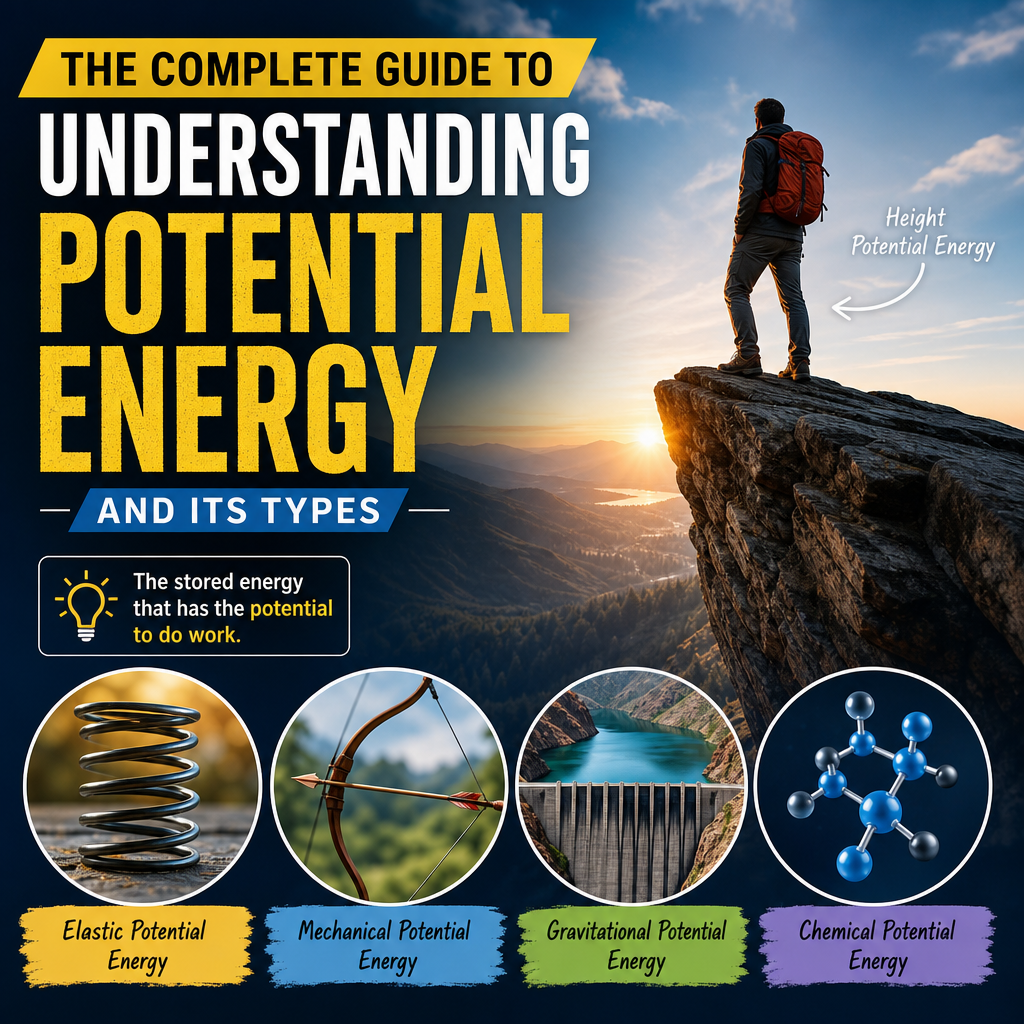
Potential energy is stored energy an object has because of its position or its shape, like water held behind a dam, a book on a high shelf or a stretched spring. Near Earth’s surface, gravitational potential energy is PE = mgh: mass times gravity times height. It is measured in joules and turns into motion when released.
Your home is full of it. The water tower that gives your faucet its pressure, the batteries in the TV remote, the gas in the stove line, the coiled spring on the garage door, even the groceries you just carried upstairs: all of them hold energy waiting to be used. Learning how potential energy works helps you understand how the grid stores power for the evening, why roof work is risky, and where the energy in your home actually sits.
Potential energy at a glance
- What it is: stored energy of position (height) or arrangement (shape, chemical bonds, the nucleus of an atom).
- The main formulas: gravitational PE = mgh; elastic (spring) PE = ½kx².
- Where it comes from: work done against a force, such as lifting something against gravity or stretching a spring.
- Renewable? It is a form of energy, not a fuel. Water stored behind dams is renewable; the chemical energy in coal, oil and gas is not.
- Grid storage: in 2025 the U.S. had about 23,156 megawatts of pumped-storage hydro, which stores energy as water lifted uphill, in 18 states (U.S. EIA).
- Main upside: it can be stored for a long time and released when needed.
- Main downside: storing a lot of it by height takes enormous masses or heights; every conversion loses some energy along the way.
What is potential energy, in plain words?
Think of potential energy as energy in the bank. When you lift a bag of groceries onto the counter, your muscles do work against gravity. That work does not vanish: it is stored in the bag’s new height. Knock the bag off the counter and gravity pays the energy back as motion on the way down.
The same idea works for shape. Stretch a rubber band and you store energy in it; let go and it snaps back. Wind a clock spring, compress a car’s suspension or bend a bow and you have stored energy the same way.
A step deeper: potential energy always belongs to a system, not to a single object. A book on a shelf has gravitational potential energy because of its relation to Earth. And only changes in potential energy matter physically. The OpenStax physics textbook points out that the zero point is chosen for convenience, such as the floor, the ground or a spring’s relaxed length, and you just stay consistent. That is why “how high is it?” always needs the follow-up “above what?”
The potential energy formulas
Gravitational potential energy: PE = mgh
- m = mass in kilograms (kg)
- g = acceleration due to gravity. The standard value is 9.80665 m/s² (NIST); 9.8 or 9.81 is fine for homework and home math.
- h = height above your chosen zero point, in meters (m)
This version works near Earth’s surface, where gravity is nearly constant. For satellites and planets, physicists use a more general formula, but for anything in your house, yard or neighborhood, mgh is all you need.
Elastic potential energy: PE = ½kx²
- k = the spring constant in newtons per meter (N/m): how stiff the spring is
- x = how far the spring is stretched or squeezed from its relaxed length, in meters
This follows from Hooke’s law (the force of a spring grows in step with how far you stretch it), which holds as long as you do not overstretch the spring. Because x is squared, stretching a spring twice as far stores four times the energy.
Units
Potential energy is measured in joules (J), the same as every other form of energy. One joule is about the energy needed to lift a small apple (roughly 100 grams) by one meter. NIST conversions you’ll meet at home: 1 kilowatt-hour (kWh) = 3,600,000 J; 1 food Calorie = 4,184 J; 1 Btu ≈ 1,055 J; 1 foot-pound ≈ 1.356 J.
Worked examples
1. Carrying groceries upstairs. A 10 kg load of groceries carried up one floor (3 m): PE = 10 × 9.81 × 3 ≈ 294 J. Your body actually burns several times more than that, because muscles are far from 100% efficient.
2. Why roofs are dangerous. A 70 kg person on a 6 m roof edge has 70 × 9.81 × 6 ≈ 4,100 J of potential energy relative to the ground. In a fall, that becomes kinetic energy: v = √(2gh) = √(2 × 9.81 × 6) ≈ 10.8 m/s, about 24 mph at impact. Use a proper ladder setup, or hire out the job.
3. A cubic meter of water up a hill. One cubic meter of water weighs about 1,000 kg. Lift it 100 m: PE = 1,000 × 9.81 × 100 ≈ 981,000 J, or about 0.27 kWh. The EIA reports the average U.S. home bought 10,791 kWh of electricity in 2022, about 899 kWh a month, or roughly 30 kWh a day. To store one day of that as water 100 m up, you’d need about 110 cubic meters, around 110 metric tons, and that is before losses. That’s why pumped storage uses whole reservoirs.
4. A spring. A spring with k = 500 N/m squeezed by 10 cm (0.1 m) stores ½ × 500 × 0.1² = 2.5 J. Squeeze it 20 cm and it stores 10 J.
5. Water pressure from height. Each foot of water height adds about 0.433 psi of pressure at the bottom, and 1 psi equals about 2.31 feet of water (University of Florida IFAS). So a water tank whose surface sits 100 feet above your faucet gives about 43 psi with no pump running. That is gravitational potential energy delivering your shower.
Types of potential energy
The U.S. Energy Information Administration lists four kinds of stored (potential) energy:
| Type | Where the energy sits | Home examples |
|---|---|---|
| Gravitational | An object’s height | Water in a tower, a raised garage door, a pendulum clock’s weights |
| Elastic (the EIA calls it “mechanical”) | Tension in a stretched or squeezed object | Springs, rubber bands, a trampoline, a bow |
| Chemical | The bonds between atoms and molecules | Batteries, natural gas, propane, gasoline, firewood, food |
| Nuclear | The forces holding an atom’s nucleus together | The uranium fuel in power plants that supply part of your electricity |
Physicists add electric potential energy too: the energy of charges held apart, which is what voltage measures. That is the bridge between potential energy and the electrical energy in your outlets.
A short history
- Ancient times: people used falling water to turn paddle wheels for grinding grain thousands of years ago (EIA), an early use of stored gravitational energy.
- 1656: Christiaan Huygens patented the first pendulum clock. Pendulum clocks run on weights slowly falling or springs slowly unwinding.
- 1678: Robert Hooke announced his general law of springs in his lecture Of Spring, after first finding an instance of it around 1660 while designing balance springs for clocks.
- Late 1600s: Gottfried Wilhelm Leibniz, criticizing Descartes’ mechanics, worked with what are effectively kinetic energy, potential energy and momentum.
- 1850: James Prescott Joule published his measurement of how falling weights, spinning a paddle wheel in water, produce heat, linking stored mechanical energy to heat.
- 1853: Scottish engineer William Rankine coined the term “potential energy,” contrasting it with “actual energy.” William Thomson (Lord Kelvin) developed the idea further alongside “kinetic energy.”
- 1882: the first U.S. hydroelectric plant opened on the Fox River near Appleton, Wisconsin, on September 30 (EIA).
Energy conversions: potential energy in action
Potential energy is only useful when it turns into something else, and it does that constantly:
- Gravitational to kinetic: water dropping through a dam’s turbine, a child sliding down a slide, a roller coaster’s first big drop. See kinetic energy.
- Elastic to kinetic: a trampoline launching you upward, a wind-up toy rolling across the floor.
- Chemical to thermal: the EIA’s own example is burning wood in a fireplace or gasoline in an engine.
- Chemical to electrical: a battery releasing its stored energy as current.
- Back and forth: a swinging pendulum trades potential and kinetic energy on every swing; their sum is its mechanical energy.
Where potential energy works for the U.S. grid
Hydropower. Rain and snow fill reservoirs high above a river; the water’s height is stored potential energy. Released through penstocks, it spins turbines and generators. The EIA reports hydropower supplied about 5.6% of U.S. utility-scale electricity in 2025, and 23.1% of the country’s renewable electricity. Read more on our hydroelectric power page.
Pumped-storage hydropower. This is the grid’s giant water battery. When power is cheap or plentiful, plants pump water to an upper reservoir; when demand peaks, the water flows back down through turbines. The DOE says the U.S. has 43 pumped-storage plants. The EIA counts about 23,156 MW of pumped-storage capacity in 2025, spread over 18 states, led by California (17%), Virginia (14%) and South Carolina (13%). The honest catch: the EIA notes these plants use more electricity to pump water uphill than they get back, so they run at a net energy loss each year. Their value is shifting energy to the hours when it’s needed most. More in our energy storage section.
Water towers. Cities pump water into elevated tanks, often at night, and let gravity provide pressure to homes all day.
Potential energy at home: what it means for you
- Your energy is mostly stored chemical energy. Natural gas, propane, heating oil, gasoline and batteries are all potential energy. Knowing that helps you think about backup: a battery or portable power station stores energy chemically for outages. Browse our energy storage guides.
- Rain barrels and gravity. A rain barrel raised on blocks gives a little gravity-fed pressure for a garden hose. Each foot of height adds only about 0.43 psi, so expect a gentle flow, not city pressure.
- Home “gravity batteries” are not practical. As the worked example showed, storing a day of household electricity by height takes over 100 tons of water lifted 100 m. For home storage, chemical batteries win easily.
- Respect stored spring energy. A garage door’s springs are wound under high tension to balance the door’s weight. That stored elastic energy is why spring and cable repairs are a job for a trained garage door technician, not a weekend project.
- Height and safety. Ladders, roofs and heavy items on high shelves all carry potential energy that becomes motion fast. Store heavy things low.
Try it at home
Ball-drop bounce test. Drop a tennis ball from 1 meter and mark how high it bounces. The bounce height divided by the drop height tells you roughly what share of the ball’s potential energy came back; the rest went into heat and sound. Try a basketball and a golf ball too.
Rubber-band launcher. Stretch a rubber band 5 cm, then 10 cm, and launch a paper wad along the floor each time. With twice the stretch you store about four times the energy (½kx²), and it should travel noticeably farther.
Marble roller coaster. Tape a foam pipe-insulation tube (cut in half lengthwise) to a stair rail as a track. Release a marble from different heights and see the lowest starting point that still carries it over a hill. The marble can never climb higher than where it started, because it can’t gain more energy than it began with.
Strengths and limits of potential energy for storing power
| Strengths | Limits |
|---|---|
| Can be stored for long periods (reservoirs, fuels, batteries) | Gravitational storage needs huge masses or heights |
| Releases on demand, which helps balance the grid | Every conversion loses energy; pumped storage is a net user |
| Pumped storage is mature, proven technology | Needs suitable geography: two reservoirs at different heights |
| Chemical potential energy is very dense (fuels, food) | Fossil fuels release carbon dioxide when burned |
| Simple to calculate with mgh and ½kx² | Stored energy (springs, heights) can cause injuries when released suddenly |
Potential energy compared with related forms
| Form | Stored or moving? | Formula | Home example |
|---|---|---|---|
| Potential | Stored | mgh, ½kx² | Water in a raised rain barrel |
| Kinetic | Moving | ½mv² | Water spraying from the hose |
| Chemical | Stored (in bonds) | Depends on the fuel | Propane in a grill tank |
| Mechanical | Both | KE + PE | A swinging pendulum clock |
Products that show potential energy at work
Prices change often. The prices below are what we saw on Amazon in October 2026; check the current price before you buy.
Potential energy clicks fastest when you can see it turn into motion. These picks make that visible, on a kitchen table and in the yard.
Thames & Kosmos Roller Coaster Engineering
- Build working coaster models
- Vary car weight and track slope
- Ages 6+, 32-page manual
RTS Home Accents 50-Gallon Rain Barrel
- 50 gallons
- Brass spigot, overflow valve
- Flat back, made in the USA
Thames & Kosmos Simple Machines
- 26 model-building exercises
- All six classic simple machines
- Spring scale to measure forces
The Thames & Kosmos Roller Coaster Engineering kit is built around this exact topic: kids build working coaster models, change the weight of the cars and the slope of the track, and see gravitational potential energy turn into kinetic energy (and what friction takes away). The maker lists potential energy, kinetic energy, free fall and friction among the ideas it teaches, with a 32-page full-color manual. It is rated for ages 6 and up. It was about $46 on Amazon in October 2026.
Check the Roller Coaster Engineering kit price on Amazon
The RTS Home Accents 50-gallon rain barrel (about $99) puts gravity to work in the garden: set it on a stand and the water’s height pushes it out of the brass spigot. Remember the 0.43 psi per foot rule, so the higher the stand, the better the flow. The Thames & Kosmos Simple Machines set (about $28) covers inclined planes, levers and pulleys, the tools people have always used to lift loads and store potential energy with less effort, and it includes a spring scale to measure the forces.
Keep exploring: see where potential energy fits among all the types of energy, follow stored energy into motion on our kinetic energy page, learn how dams use height on the hydroelectric power page, and see how homes store power in our energy storage section.
Potential energy FAQs
What is potential energy in simple words?
Potential energy is stored energy: energy an object holds because of where it is or how it is shaped. A rock at the top of a hill, a stretched rubber band and a charged battery all hold it. Nothing happens until it is released, and then it turns into motion, heat, light or electricity.
What is the formula for potential energy?
For gravity near Earth’s surface, PE = mgh: mass in kilograms times 9.81 m/s² times height in meters, giving joules. For a spring, PE = ½kx², where k is the spring’s stiffness in newtons per meter and x is how far it is stretched or compressed. A 2 kg box on a 1.5 m shelf holds about 29 J.
What are 5 examples of potential energy?
Water held behind a dam, a book on a high shelf, a drawn bow or stretched rubber band, a charged phone battery (chemical potential energy), and the uranium fuel in a nuclear plant. At home you’ll also find it in natural gas or propane lines, firewood, food and the wound springs on a garage door.
What is the difference between potential and kinetic energy?
Potential energy is stored; kinetic energy is energy of motion. They swap constantly. A ball held up high has potential energy; as it falls, that becomes kinetic energy, and just before it lands almost all of it is kinetic. Their total is called mechanical energy, which stays nearly constant when friction is small.
Can potential energy be negative?
Yes. Only differences in potential energy have physical meaning, so the zero point is a choice. If you set the zero at a tabletop, a ball on the floor has negative gravitational potential energy. Physicists also often set zero infinitely far away for planets, which makes gravitational potential energy negative everywhere else.
How is potential energy used to store electricity?
Mostly through pumped-storage hydropower: water is pumped uphill when electricity is plentiful and run back through turbines when demand peaks. The U.S. had about 23,156 MW of it in 2025, per the EIA. At home, the practical way to store electricity is a battery, which holds it as chemical potential energy.