This article contains affiliate links: if you buy through them we may earn a commission, at no extra cost to you. Learn more.
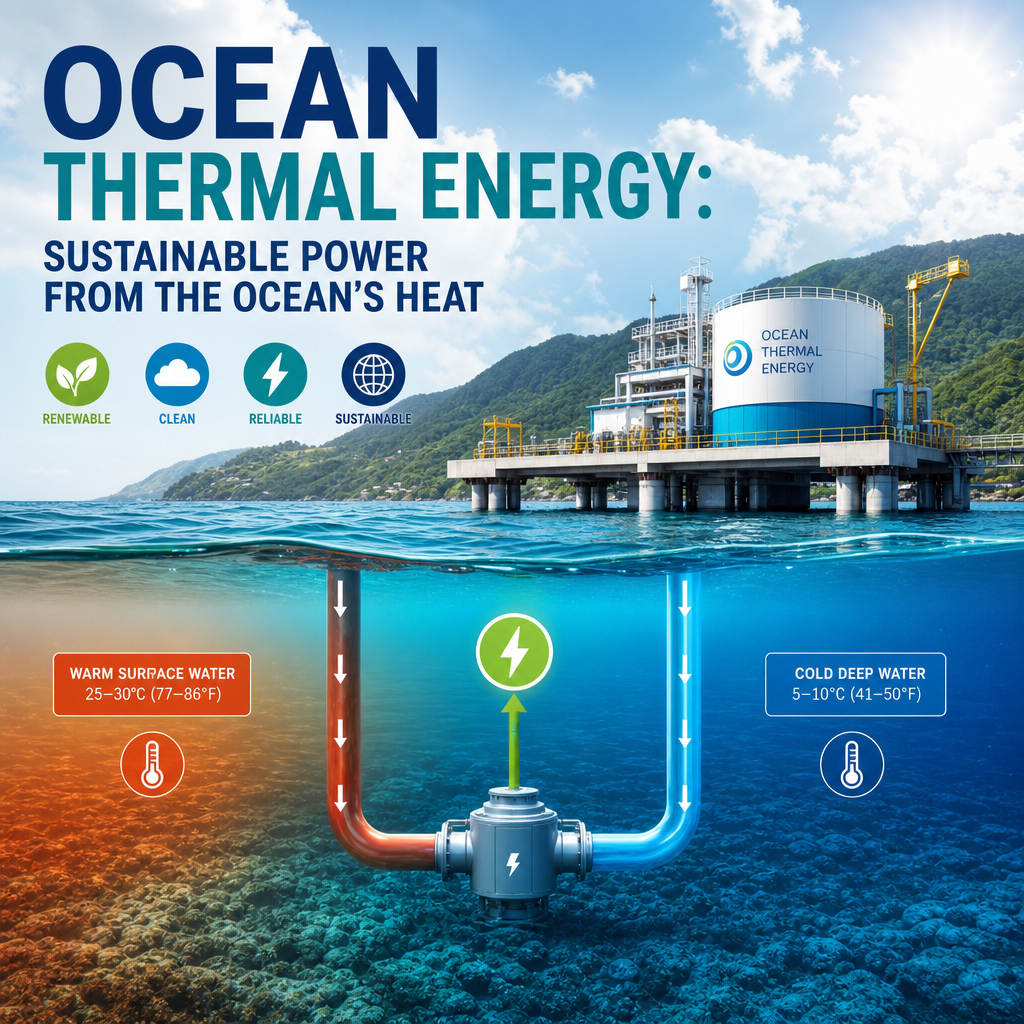
Ocean thermal energy is electricity made from the difference in temperature between warm tropical surface water and cold water about 1,000 meters (3,300 feet) down. The technology is called ocean thermal energy conversion, or OTEC. It needs a gap of at least 20°C (36°F), works day and night, and so far runs only at small demonstration plants.
Think of the last time you waded into the sea on a hot day: the top layer felt like bath water, and a few feet down your toes found something colder. The tropical ocean is a giant solar collector that soaks up sunshine every day and stores it as heat near the surface, while the deep water stays near freezing. OTEC tries to run a power plant on that gap. You can’t put one in your backyard, but the idea behind it shows up in everyday things, from heat pumps to the air conditioning in some island hotels.
Ocean thermal energy at a glance
- What it is: a heat engine that uses warm surface seawater as its heat source and cold deep seawater as its cooling source.
- Where it comes from: sunlight stored as heat in the top layer of the tropical ocean, while water about 1,000 meters down stays near 4°C to 5°C.
- Renewable? Yes. The sun reheats the surface water every day.
- Share of U.S. electricity: essentially zero. The best-known U.S. plant, a 105-kilowatt system in Hawaii, began feeding the local grid in 2015 (U.S. EIA).
- Where it works: mainly between about 20° north and 20° south latitude, where the year-round temperature gap is greater than 20°C (NOAA).
- Main upside: steady, around-the-clock power. IRENA puts the capacity factor of OTEC plants at around 90%–95%, among the highest of any power source.
- Main downside: very low efficiency and very high up-front cost. The giant cold-water pipe is still an engineering challenge.
How ocean thermal energy conversion works
In simple words: warm water boils a liquid, the vapor spins a turbine, and cold water turns the vapor back into liquid so the loop can start again. Every steam power plant works on the same idea. The difference is that a coal or nuclear plant has a fire or a reactor hundreds of degrees hot, while OTEC has only about 20°C to work with.
Here is the closed-cycle version step by step, the design NOAA calls the most likely first commercial OTEC plant:
- Pump up warm water. Surface seawater at about 25°C (77°F) flows into a heat exchanger called the evaporator.
- Boil the working fluid. On the other side of the evaporator is a closed loop of a fluid with a low boiling point, most likely ammonia. The warm water turns it into vapor.
- Spin the turbine. The expanding vapor drives a turbine connected to a generator, which makes electricity.
- Bring up cold water. A huge pipe draws seawater at about 5°C (41°F) from roughly 1,000 meters deep.
- Condense and repeat. The cold water cools the vapor in a second heat exchanger, the condenser. The fluid turns back into liquid and is pumped to the evaporator again. Both streams of seawater go back into the ocean.
A bit deeper: the physics of heat engines sets a hard ceiling on how much of the heat can become work, and that ceiling depends on the temperature gap. With only about 20°C between hot and cold, IRENA puts the maximum theoretical (Carnot) efficiency at about 7%. Real plants do worse, and the pumps that move all that water eat roughly 20%–30% of the power produced. That is why OTEC plants have to move enormous amounts of water. NOAA estimates that a 100-megawatt plant would need 10–20 billion gallons of seawater a day, and its cold-water pipe could be about 10 meters (33 feet) wide.
The low efficiency doesn’t make OTEC pointless, because the “fuel” is free and never runs out. It does make the plants big and expensive for the power they deliver.
A short history of OTEC
- 1870: Jules Verne mentions using ocean temperature differences to make electricity in Twenty Thousand Leagues Under the Sea.
- 1881: French physicist Jacques-Arsène d’Arsonval proposes using the warm surface water of tropical seas to boil pressurized ammonia and drive a turbine.
- 1930: Another French inventor, Georges Claude, builds the first OTEC plant, a small open-cycle unit on the coast of Cuba. It runs for several weeks but never produces more power than it uses. A floating plant he tried next was abandoned in 1935 because he couldn’t install the long cold-water pipe.
- 1974: U.S. OTEC research gets a home when the Natural Energy Laboratory of Hawaii Authority (NELHA) is set up on the Kona coast.
- 1979: “Mini-OTEC,” a closed-cycle plant on a U.S. Navy barge off Hawaii, produces 50 kilowatts gross and about 18 kilowatts net, proving d’Arsonval’s idea at sea. A 100-kilowatt land-based plant built by Japanese companies on the island nation of Nauru follows in the early 1980s.
- 1990s: A 250-kilowatt demonstration plant runs in Hawaii for six years (EIA).
- 2013: A 100-kilowatt demonstration plant starts on Kumejima, an island in Okinawa, Japan.
- 2015: A 105-kilowatt plant at NELHA begins supplying electricity to Hawaii’s local grid.
- 2019: A Korean research institute reports about 338 kilowatts from a test barge.
Nearly 150 years after d’Arsonval, the technology works on paper and in demonstrations. IRENA’s 2014 review noted that only plants up to about 1 megawatt had been built, and that plants beyond 10 megawatts had never been tried.
Types of OTEC plants
Engineers sort OTEC designs two ways: by the thermodynamic cycle they use, and by where the plant sits.
- Closed cycle: the warm water boils a separate working fluid, such as ammonia, that stays sealed in a loop. This is the design used by Mini-OTEC, Kumejima and most current projects.
- Open cycle: the seawater itself is the working fluid. Warm water is “flash evaporated” in a low-pressure chamber, the steam spins a turbine, and when the cold water condenses it, the result is fresh, desalinated water. The 1930 Cuban plant was open cycle.
- Hybrid cycle: combines both: a closed loop makes the electricity while an open-cycle stage produces fresh water.
- Onshore vs. floating: land-based plants pipe water up a steep underwater slope to the shore, which makes maintenance easier. Floating or moored plants sit over deep water and send power to land through a cable on the seabed. IRENA notes that a large floating plant could be cheaper per kilowatt, and that larger offshore plants are likely to sit farther from the coast.
Where ocean thermal energy is used today
Today OTEC is a handful of small plants, mostly on islands. The two that people visit most are in Hawaii and Japan.
- Hawaii, United States: EIA calls the Natural Energy Laboratory of Hawaii one of the world’s leading OTEC test sites. Its 105-kilowatt plant began supplying the local grid in 2015. Run nonstop for a year, 105 kilowatts would cover roughly 85 average U.S. homes (our estimate, using EIA’s 2022 average of 10,791 kWh per home).
- Kumejima, Japan: a 100-kilowatt demonstration plant has run since 2013. The real story is what happens to the cold deep water afterward: it feeds prawn, sea grape and oyster farms, drinking-water production, cosmetics and coral nurseries. JICA reports that businesses using the island’s deep seawater turn over about 2.5 billion yen a year and support about 140 jobs.
- Other places: EIA notes that larger plants are planned in several countries, mostly to supply electricity and fresh water to island communities. France, Japan, the Philippines and South Korea have published OTEC roadmaps (IRENA, 2014).
The potential is far larger than what exists. IRENA counts as many as 98 nations and territories with usable OTEC resources in their waters, and many Caribbean and Pacific islands have them within 10 kilometers of shore. In U.S. waters, the best sites are around Hawaii, Puerto Rico and the U.S. Virgin Islands, Guam and the Northern Mariana Islands, and American Samoa. A 2025 study by researchers at the U.S. Department of Energy’s Pacific Northwest National Laboratory estimated about 138 megawatts of OTEC potential south of Puerto Rico’s main island, about the electricity used by 219,000 households.
Ocean thermal energy and your home
Let’s be honest: there is no OTEC kit for a house. The plant needs a pipe reaching about 1,000 meters down and huge pumps, so it only makes sense as a utility project. Even if you live on a tropical coast, you will meet ocean thermal energy as a line on your power bill, not as something you install.
Still, the idea behind OTEC (using a steady temperature difference instead of burning fuel) is something homeowners can put to work today:
- Ground-source heat pumps use the steady temperature a few feet underground the way OTEC uses the deep ocean: as a reservoir that stays cool in summer and mild in winter. Read more in our geothermal energy guide.
- Cold seawater for cooling: deep-water air conditioning is one of the by-products IRENA and NOAA list for OTEC. On islands, it can cool buildings with far less electricity than a normal chiller. For most of us on land, a well-sized heat pump is the practical version.
- If you live on an island: islands are where OTEC makes sense because power there often comes from imported oil and costs a lot. IRENA’s review describes island electricity prices of about 30 cents per kilowatt-hour as the point where OTEC can make economic sense. The same high prices make rooftop solar with a home battery worth a close look, and cutting waste with our energy-saving tips pays off faster.
- Teach it at the kitchen table: a low-temperature Stirling engine runs on the warmth of a cup of coffee. It isn’t the same cycle as OTEC, but it is a heat engine running on a small temperature gap, which is the whole point of ocean thermal energy.
A note on money: the federal tax credits for home solar, batteries and geothermal heat pumps ended for systems completed after December 31, 2025. In 2026, look for state, utility and local rebates instead; the DSIRE database (dsireusa.org) lists them by state, and our tax credits and grants section keeps track of the changes.
Products that bring ocean thermal energy home
You can’t buy an OTEC plant, but you can see the physics work on your desk. These two are genuinely good ways to explain heat engines and renewable power to curious kids (and adults).
Prices change often. The prices below are what we saw at a major retailer in October 2026; check the current price before you buy.
Sunnytech Low Temperature Stirling Engine (LT001)
- Runs on a cup of hot coffee
- Starts at about a 20°C (68°F) difference
- Glass cylinder, steel base
Thames & Kosmos Renewable Energy Lab
- 24 experiments
- Solar panel and wind turbine parts
- 32-page illustrated manual
The Sunnytech LT001 (about $40, seen October 2026) is the closest thing to OTEC you can hold. You set it on a mug of hot water and give the flywheel a push; the maker lists a starting temperature difference of about 20°C, the same gap an OTEC plant needs between surface and deep water. Put an ice cube on top and it runs faster, because the gap gets bigger. That one demonstration explains why OTEC only works in the tropics.
Check the Sunnytech Stirling engine price on Amazon
The Thames & Kosmos Renewable Energy Lab (about $174, seen October 2026) is a bigger classroom-style set with 24 experiments, a solar panel and wind turbine parts. It doesn’t model ocean heat, but it is a solid way to compare how different renewable sources turn into electricity.
Pros and cons of ocean thermal energy
| Pros | Cons |
|---|---|
| Runs 24 hours a day, every season; capacity factor around 90%–95% (IRENA) | Very low efficiency: maximum theoretical about 7%, with 20%–30% of output used by pumps |
| Free, renewable “fuel”: sunlight stored in the sea | Very high up-front cost, especially for small plants |
| No fuel to import, a big deal for islands that burn oil for power | Only works where the gap is at least 20°C, mainly in the tropics |
| Useful by-products: fresh water, seawater air conditioning, aquaculture | The huge cold-water pipe is hard to build, install and keep in place |
| Can balance variable sources like solar and wind on an island grid | Few working plants and little experience at commercial scale |
| Little visual footprint offshore compared with a large fuel-burning plant | Possible effects on marine life from moving huge volumes of water |
Environmental and safety impact
OTEC burns nothing, so it has no smokestack. Its environmental questions are about water. A large plant moves enormous volumes of seawater, and the cold water it brings up is rich in nutrients. IRENA’s review lists the main concerns: unknown effects on marine life at depth and on the seabed, fish and small organisms caught at the intakes, and discharged water that is colder than the surface and could trigger algae growth if released too shallow.
There are ways to reduce these effects. Intakes can be screened. A U.S. Department of Energy modeling study described by IRENA found that releasing the water at 70 meters or deeper had no effect on the top 40 meters of the ocean, and that effects on tiny plankton deeper down stayed within natural variation. Siting plants farther offshore also helps. Because only small plants exist, though, nobody has measured what a 100-megawatt plant would do over decades.
The working fluid in most closed-cycle designs is ammonia, a common industrial chemical that has to be handled with care. Plants also have to survive storms, corrosion and marine growth on pipes and heat exchangers, which IRENA lists among the main technical challenges. The cold-water pipe has been the weak point since the beginning: Georges Claude gave up his floating plant in 1935 after failing to install one.
How much does ocean thermal energy cost?
There is no market price for OTEC electricity yet, only estimates from feasibility studies. The most-cited figures come from IRENA’s 2014 technology brief, in 2010 dollars:
- Small plants (under 10 MW): about $16,400 to $35,400 per kilowatt to install. These plants would usually need to sell fresh water or cooling too in order to pay off.
- Larger plants: estimated at $5,000 to $15,000 per kilowatt.
- Large floating plants: possibly as low as about $2,500 per kilowatt, giving electricity around 7 to 19 cents per kilowatt-hour, but only with cheap financing and many plants built.
Treat these as ranges, not quotes; they are more than ten years old and depend heavily on interest rates. A feature in Eos, the American Geophysical Union news magazine, reported that a planned expansion at Kumejima to 5 megawatts was expected to cost $60 million to $80 million for the cold-water intake pipe alone. The pattern is clear: OTEC gets cheaper per kilowatt as plants get bigger, but someone has to pay for the first big ones.
The future of ocean thermal energy
What is real and announced, not hype:
- Kumejima, Japan: Mitsui O.S.K. Lines became the operating partner in 2022 and planned to grow the plant from 100 kilowatts to 1 megawatt by 2026 (JICA, 2023). The island aims to run fully on renewable energy by 2040.
- São Tomé and Príncipe: the company Global OTEC is planning a 1.5-megawatt floating plant for this island nation off West Africa (Eos).
- U.S. islands: a Pacific Northwest National Laboratory study of small 3–10 megawatt OTEC plants in Hawaii, Puerto Rico, St. Croix and Guam found no strong barriers to development and pointed to pathways for further work.
The key step, as IRENA put it, is getting the first megawatt-scale plants built and running well. Until that happens, OTEC will stay a promising island technology rather than a mainstream power source. For the mainland United States, the ocean’s other energies, tidal and wave power, have better-placed resources.
How ocean thermal energy compares
| Ocean thermal (OTEC) | Tidal energy | Wave energy | Solar PV | |
|---|---|---|---|---|
| Energy source | Heat stored in tropical seawater | Rise and fall of tides | Wind-driven waves | Sunlight |
| Runs at night? | Yes, around the clock | Yes, on a predictable tide schedule | Yes, when waves are running | No, needs storage |
| Where it fits | Tropical islands and coasts | Places with a tidal range of at least 10 feet | Exposed coasts, such as the U.S. and European west coasts | Almost anywhere |
| Largest examples | About 100 kW (Kumejima, Hawaii) | 254 MW Sihwa Lake, South Korea; 240 MW La Rance, France | Devices still in development | About 7% of U.S. utility-scale electricity in 2025 |
| Can a homeowner use it? | No | No | No | Yes, rooftop or portable panels |
Sources: EIA (tidal, wave, U.S. electricity 2025), NOAA and IRENA (OTEC).
Ocean thermal energy FAQs
What is ocean thermal energy in simple words?
It is power made from the difference between warm water at the surface of tropical seas and cold water deep below. Warm water boils a liquid such as ammonia, the vapor spins a turbine to make electricity, and cold water pumped up from about 1,000 meters turns the vapor back into liquid. The sun keeps reheating the surface, so the supply doesn’t run out.
Is ocean thermal energy renewable?
Yes. OTEC uses solar energy that the ocean absorbs and stores as heat every day, while the deep water stays cold. NOAA describes it as a renewable technology that can produce baseload electricity. Studies cited by IRENA suggest the resource is very large and that tapping it would not noticeably change the ocean’s temperature profile.
Why isn’t OTEC used more?
Because it is expensive and hard to build at scale. With only about a 20°C temperature gap, plants are inefficient and must pump huge amounts of water through a cold-water pipe that may be several meters wide and about 1,000 meters long. Only small demonstration plants exist, so lenders lack the track record they want before funding big projects.
Where is ocean thermal energy used in the United States?
Hawaii is the U.S. center for OTEC. The Natural Energy Laboratory of Hawaii Authority on the Kona coast has hosted research since 1974, a 250-kilowatt plant ran there for six years in the 1990s, and a 105-kilowatt plant began supplying the local grid in 2015. Puerto Rico, the U.S. Virgin Islands, Guam and American Samoa also have good resources.
How efficient is OTEC?
Not very. With a 20°C temperature difference, the theoretical maximum is about 7%, and real plants convert only a few percent of the heat into electricity. Pumps use roughly 20%–30% of the gross power. The upside is that the heat is free and available day and night, so low efficiency matters less than it would for a plant that burns fuel.
Can OTEC make drinking water?
Yes. In an open-cycle or hybrid plant, warm seawater is evaporated at low pressure and the steam is condensed by the cold water, which leaves fresh, desalinated water. The cold deep water can also cool buildings and supply fish and shellfish farms, as it does on Kumejima in Japan. These by-products often decide whether a small OTEC plant pays off.
What is the difference between ocean thermal energy and tidal energy?
Ocean thermal energy uses heat: the temperature gap between surface and deep water in the tropics. Tidal energy uses motion: the rise and fall of tides caused by the moon and sun, which needs a tidal range of at least 10 feet. Tidal plants are already much bigger, up to about 254 megawatts, while OTEC plants are around 100 kilowatts.
Keep exploring
OTEC is one of several ways to pull energy from the sea. Compare it with tidal energy and wave energy, see how it fits with renewable energy as a whole, or brush up on the physics in our guide to thermal energy. For the full map of sources and forms, start at types of energy, and for the basics behind it all, browse Energy 101.