In short: Ohio customers averaged about 8.5 hours without power in 2024, almost four times the 2.2 hours on normal days, because of major storms (EIA). Home prices rose about 12% in a year, to 19.45¢/kWh in July 2026. Storm backup comes first in Ohio; solar savings depend on how your utility credits exports.
Ohio sits in the path of tornadoes, high wind and ice, and its 2024 outage numbers show it. This guide uses Ohio’s own data on prices, outages, sun and utilities, with sources and dates, to help you decide what is worth doing first.
Ohio at a glance
- Home electricity price: 19.45¢/kWh in July 2026, up from 17.38¢ in July 2025, vs 18.31¢ U.S. average; 18.70¢ for January to July 2026 (EIA, preliminary).
- Outages: about 510 minutes per customer in 2024 including major events, 133 minutes without them; 1.3 interruptions per customer (EIA-861, 2024).
- Sun: 3.92 kWh/m² a day in Columbus; roughly 1,150 kWh a year per kW of panels (our estimate from NASA POWER data).
- Net metering: required, but monthly excess is credited at only the energy part of the utility’s standard rate, not full retail (PUCO).
- Plug-in (balcony) solar: no state law.
- Electric cars: 94,200 battery-electric cars (2025) and 5,357 public charging ports, 1,517 of them DC fast (AFDC, October 2026).
- Main utilities: AEP Ohio (Ohio Power, 28% of customers), Ohio Edison (19%), Duke Energy Ohio (14%), Cleveland Electric Illuminating (14%) (EIA-861, 2024).
- Top weather hazards: tornadoes, strong wind, winter weather, ice storms and cold waves, all rated relatively high (FEMA National Risk Index, December 2025).
- Wildfire power shutoffs: no utility program found.
Backup power in Ohio
The gap between Ohio’s two outage numbers is the clearest signal on this page. On ordinary days in 2024, the average customer lost about 2 hours 13 minutes of power over the whole year. Count the major event days and it was about 8 hours 30 minutes. Most of Ohio’s outage time comes from a few big storms, and FEMA rates five weather hazards relatively high here: tornadoes, strong wind, winter weather, ice storms and cold waves. That points to planning for the long outage, not just the blink.
What fits which home:
- Basements and sump pumps: homes with a sump pump need it running when a storm knocks out power. A portable generator on a transfer switch, or a battery sized for the pump’s starting surge, protects the basement. Size it with the generator sizing calculator.
- Whole-house, hands-off backup: a standby generator on natural gas starts by itself and runs for days. See home generators.
- Quiet backup for essentials: a home battery covers fridge, furnace blower, lights and internet through an evening outage, longer with solar. Estimate size with the battery backup calculator.
- Renters and small loads: a portable power station for phones, CPAP and router.
Generator safety is not optional: outdoors only, at least 20 feet from the house, exhaust pointed away from windows, doors and vents, and never in a garage, even with the door open (CPSC). Put battery or battery-backup carbon monoxide alarms on every level. Use a transfer switch or interlock installed by a licensed electrician with a permit; never backfeed through an outlet.
Solar in Ohio
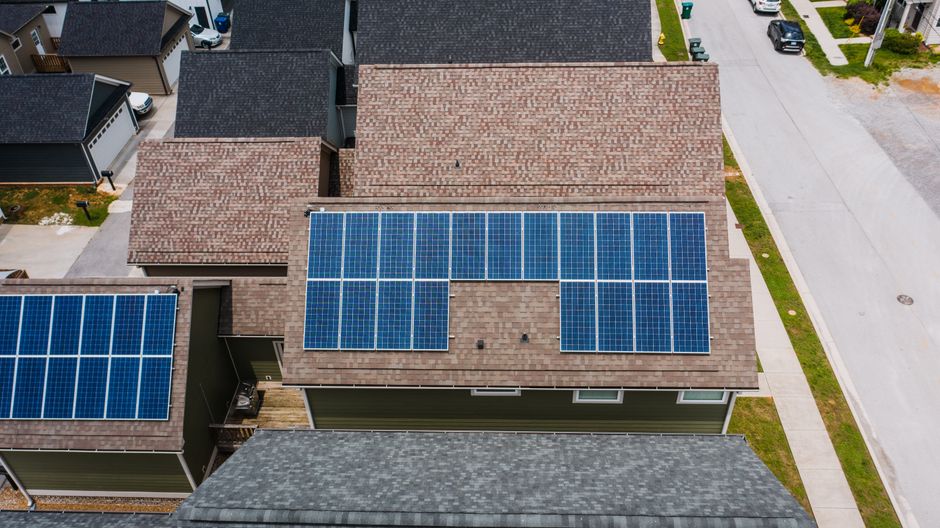
By our rough estimate, panels in Columbus make about 1,150 kWh a year per kilowatt, so a 6 kW system would produce around 6,900 kWh. If every one of those kilowatt-hours replaced power you would have bought, it would be worth up to about $1,340 a year at the July 2026 rate of 19.45¢, or $1,290 at the year-to-date 18.70¢. Rising prices help: the same output was worth about 12% less a year earlier.
The catch is how exports are credited. Under the Public Utilities Commission of Ohio’s net metering rule (Ohio Adm. Code 4901:1-10-28), utilities must offer net metering, but when your panels make more than you use in a month, the excess becomes a money credit at only the energy component of the utility’s standard service offer, not the full retail rate, and it carries forward. In practice, the more of your solar you use at home as it is made, the better the return; oversized systems pay back more slowly. These figures are estimates, not promises. Model a system with the solar potential calculator, compare prices in the solar cost guide, and read net metering explained.
Incentives: we found no state solar or battery incentive for homes that we could confirm in October 2026. The federal 25D credit ended for systems completed after December 31, 2025, so 2026 projects in Ohio should be judged on bill savings alone. Ask your utility about any local programs, and see energy incentives and the solar guide. Ohio has no plug-in (balcony) solar law; utility interconnection rules apply.
EIA counted about 27,500 net-metered home solar systems in Ohio in 2024, about 205 MW.
Home batteries in Ohio
Ohio solar owners already add batteries more often than in most states: of those 27,500 home systems, about 1,650, roughly 6%, were paired with a battery in 2024 (EIA-861), one of the ten highest shares in the country. The reasons line up with the data. A battery lets you use more of your own solar instead of exporting it at the lower energy-only credit, and it covers the storm outages that make up most of Ohio’s outage time. For a long ice-storm outage, a battery plus solar or a battery plus generator is sturdier than a battery alone. Compare prices in home battery cost and the basics in home batteries. We found no confirmed state battery incentive.
EV charging in Ohio
Ohio had 94,200 battery-electric cars and 37,200 plug-in hybrids at the end of 2025, with 5,357 public charging ports at 1,923 locations, of which 1,517 are DC fast (AFDC). That is about 18 electric cars per public port, so most owners will rely on home charging.
Drive on another fuel? See every alternative fuel station in Ohio: hydrogen, propane, natural gas, E85 ethanol, biodiesel and renewable diesel.
Our estimate at 19.45¢ and about 30 kWh per 100 miles (a fueleconomy.gov-style assumption): about $5.84 per 100 miles, roughly $58 for 1,000 miles a month. A 30-mpg gas car at the U.S. average of $4.465 a gallon (EIA, late September 2026) costs about $14.88 per 100 miles. Use your own rate in the EV charging cost calculator and read home EV charging for chargers and installation. A Level 2 circuit needs a licensed electrician and, in most places, a permit. The federal 30C charger credit ended for chargers placed in service after June 30, 2026.
Off-grid, small wind and micro-hydro
Full off-grid living is uncommon in Ohio, but barns, cabins in the Appalachian southeast and remote outbuildings can run on a stand-alone system; start with off-grid power systems and the off-grid planner. Wind is fair but very site-dependent: NASA data shows about 5.6 m/s at 50 m near the center of the state and only about 3.5 m/s at 10 m. DOE suggests at least 4.5 m/s at hub height for a grid-tied turbine, so only open sites with tall towers are worth measuring. See wind energy and hydroelectric power; we have not checked state micro-hydro sources.
Licensing and permits in Ohio
The Ohio Construction Industry Licensing Board (Department of Commerce) licenses commercial electrical contractors; you can check a license on the Ohio eLicense lookup. Residential electrical licensing is mostly handled by cities and counties, so also ask your local building department which licenses it requires and whether your contractor holds them. Permits come from your city or county building department, and your utility must approve interconnection before solar or a grid-tied battery goes live.
Local guides in Ohio
Utilities, rates, outage records, permit offices and local programs for each area:
Where we cover in Ohio
- Columbus: Columbus, Dublin, Westerville, Hilliard, Grove City
- Cleveland: Cleveland, Parma, Strongsville, Westlake
- Cincinnati: Cincinnati, Mason
- Dayton: Dayton, Beavercreek
- Akron: Akron
- Toledo: Toledo
Local pages will follow as we verify local information and installers.
Get quotes in Ohio
Are you a licensed installer in Ohio? Join SolutionEnergy and get requests from homeowners and businesses →
Tell us about your project and we will connect you with a licensed, independent installer who serves Ohio. It is free, there is no obligation, and only the installer you choose gets your details. See how it works.
Ohio energy FAQ
Does Ohio have net metering?
Yes, utilities must offer it under PUCO rule 4901:1-10-28. Power you use from your panels offsets retail purchases, but any monthly excess is credited at only the energy component of the utility’s standard service offer, not the full retail rate. Credits carry forward. That makes right-sizing the system important.
Why were Ohio outages so long in 2024?
Major events. EIA’s 2024 data shows about 133 outage minutes per customer on normal days but about 510 minutes once major event days are included. FEMA rates Ohio relatively high for tornadoes, strong wind, ice storms and winter weather, all of which bring down lines.
Are there solar incentives in Ohio in 2026?
We found no confirmed state rebate or tax credit for home solar or batteries, and the federal 25D credit ended for systems completed after 2025. Check with your utility and city for local programs, and judge a quote on bill savings at your own rate.
Do I need a licensed electrician for a generator in Ohio?
For anything connected to your home’s wiring, yes in practice: a transfer switch or interlock should be installed by a licensed electrician with a permit from your local building department. Residential licensing is mostly local in Ohio, so ask the city or county which license it requires.
How much does it cost to charge an EV at home in Ohio?
By our estimate, about $5.84 per 100 miles at the July 2026 average of 19.45¢ per kWh, assuming about 30 kWh per 100 miles. That is roughly $58 for 1,000 miles, versus about $149 for a 30-mpg gas car at the U.S. average gas price.
Sources
Electricity prices: EIA Electric Power Monthly, Tables 5.6.A and 5.6.B (July 2026, preliminary). Outages, utilities, solar and battery counts: EIA-861 (2024). Sun and wind: NASA POWER climatology 2001–2020. Hazards: FEMA National Risk Index (December 2025). Electric cars and charging: AFDC (registrations 2025; stations read October 3, 2026). Net metering: Public Utilities Commission of Ohio, Ohio Adm. Code 4901:1-10-28. Licensing: Ohio Construction Industry Licensing Board. Generator safety: CPSC. Checked October 2026.