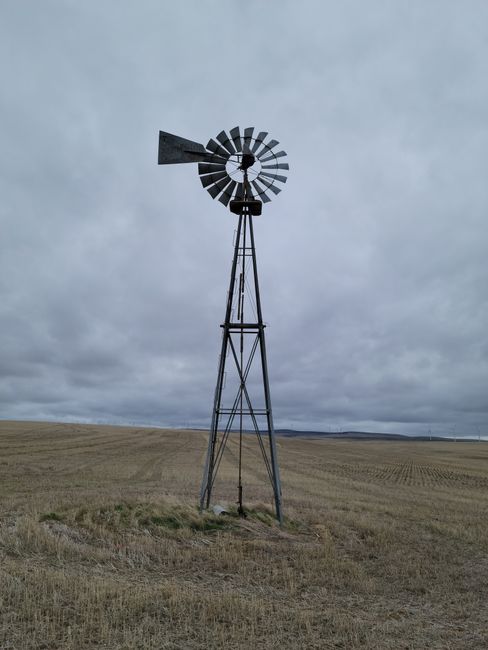
In short: a small wind turbine can make sense with open land (the U.S. Department of Energy suggests at least an acre), average wind of about 10 mph at turbine height, and a tower tall enough to clear everything within 300 feet by 30 feet. Most suburban lots and rooftops fail those tests; solar plus a battery usually fits them better.
Small wind is a real technology with real owners, mostly on farms, ranches and rural homes. It is also the energy product most often oversold. This page is a practical, honest check: what your site needs, what size and tower it takes, what it costs, the permits, the upkeep, and when to walk away. For how turbines work, see our wind energy explainer.
Small wind at a glance
- Sizes: home turbines typically run from 400 watts to 20 kW; a turbine of 5 to 15 kW is needed to make a significant contribution to an average home’s use (DOE Energy Saver).
- Wind needed: about 10 mph (4.5 m/s) average at hub height for a grid-connected system, about 9 mph (4 m/s) for an off-grid hybrid (DOE Small Wind Guidebook).
- Tower: 60 to 140 feet is common for home systems (DOE consumer guide, 2022).
- Cost: DOE gives $5,000 to $10,000 per kW installed; the latest national sample of new small wind projects averaged $7,370 per kW in 2023 (DOE/PNNL).
- Life: up to 20 years or longer with proper installation and yearly maintenance (DOE).
- Market: 1,994 small turbines (100 kW or less), 2.3 MW in total, were installed in the U.S. in 2023 (DOE/PNNL). It is a niche, so installers are few.
Is your site right for a wind turbine?
Answer these five questions honestly. If you hit a “no,” stop there and look at the alternatives further down.
- Do you have the land? DOE’s rule of thumb is at least one acre, with room to raise and lower the tower and space for guy wires if the tower is guyed.
- Is there enough wind? An average of about 10 mph at hub height for grid-connected use. Hilltops and the windward side of a hill beat gullies and sheltered slopes on the same property.
- Can the rotor get above the turbulence? DOE says the turbine should be upwind of buildings and trees and 30 feet above anything within 300 feet, allowing for trees that are still growing.
- Will zoning allow it? Height limits, setbacks from property lines, and neighborhood covenants often decide the project before the wind does.
- Does the math work? Expensive grid power, fair credit for exported power or a costly line extension make wind more attractive.
How to check your wind
Start with a map, then measure. Our state pages show the NASA POWER long-term average wind speed at 50 meters for the state’s center. At that height, Nebraska (7.45 m/s), Kansas (7.31), North Dakota (7.26), Oklahoma (7.14), Minnesota (7.12) and South Dakota (7.07) lead, while California’s figure is 3.24 and Alabama’s 3.96. These are coarse, high-altitude averages: small turbines sit lower, and a hill or tree line on your land matters more. Use them to decide whether to look closer, not to buy. See Nebraska, Kansas, North Dakota, Oklahoma or your state.
A serious installer will estimate yearly output from the turbine’s power curve, your average wind speed, the tower height and how often the wind blows at each speed, adjusted for your elevation. If the estimate rests only on a brochure or a rooftop anemometer, ask for more.
When small wind does not fit
- Rooftop turbines. DOE warns that turbines mounted on buildings can cause vibration and noise inside, and rooftop air is turbulent. Small “vertical home turbines” sold for roofs rarely produce what the marketing suggests.
- Suburban lots under an acre, surrounded by houses and trees, almost never clear the 30-feet-over-300-feet rule.
- Low-wind regions with averages well under 9 mph at hub height.
- Backup only. A grid-connected turbine shuts off when the grid goes down, unless it’s paired with storage set up as a home microgrid (DOE). If outages are the worry, see backup power.
Sizing a home turbine
Start with an energy budget: your yearly use from 12 months of bills, after cutting waste, since efficiency is cheaper than generation. DOE gives two reference points: a home using about 10,600 kWh a year needs a turbine in the 5 to 15 kW range to make a significant contribution, and a 1.5 kW turbine can meet a 300 kWh-per-month home at a site averaging 14 mph. DOE notes that tower height also affects how much a turbine generates, because wind is usually stronger and steadier higher up, so a professional installer should help choose both together.
DOE also encourages buying only turbines tested and certified to national performance and safety standards. Ask the installer which certification the model holds and for its certified power curve and sound rating.
Grid-connected or off-grid?
A grid-connected turbine feeds your home first and sends any extra to the utility, which credits it under your state’s rules; when it is calm, you buy power as usual. DOE says grid-connected small wind can be practical where the average wind is at least about 9 to 10 mph, power from the utility is expensive, and the utility’s connection requirements are not prohibitively costly. An off-grid turbine charges a battery bank instead, and most off-grid systems pair it with solar and a backup generator so there is power when neither the wind nor the sun cooperates. DOE notes that battery banks are typically sized for one to three days of use.
What small wind costs
| Source | Figure | Notes |
|---|---|---|
| DOE Consumer Guide to Small Wind (2021) | $5,000 to $10,000 per kW | Installed, general range |
| DOE Consumer Guide to Residential Renewable Energy (2022) | $10,000 to $70,000 per home system | Systems of 5 to 30 kW on 60 to 140 ft towers |
| DOE/PNNL Distributed Wind Market Report (2024 edition) | $7,370 per kW (2023); $11,410 per kW average 2014 to 2023 | Only five 2023 projects in the sample; treat as indicative |
At those rates, a 10 kW home system would land roughly between $50,000 and $100,000 installed (our arithmetic from the DOE range). Budget for the tower, foundation, wiring run, inverter, permits and yearly upkeep. Long wire runs lose power, more so with direct current, so placement affects cost too.
Incentives: the federal residential clean energy credit (25D), which covered small wind, ended for expenditures after December 31, 2025 (IRS). For businesses and farms, IRS guidance says the 48E and 45Y credits end for wind facilities placed in service after 2027 when construction begins after July 4, 2026; ask a tax professional. State programs vary; some, such as Nebraska’s Dollar and Energy Saving Loans, finance small wind. Check incentives and your state page.
Permits, zoning and the utility
- Zoning and building permits: many counties cap structure height or require a special-use permit and setbacks, often tied to tower height. Ask the county planning office before you pay a deposit.
- Covenants: homeowners’ association rules can forbid towers outright.
- Electrical permit and inspection: the wiring is done by a licensed electrician to code.
- Interconnection: to connect to the grid you sign your utility’s interconnection agreement; how exported power is credited follows your state’s rules. See net metering, which applies to wind as well.
Maintenance
DOE lists the yearly checks: tighten bolts and electrical connections, look for corrosion, check guy-wire tension, replace worn leading-edge tape on the blades, and replace blades or bearings when needed. Towers you can tilt down make this far easier and safer. Ask the installer for a service plan, or for someone who will provide one.
Wind, solar or both?
Solar has no moving parts, fits on roofs and is sold by many more installers, so it is the default for most homes. Wind earns its place on open, windy land and in off-grid systems, because in much of the U.S. the wind is strongest in winter, when solar output is lowest (DOE). That’s the case for a hybrid system. If you’re far from a power line, read off-grid power and try the off-grid planner; if you have a stream with a good drop, compare micro-hydro.
Choosing an installer
DOE recommends a professional installer: ask whether they are a licensed electrician, ask for references and call them, and check complaints. Ask how many turbines of this model they have installed, who services it, and for a written production estimate with its assumptions. Your state page links to the license lookup.
Ask about small wind for your property
Tell us about your land, your power use and your average wind if you know it. Tell us about your project and we will connect you with a licensed, independent installer who serves your area. It is free, there is no obligation, and only the installer you choose gets your details. Read how it works.
Small wind questions
Can a wind turbine power a whole house?
On a good site, a turbine of roughly 5 to 15 kW can make a significant contribution to an average home’s use, according to DOE, but output swings with the wind. Grid-connected homes rely on the utility when it’s calm; off-grid homes add batteries and usually solar and a generator. On a poor site, even a large turbine won’t come close.
Are rooftop wind turbines worth it?
Usually not. Air over and around buildings is slow and turbulent, and DOE notes that building-mounted turbines can cause vibration and noise indoors. A turbine needs to sit 30 feet above anything within 300 feet. For most rooftops, solar panels produce far more energy per dollar.
How much land do I need for a wind turbine?
DOE’s rule of thumb is at least one acre. Beyond that, you need space to raise and lower the tower, room for guy wires on guyed towers, and enough distance from property lines to meet local setback rules, which are often tied to tower height. Check with the county before buying.
Is there a tax credit for a home wind turbine in 2026?
Not a federal one for homeowners. The residential clean energy credit (25D), which covered small wind, is not allowed for expenditures made after December 31, 2025. Some states offer loans, rebates or property-tax exemptions; search DSIRE or your state energy office. Businesses and farms should ask a tax professional about 48E.
How long do small wind turbines last?
DOE says up to 20 years or longer with proper installation and maintenance. Expect yearly checks of bolts, wiring, corrosion and guy wires, and occasional replacement of blades, bearings or blade tape. A tilt-down tower and a local service provider make a long life much more likely.
Sources: U.S. Department of Energy: Small Wind Guidebook (WINDExchange), Energy Saver “Installing and Maintaining a Small Wind Electric System,” FAQs on small distributed wind systems, Consumer Guide to Small Wind (2021) and Consumer Guide to Residential Renewable Energy (2022); DOE/PNNL Distributed Wind Market Report 2024 edition; NASA POWER climatology (2001 to 2020) via our state dataset; IRS One Big Beautiful Bill provisions, Notice 2025-42 and Form 3468 instructions; Nebraska Department of Environment and Energy (state dataset). Written by the SolutionEnergy editorial team; last reviewed October 2026.