In short: micro-hydro turns a stream on your property into steady electricity, day and night. It needs head (how far the water drops) and flow (how much water). The U.S. Department of Energy’s quick estimate: net head in feet times flow in gallons per minute, divided by 10, equals watts. You also need the right to use the water and local permits.
Few properties have a good hydro site, but the ones that do have something solar and wind can’t offer: power that keeps coming at night and in calm weather. This page helps you check your stream, estimate output, understand permits and water rights, and decide whether to go further. For the science and big dams, see our hydroelectric power explainer.
Micro-hydro at a glance
- Size: micro-hydro systems usually generate up to 100 kW; DOE says a 10 kW system can generally power a large home, a small resort or a hobby farm.
- Quick estimate: net head (ft) × flow (gpm) ÷ 10 = watts, for a system of 50% to 70% efficiency (DOE).
- Head matters most: more drop means less water and smaller, cheaper equipment for the same power. A drop under 2 feet probably makes a small system unfeasible (DOE).
- Design for the dry season: DOE suggests basing the design on the lowest average flow of the year.
- Permits: start with the county engineer and state energy office; you’ll also need to contact the Federal Energy Regulatory Commission (FERC) and the U.S. Army Corps of Engineers, and confirm your state water right (DOE).
Is your stream a hydro site?
- Water on your land, all year. A stream that dries up in late summer will only power you part of the year.
- A real drop. Hilly or mountainous sites usually work best. DOE calls under 66 feet “low head” and under 10 feet “ultralow head.”
- A short distance to where you use the power. Low-voltage power is hard to send far; DOE advises keeping batteries close to the turbine.
- The legal right to divert the water. Each state controls water rights, and you may need a separate right to make power even if you already hold one for another use.
Measure head and flow
Head: how far the water falls
Gross head is the vertical distance from the water surface where the pipe (penstock) would start to where the turbine would discharge. Net head is gross head minus friction losses in the pipe; DOE suggests allowing 5% to 10% for a first estimate. A professional survey is most accurate. For a rough check, DOE describes the hose method: with a helper holding a funnel in a 20 to 30 foot hose underwater upstream, lift the downstream end until water stops flowing and measure the height; repeat down the stream and add up the steps. Topographic maps from the U.S. Geological Survey help too.
Flow: how much water
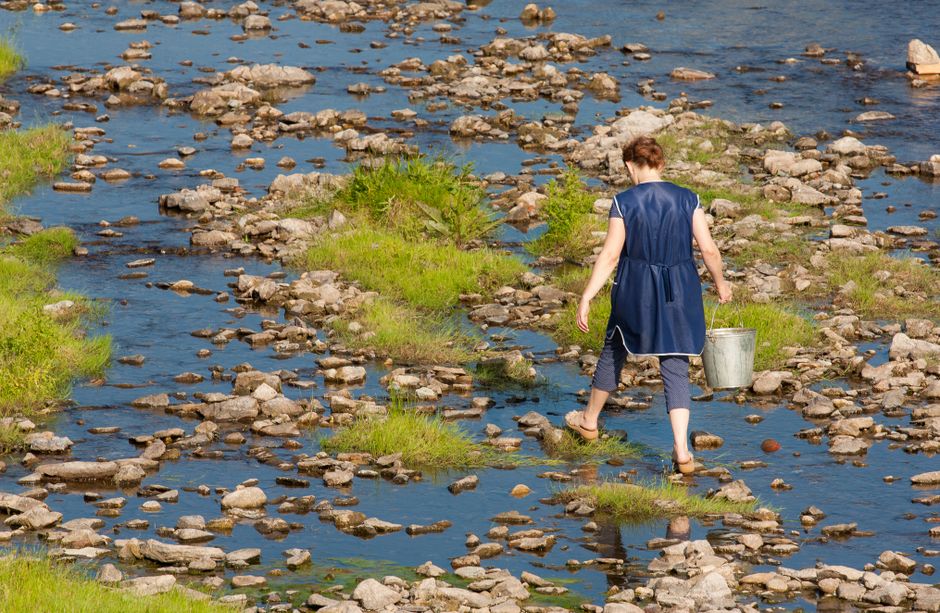
First look for existing data from the U.S. Geological Survey, the Army Corps of Engineers, the U.S. Department of Agriculture, your county engineer or the local water authority. For a small stream, DOE’s bucket method works: divert the flow into a bucket and time it; a 5-gallon bucket that fills in one minute means 5 gallons per minute. Larger streams need the weighted-float method (cross-section area × surface speed × a roughness factor). Don’t wade fast water or water above your calves. Measure in different seasons, because flow changes a lot through the year.
Estimate your power
Using DOE’s formula, here are three examples. The arithmetic is ours and assumes the flow lasts all year.
| Net head | Flow | Power (DOE formula) | Energy per day (24 h) |
|---|---|---|---|
| 20 ft | 100 gpm | 200 W | about 4.8 kWh |
| 100 ft | 50 gpm | 500 W | about 12 kWh |
| 200 ft | 100 gpm | 2,000 W | about 48 kWh |
For scale, the average U.S. home used about 10,791 kWh in 2022, close to 30 kWh a day (EIA; daily figure is our arithmetic). Because hydro runs around the clock, even a few hundred watts covers a careful off-grid cabin, and 2 kW of steady output is more than an average home uses. That’s why a good site is valuable.
What a system includes
- Water conveyance: an intake with a screen, and a channel or pressurized pipe (penstock) down to the turbine.
- Turbine, pump or waterwheel: impulse turbines such as Pelton and Turgo wheels suit high head; cross-flow and propeller types suit lower head and more flow (DOE).
- Generator and controller: commercially available turbines and generators are usually sold as a package; a regulator controls the generator (DOE). Do-it-yourself systems need careful matching of generator to turbine.
- Inverter and wiring: to make 120/240-volt AC, and a tailrace to return water to the stream.
- Batteries (sometimes): useful off-grid, though DOE notes that because hydro is seasonal, batteries are not always practical.
Grid-connected or stand-alone?
DOE notes that whether a system is grid-connected or stand-alone decides much of the equipment and the permits. A stand-alone (off-grid) system powers the property directly, often with an inverter and sometimes a small battery bank to cover short peaks such as a well pump starting. A grid-connected system needs your utility’s interconnection approval and a licensed electrician’s work, and selling power to the utility usually brings more paperwork. If the property is already on the grid with fair credit for exported power, compare the payback with rooftop solar first; hydro shines most where there is no line or where the line is expensive to bring in.
Costs: what we can and can’t tell you
We have not found a current cost range for home micro-hydro from DOE, NREL or another official source, and we won’t invent one. Costs swing with the length of pipe, the civil work at the intake, the turbine type and how far the power has to travel. DOE’s method for judging a quote is simple: add up all the costs of building and maintaining the site over the equipment’s life, divide by the system’s capacity in watts, and compare that cost per watt with grid power or other options such as solar. DOE adds that hydro systems typically last a long time and maintenance is often inexpensive. If you are far from a power line, compare against the line extension, which DOE puts at $15,000 to $50,000 per mile.
The federal home credit (25D) ended for expenditures after December 31, 2025 (IRS). Hydropower is not part of the wind and solar cut-off for business credits, but whether a farm or business project qualifies under 48E is a question for a tax professional. Check your state’s programs on its page and in our incentives guide.
Permits and water rights
DOE says a system with minimal environmental impact that doesn’t sell power to a utility will most likely face a light permitting process, but you still have to ask. Start with the county engineer and your state energy office, then contact FERC and the U.S. Army Corps of Engineers. FERC offers exemptions from licensing for small projects, for example at existing dams or natural water features up to 10 MW and on conduits such as irrigation canals. Your state decides how much water you may divert, and fish and stream-flow protections can limit diversions in dry months.
When micro-hydro is not for you
- Flat land with a slow stream and less than 2 feet of drop.
- A stream that isn’t yours, or one you can’t get a water right for.
- A seasonal creek that stops for months, unless you pair hydro with solar in a hybrid system.
- A site where the power would have to travel a long way to the house.
If that’s you, look at solar with a battery, small wind on open land, or a complete off-grid system. The off-grid planner sizes solar, batteries and a generator for your location.
Upkeep and the stream
Most of the work is at the intake: clearing leaves and debris from the screen, especially after storms and in autumn, and protecting the pipe from freezing. Turbine bearings and nozzles wear slowly. Keep enough water in the stream for fish and other life; EIA notes that hydropower can affect fish, water temperature and flow. Wiring to the house and any grid connection should be done by a licensed electrician, with permits.
Ask about micro-hydro for your property
Send us your head and flow measurements, or what you know so far, and how you want to use the power. Tell us about your project and we will connect you with a licensed, independent installer who serves your area. It is free, there is no obligation, and only the installer you choose gets your details. Read how it works.
Micro-hydro questions
How much power can a small stream make?
Use DOE’s estimate: net head in feet times flow in gallons per minute, divided by 10, gives watts. A stream with 100 feet of drop and 50 gallons per minute makes about 500 watts, or roughly 12 kWh a day if it runs all day. With only a few feet of drop, the same flow makes very little.
Do I need a permit for micro-hydro on my own land?
Almost certainly some permission. DOE says to contact your county engineer, state energy office, FERC and the U.S. Army Corps of Engineers, and to confirm your water right, since each state controls water use. Small projects that don’t sell power usually face a lighter process, and FERC offers exemptions for some small projects.
How much head do I need?
More is better. DOE says a drop of less than 2 feet will probably make a small system unfeasible. Low-head sites, under 66 feet, need much more water for the same power and bigger equipment. High-head sites can make useful power from a modest flow with compact impulse turbines such as a Pelton wheel.
Is micro-hydro better than solar?
On a good site, it can be: it runs day and night in any weather, so a small turbine can match a much larger solar array in daily energy. But good sites are rare, permits take longer, and fewer installers work with hydro. Many owners combine the two, with solar covering the dry season.
Sources: U.S. Department of Energy Energy Saver, “Microhydropower Systems” and “Planning a Microhydropower System” (archived 2024 copies; the live pages now return errors), “Types of Hydropower Turbines” and off-grid systems guidance; FERC, Exemptions from Licensing; EIA FAQ on home electricity use (2022) and “Hydropower and the environment”; IRS One Big Beautiful Bill provisions and Notice 2025-42. Written by the SolutionEnergy editorial team; last reviewed October 2026.