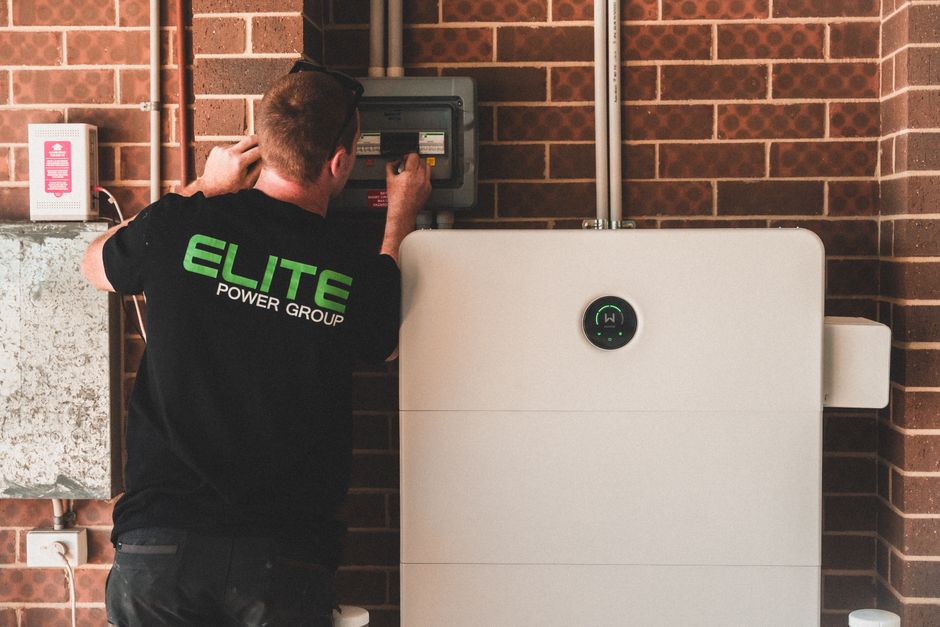
In short: a home battery installation goes from a load check and site visit through design, electrical permits, installation, inspection and utility approval. The work at your house is usually the quick part; with solar, NREL found projects averaged 8 to 9 months from contract to permission to operate in 2023. Use an installer licensed in your state and certified by the battery’s maker.

This page explains each step, the codes and permits behind it, the brand certification programs (Tesla, Enphase, FranklinWH and others), what drives the price, and how to check an installer. Already know you want storage with solar? See solar battery storage. Still comparing brands? Start with the best home batteries.
Home battery installation at a glance
- Timeline: solar-plus-battery projects up to 20 kW averaged 8 to 9 months from contract to permission to operate in 2023, about 3 months longer than solar alone (NREL, November 2025). Storage projects had a median of about 5 months from utility application to approval in 2020 to 2025 data (Berkeley Lab, September 2026).
- Cost: about $1,159 per kWh installed, or $15,647 for 13.5 kWh (EnergySage, August 2026).
- Who installs: a licensed electrical contractor, ideally certified by the battery’s maker; NABCEP also certifies Energy Storage Installation Professionals.
- Safety rules: the fire code standard for battery systems, NFPA 855, sets limits on unit size, spacing and location in homes; your local code decides which edition applies.
- No federal credit for homeowners on batteries installed after 2025 (IRS, 25D).
The battery installation process, step by step
- Decide what the battery is for. Backup for essentials, whole-home backup, cutting evening bills, or a utility program. The goal sets the size and the price. Our battery backup calculator gives a first estimate.
- Site visit. The installer looks at your main electrical panel and its capacity, your meter, any solar inverter, where the battery could go (garage wall, outside wall, utility room) and the path for wiring. Expect questions about your biggest loads: central air, well pump, electric range, EV charger.
- Design and quote. Partial-home backup usually moves chosen circuits to a backup panel; whole-home backup puts a switching device (Tesla’s Backup Gateway, Enphase’s IQ System Controller, FranklinWH’s aGate) between the grid and your main panel. The quote should list the battery model and number of units, usable kWh, power in kW, the switching device, any panel upgrade and who handles permits.
- Permits. The installer files for an electrical permit, and in many places a building or fire review of the battery’s location. HOA approval may be needed for outside units.
- Utility paperwork. Batteries connected to solar or set to send power to the grid need an updated interconnection agreement. Some utilities also want to know about non-exporting batteries; your installer checks the rules.
- Installation. Mounting the battery and switching device, wiring to the panel and any solar, and connecting the communications so the system can be monitored.
- Inspection. A local inspector checks the work. Fire inspectors may look at location and clearances.
- Utility approval and commissioning. After any required permission to operate, the installer registers the system with the maker (Tesla, for instance, has certified installers complete registration), sets backup reserve and operating modes, and shows you the app.
- Test a backup. Ask the installer to simulate an outage before they leave, so you know which circuits stay on.
Permits, codes and where a battery can go
Lithium-ion batteries store a lot of energy in a small space, so codes treat them seriously. The National Fire Protection Association’s fact sheet explains the main hazard, thermal runaway: a cell that overheats can set off its neighbors and cause a fire that’s hard to put out. NFPA 855, the installation standard for stationary energy storage, has a chapter for one- and two-family homes and townhouses that limits individual units to 20 kWh and generally requires 3 feet between units unless testing supports less. Local fire and building codes adopt these rules on their own schedule, so what’s allowed in a garage or on an outside wall varies by town.
In practice: buy a battery system listed to UL 9540 (the safety listing codes look for), let the installer pick a location that meets your local code, keep the area clear of clutter and protected from vehicles, and make sure smoke alarms work. Never place or move a battery yourself to save on installation.
Certified installer programs by brand
Installer-sold batteries such as Powerwall, Enphase IQ and FranklinWH are sold and installed through companies the maker has trained. That matters for the warranty and for support later.
| Brand | Program | How to check |
|---|---|---|
| Tesla Powerwall | Tesla Certified Installers, where Tesla doesn’t install directly | Tesla’s “Find a Certified Installer” search by ZIP code |
| Enphase IQ Battery | Enphase Installer Network: Platinum and Gold installers are certified to install IQ Batteries; some Silver installers are | Enphase’s installer finder |
| FranklinWH aPower | FranklinWH certified installers (more than 3,000, the company said in May 2025) | Contact FranklinWH; it connects homeowners with a local certified installer |
| Any brand | NABCEP Energy Storage Installation Professional (ESIP): requires training, OSHA 30 and documented storage projects | NABCEP directory |
Can any electrician install a Powerwall? A licensed electrician can do the wiring, but these makers route sales, registration and support through their certified installers. Ask to see the certification and confirm it in the maker’s own finder. Plug-in whole-home kits (such as EcoFlow or Anker SOLIX systems) are bought directly, but their transfer panels or inlet boxes still need a licensed electrician; compare them in the best home batteries.
What affects the cost of battery installation
EnergySage’s 2026 quote data give the clearest range: an average of $1,159 per kWh installed, about $15,647 for a 13.5 kWh battery. By state, H1 2026 averages per kWh ran from $563 in Alabama to $1,586 in Louisiana, with Florida at $1,005, Texas $1,059, California $1,079, North Carolina $1,241 and Massachusetts $1,352. Equipment is about half to 60% of the price; labor, permits, design and the installer’s overhead are the rest.
| Cost driver | What to know |
|---|---|
| Capacity (kWh) and number of units | Whole-home backup often needs two or three batteries |
| Partial vs whole-home backup | Whole-home needs a larger switching device and more power for motor starts |
| Panel upgrade | An older or full main panel may need replacing |
| Inverter | A separate inverter “could add a couple of thousand dollars” (EnergySage) |
| Retrofit to existing solar | More labor and wiring than installing with new solar |
| Location and code work | Long wire runs, bollards, fire-rated surfaces or an outdoor enclosure add cost |
Incentives: the federal 25D credit ended for batteries installed after December 31, 2025. Some state and utility programs pay well: ComEd in Illinois pays $300 per kWh for batteries paired with solar on its Hourly Pricing rate (CUB, March 2026), and Connecticut’s Energy Storage Solutions program pays for peak-time use. Check your state page. Full numbers are in home battery cost.
How to choose and check a battery installer
- License: look up the electrical contractor license on your state or city board. Each state page links to its lookup, for example Texas (TDLR), Florida (DBPR), North Carolina and Illinois (local licensing).
- Brand certification: confirmed in the maker’s own finder, not just a logo on a website.
- Insurance: liability and, where required, workers’ compensation certificates.
- Experience: how many installs of this exact battery, and references from the last year.
- Service: who handles warranty claims and how fast they respond. Battery warranties vary: Enphase lists 15 years, Tesla 10 years for Powerwall (maker documents).
Questions to ask before you sign
- Which circuits will stay on in an outage, and for how long with my typical use?
- Can the system start my central air or well pump? What’s its surge rating?
- Where will the battery go, and does that location meet our local fire code?
- Will solar recharge it during an outage?
- Do I need a panel upgrade? Is it in the price?
- Which rebates or utility programs apply, and who applies for them?
- What’s your typical time from contract to switch-on here?
Red flags, and your right to cancel
- “Whole-home backup” from a single small battery with no load calculation.
- A promise of a federal tax credit for a battery you buy in 2026.
- No license number, no brand certification you can verify, or pressure to sign the same day.
- A plan to put the battery in a bedroom or living space, or to skip the permit.
If you sign at home, the FTC’s Cooling-Off Rule requires the seller to tell you about your right to cancel within three business days for sales of $25 or more. In Texas, residential solar sales and leases carry a five-business-day right to cancel in writing (SB 1036); if your battery comes with solar, ask whether your contract falls under it. Read the cancellation clause before you sign.
What happens when you ask us for help
We read your request, reply ourselves with answers on sizing, rules in your state and what to ask, and, if you want, suggest an independent licensed installer. You decide whether to share your details. We don’t sell or install batteries. Details are on how it works.
Get help with your battery project
Tell us about your project and we will connect you with a licensed, independent installer who serves your area. It is free, there is no obligation, and only the installer you choose gets your details. How it works.
Battery installation questions
How long does it take to install a home battery?
The work at your house is short compared with the paperwork. NREL found solar-plus-battery projects up to 20 kW averaged 8 to 9 months from contract to permission to operate in 2023, about 3 months longer than solar alone. Berkeley Lab’s data show a median of about 5 months from utility application to approval for storage projects. Permits and utility review set the pace.
Can any electrician install a Tesla Powerwall?
A Powerwall should be installed by a Tesla Certified Installer where Tesla doesn’t install directly; Tesla’s installer finder lists them by ZIP code. The installer must also hold the electrical license your state or city requires. The same idea applies to Enphase (Platinum and Gold installers are battery-certified) and FranklinWH. Always check certification in the maker’s own finder.
Do I need a permit to install a home battery?
Yes, for any battery wired into your home’s electrical system. Expect an electrical permit and an inspection, and in many places a fire or building review of the location under rules based on NFPA 855. If the battery connects to solar or the grid, your utility’s approval is needed too. Your installer should file all of it.
Where can a home battery be installed?
Commonly on a garage wall, an outside wall or in a utility room, depending on the model’s rating and your local code. NFPA 855 limits individual home units to 20 kWh and generally requires 3 feet between units unless testing supports less. Local codes add their own rules, so let a licensed installer choose and confirm the spot with the permit office.
How much does home battery installation cost?
EnergySage’s 2026 average was $1,159 per kWh installed, about $15,647 for a 13.5 kWh battery, with state averages from $563 to $1,586 per kWh in H1 2026. Whole-home backup often takes two or three batteries. Panel upgrades, retrofits to existing solar and long wire runs add cost. Rebates in states like Illinois can cut it.
Sources
NREL, Residential and Small Commercial Solar PV and Storage Permitting, Inspection, and Interconnection Timelines (2017–2023), November 2025; Berkeley Lab, Interconnection Timelines and Costs for Distributed Energy Projects, September 2026; EnergySage battery cost pages (July and August 2026); NFPA Energy Storage Systems Safety Fact Sheet (2024) and NFPA 855 committee documents; Tesla certified installer and Powerwall registration pages; Enphase Installer Network; FranklinWH installer support page and May 2025 announcement; NABCEP ESIP requirements; IRS Residential Clean Energy Credit; FTC Cooling-Off Rule; Texas TDLR on SB 1036; Citizens Utility Board Illinois rebates (March 2026). Checked October 3, 2026.