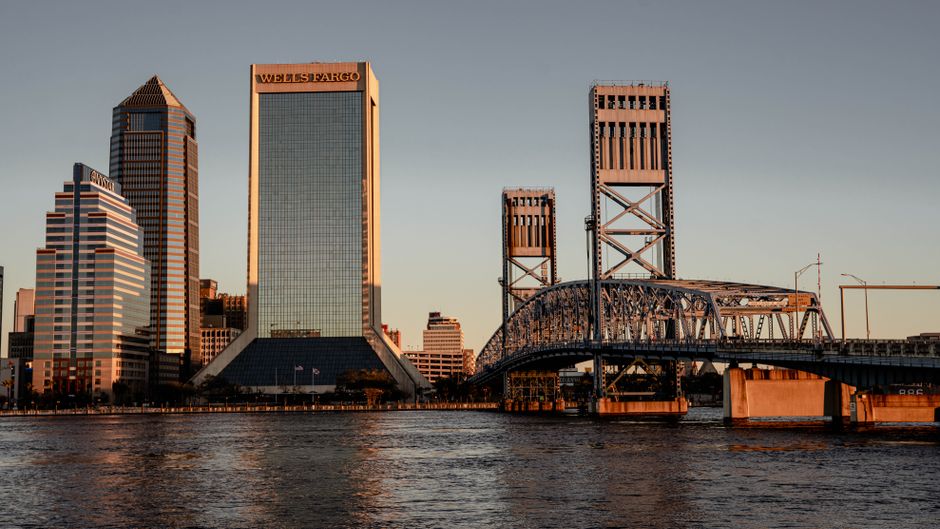

Jacksonville, Florida
Your complete local energy guide: electricity rates, solar panels, home batteries, generators, and EV charging. Compare costs, incentives, permits, and find local installation professionals.
Your complete Jacksonville energy guide
Everything you need to find and understand about energy in Jacksonville: what electricity costs, who supplies it, and how solar, home batteries, generators and EV charging fit your home, with local incentives, permits and where to start.
Jacksonville energy dashboard
General information
What every Jacksonville home deals with, whatever you installWhat this means for your home
Short answers, from the local numbersCooling. Jacksonville has about 2,960 cooling degree-days a year against 1,220 for heating (NASA POWER, base 65°F), so air conditioning is the big load. Seal gaps around doors, windows and the attic, shade sun-facing windows, service the air conditioner and move big loads out of your utility’s peak hours.
Florida electricity costs →Rooftop solar in Jacksonville makes roughly 1,400 kWh a year per kW of panels (our estimate from NASA POWER sunshine of 4.79 kWh per square meter per day). JEA credits exports at its fuel rate, not the retail rate; credits build up through the calendar year and any year-end balance is paid out. Its distributed-generation policy page dates from 2018; confirm it is current. Size solar to what you use at home, or pair it with a battery.
Florida incentives →Lightning causes short outages and damages electronics. Surge protection and a battery that switches over automatically protect the things you care about. FEMA rates Duval County lightning “very high”.
Get a quote →Jacksonville has 583 public ports at 167 locations, 255 of them DC fast (AFDC, October 2026). Home charging does most of the work.
EV charging stations in Jacksonville →Tell us your project and your city and we match you with a licensed installer who serves your area. It is free, with no obligation.
Request a quote →Tags show the scope of each number: Jacksonville, a whole utility, Florida, or the U.S. Data checked October 21, 2026; sources are listed at the bottom. Utility figures are for the whole utility, not Jacksonville alone. The numbers for each solution are in its own section below, in its own color: solar yellow, battery green, generator red, EV purple.
How we rank: price and outage ranks compare Florida with the other states and D.C. (EIA Electric Power Monthly, July 2026; EIA-861 reliability reports, 2024). Sun: NASA POWER. Public charging: AFDC, October 2026.
Jacksonville electricity providers
Do not assume every Jacksonville home has the same provider. JEA serves homes in Jacksonville. Check the top of your bill, or ask the utility with your address.
- Type: city-owned.
- Home customers (2024): 470,564.
- Price: 12.43 cents per kWh on average, utility-wide (EIA-861).
- Outage minutes (2024): 75 normal days, 75 with major events.
- Solar export: JEA credits exports at its fuel rate, not the retail rate; credits build up through the calendar year and any year-end balance is paid out. Its distributed-generation policy page dates from 2018; confirm it is current.
- Programs: JEA offers efficiency rebates (attic insulation, heat pump water heater, heating and cooling) and says no EV incentives are offered at this time. We found no solar or battery rebate.
Program details are from each utility’s own pages, read October 2026; we have not verified anything we do not state. Statewide: Florida utilities.
Jacksonville electricity rates and average bills
Every Jacksonville home has one utility, so the price is the utility’s rate plan plus fuel and storm-cost charges that change each year. The averages below are for each whole utility, not one street; your bill is the real number.
| Utility | Price we confirmed |
|---|---|
| JEA | 12.43 cents per kWh, utility-wide average, 2024 (EIA-861) |
Florida average residential price, July 2026: 15.03 cents per kWh (EIA Electric Power Monthly, preliminary), against 18.31 for the U.S. This state number is not a price for Jacksonville alone.
Why electricity bills are high in Jacksonville
- Cooling. Jacksonville has about 2,960 cooling degree-days a year against 1,220 for heating (NASA POWER, base 65°F), so air conditioning is the big load.
- Heat and humidity. Air conditioning runs most of the year, so cooling is the biggest part of a Florida bill.
- Fuel and storm charges. Fuel costs and hurricane recovery charges are added to the base rate and change each year (FPL’s new base rates began in January 2026).
- Your plan and your home. The rate plan, the size and age of the house, and when you use power all change the bill; compare plans before you assume the price is fixed.
Most of this is cooling or heating and timing, which means a lot of it can be changed. See our guide to what uses the most electricity, and the next section.
How to lower your electric bill in Jacksonville
- Check your rate plan. Ask your utility about time-of-use plans and load-control credits (FPL On Call Savings, Duke EnergyWise Home, Tampa Electric Prime Time Plus), which pay small credits for letting it cycle A/C or equipment.
- Move big loads out of the peak. Run the dishwasher, laundry and EV charging when power is cheapest on your plan.
- Attack cooling first. Shade windows, seal and insulate the attic and ducts, service the air conditioner and use a smart thermostat.
- Pick efficient equipment. See our guide to lowering your electric bill.
- Size solar to your own use. It saves the most on power you use at home; see the solar section below.
- Add a battery if exports pay little. It moves midday power into the evening peak.
- Charge an EV cheaply. Use the cheap hours on your plan.
We have not put dollar savings on these steps because they depend on your home and plan. Use the calculators in the cost section to test your own numbers.
Power outages and backup power in Jacksonville
In 2024 the average JEA customer lost 75 minutes of power in a normal year (75 with major events; EIA-861, whole utility). FEMA rates the biggest risks in Duval County as: lightning (very high); cold waves (relatively high); hurricanes (relatively high).
- Lightning (very high): Lightning causes short outages and damages electronics. Surge protection and a battery that switches over automatically protect the things you care about.
- Cold waves (relatively high): Cold waves raise demand and can cause both outages and frozen pipes. Keep at least one room warm with a battery-run heater circuit or a generator.
- Hurricanes (relatively high): Hurricanes can mean a week without power. A standby generator on natural gas or propane, or a battery with solar, beats a stack of gas cans; check flood height before you site equipment.
| Backup option | Best for | Guide |
|---|---|---|
| Portable power station | Phones, internet, a fan and small medical devices | Power stations |
| Home battery | Silent, automatic backup; works with solar | Jacksonville battery guide |
| Standby generator | Multi-day outages and central air conditioning | Jacksonville generator guide |
See also our backup power guide.
Solar panels in Jacksonville
About 1,400 kWh a year from each kW of rooftop panels here (our estimate). Under state net metering, FPL, Duke Energy Florida and Tampa Electric credit exports to your next bill; city utilities and co-ops differ, so check yours.
- Permits come from Building Inspection Division (City of Jacksonville); the utility must approve the connection before you switch on.
Info about Solar Panel Installation in JacksonvilleGet solar quotes
Home batteries in Jacksonville
A battery keeps the essentials running in an outage and moves midday power into the expensive evening peak. Heat limits where it can go, and local permits apply.
- It earns the most where evening power costs more than midday power or where a utility pays for sharing it.
Info about Home Battery Installation in JacksonvilleGet battery quotes
Backup generators in Jacksonville
A standby generator runs as long as it has fuel, which suits multi-day storms and big loads like central air conditioning. A transfer switch keeps it from feeding power back to the grid.
- Natural gas or propane: a propane tank may need its own permit.
Info about Backup Generator Installation in JacksonvilleGet generator quotes
EV chargers in Jacksonville
Most charging happens at home on a Level 2 charger, and your rate plan decides what it costs.
- A licensed electrician installs it, usually with a permit.
Info about Home EV Charger Installation in JacksonvilleGet EV charger quotes
Find fueling and charging stations in Jacksonville
Looking for a charger or a fuel pump near you? Each card below opens its own page, with a map that starts on Jacksonville, the station counts, the price of the fuel, how it compares with the others, and what to know before you go. Station data: U.S. Department of Energy, read 2026-10-21.
Station counts: U.S. Department of Energy, Alternative Fuels Data Center, public stations open 2026-10-21.
Not on the map, or something wrong? Submit a new station or report a change to the U.S. Department of Energy, which runs the map.
Jacksonville energy system costs and savings
We could not find verified installed prices for Jacksonville alone, so these are the closest sourced figures, labeled by where they come from. Real quotes depend on your home, equipment and installer.
| Solution | Typical cost (source) | What it can save | Try the calculator |
|---|---|---|---|
| Solar panels | $2.12 a watt in Florida (EnergySage, October 2026); about $12,720 for a 6 kW system (our arithmetic) | Each kW makes about 1,400 kWh a year (our estimate); used at home it saves your retail price per kWh | Solar savings |
| Home battery | About $12,829 for 13 kWh in Florida (EnergySage, before incentives) | Moves cheap midday or night power into the expensive evening; some utilities pay for sharing it | Battery sizing |
| Standby generator | $8,000 to $16,000 installed incl. generator (Generac, U.S.) | No savings; avoids losses in outages | Generator sizing |
| EV charger | About $800 to $3,000 before the charger (EnergySage, U.S. range) | Charging at home costs less than most public fast charging | EV charging cost |
Each guide has a calculator built for Jacksonville: solar, battery, generator and EV.
Rebates, tax credits and financing in Florida (checked October 21, 2026)
| Program | Status | What we confirmed | Source |
|---|---|---|---|
| Federal Residential Clean Energy Credit (25D): solar and batteries | ENDED | Not allowed for expenditures after December 31, 2025; solar or a battery finished in 2026 gets nothing. | IRS |
| Federal charger credit (30C) | ENDED | Not allowed for chargers placed in service after June 30, 2026. | IRS |
| Federal EV purchase credit (30D) | ENDED | Not allowed for vehicles acquired after September 30, 2025. | IRS |
| Florida solar property-tax rule (s.193.624) | ACTIVE | The value a solar, wind or storage device adds is not counted in your home’s assessed value. | Florida Statutes 193.624 |
| Florida sales-tax exemption for solar systems (s.212.08(7)(hh)) | ACTIVE | Solar energy systems and components are exempt from sales tax; the Florida Solar Energy Center certifies qualifying equipment. | Florida Statutes 212.08 |
| JEA: solar and programs | CHECK | JEA credits exports at its fuel rate, not the retail rate; credits build up through the calendar year and any year-end balance is paid out. Its distributed-generation policy page dates from 2018; confirm it is current. JEA offers efficiency rebates (attic insulation, heat pump water heater, heating and cooling) and says no EV incentives are offered at this time. We found no solar or battery rebate. | See the utility’s own pages |
Financing. You can pay cash, borrow, or lease or sign a power purchase agreement, and each changes who gets any incentive. Ask any company offering a lease who claims what and what you pay in total. Compare the options in our buy versus lease guide.
A generator has never qualified for a federal credit. Rules and amounts change, so check each program page before you count on it, and talk to a tax professional about your own situation. Statewide detail: Florida incentives table.
Compare energy solutions for your Jacksonville home
| Solar panels | Home battery | Standby generator | EV charger | |
|---|---|---|---|---|
| Main purpose | Make your own power | Store power; backup; peak shifting | Make power in an outage | Charge a car at home |
| Typical cost (not Jacksonville quotes) | $2.12 a watt in Florida (EnergySage) | $12,829 for 13 kWh in Florida (EnergySage) | $8,000 to $16,000 installed incl. generator (Generac) | About $800 to $3,000 before the charger (EnergySage) |
| Installation factors | Roof, shade, panel size, utility approval | Location (heat), panel, program rules, permits | Gas line or propane tank, pad, transfer switch, permits | Panel capacity, distance to panel, outdoor rating |
| Operating cost | None; small inverter replacement later | None; may earn utility payments | Fuel while it runs | Electricity |
| Maintenance | Occasional cleaning and checks | Little; app monitoring | Oil and filter, annual inspection, exercise runs | Little |
| Financial benefit | Bill savings, mainly on power used at home | Evening-peak savings, any utility bonus | None; avoids loss during outages | Lower fuel cost than gasoline |
| Backup in an outage | Only with a battery or special inverter | Yes, silent and automatic | Yes, for as long as fuel lasts | No (unless vehicle-to-home equipment) |
| Works well with | Battery, EV | Solar, EV overnight | Battery for short outages | Solar, time-of-use plan |
Common combinations in Jacksonville: solar plus battery for bill savings and backup; battery plus generator for everyday outages and multi-day events; solar plus an EV charger on a time-of-use plan.
Jacksonville energy permits, regulations and installation rules
| Project | City permit office | Utility |
|---|---|---|
| Solar | Building Inspection Division (City of Jacksonville). Permit applications are submitted electronically through the JaxEPICS portal. Homeowners may permit work on their own primary residence, applying in person; the division’s main line is (904) 255-8500. | Interconnection approval before you switch on |
| Home battery | The same office; ask whether a fire-department or placement rule applies to batteries | Interconnection approval; ask about battery requirements |
| Generator | Electrical permit, and a gas or propane permit where required | Ask the utility about transfer-switch rules |
| EV charger | Electrical permit from the same office | Optional rate plans or rebates |
- City permit page: Building Inspection Division (City of Jacksonville) · (904) 255-8500.
- HOAs: Florida law (s.163.04) stops homeowner associations and local governments from banning solar panels; an association may set where roof panels go, within 45 degrees of south (Florida Statutes 163.04).
- Contractors: check the license on the Florida DBPR license lookup.
- Details and links are on each guide: solar, battery, generator, EV charger. Statewide rules: Florida laws and permits.
Find local energy installers and get quotes in Jacksonville
We do not rank or rate companies. When you compare solar installers, battery installers, generator installers and EV charger installers in Jacksonville, ask each bid to include:
- License: a license you can check on the Florida DBPR license lookup.
- Sizing to your loads and your rate plan.
- Itemized, written price: equipment models, permits, utility fees and what is excluded.
- Warranty and service: who services the system if the installer closes.
- Permits and inspections: who pulls them, and whether the utility paperwork is included.
Pick what you need, tell us about your home, and we will reply ourselves. Need more than one? Send a request for the first and mention the others in the message. Nothing is shared with an installer unless you choose one. We are lining up independent, licensed installers in the Jacksonville area. Read how it works.
Jacksonville energy FAQs
Which utility serves my Jacksonville home?
It depends on your address. JEA serves homes in Jacksonville. Check the top of your electric bill or ask the utility with your address.
Is solar worth it in Jacksonville?
The sun is strong (about 1,400 kWh a year per kW of panels, our estimate). Florida’s three big investor-owned utilities must credit exported power to your next bill under state net metering, so solar can pay well when sized to your own use; city utilities and co-ops set their own, often lower, export credits. See the Florida incentives.
Is there a federal tax credit in 2026?
No. The 25D credit for solar and batteries ended for expenditures after December 31, 2025, the charger credit ended after June 30, 2026, and the EV purchase credit ended after September 30, 2025 (IRS). Florida has no state income tax credit for solar; the sales-tax exemption and the property-tax rule are separate.
Should I get a battery or a generator in Jacksonville?
A battery is silent and automatic, works with solar and can save money at the evening peak. A generator keeps running as long as it has fuel and suits multi-day outages. Many homes choose a battery first; see the comparison table above.
How much does home battery installation cost in Jacksonville?
EnergySage’s data shows about $12,829 for a 13 kWh battery in Florida before incentives; local quotes differ.
What do I need to power my air conditioner in an outage?
It takes a large battery system or a standby generator, because starting a central air conditioner needs far more power than running it. Check your unit’s nameplate and consider a soft starter, or back up a window or mini-split unit instead.
How much does a home EV charger install cost?
EnergySage’s U.S. range is about $800 to $3,000 before the charger; your panel and wiring decide your price. Duke Energy Florida reports a $7.50-a-month off-peak charging credit and Tampa Electric’s Prime Time Plus credits a hardwired charger; OUC pays $200 for an EV; ask your own utility.
Do I need a permit?
Usually yes for all four. Building Inspection Division (City of Jacksonville) handles permits in Jacksonville. The utility must approve any system that connects to your wiring.
Does weather affect solar panels, batteries and generators?
Yes. Panels lose a little output when hot, many batteries reduce power in extreme heat or cold, and generators derate in heat. Pick equipment rated for Jacksonville’s weather.
How do I choose an installer?
Ask for the contractor license number and look it up on the Florida DBPR license lookup, get itemized written bids, make sure the installer sizes the system to your loads and your rate plan, and check warranty and service. We do not rank installers.
Jacksonville energy resources
- Jacksonville solar panel installation
- Jacksonville home battery installation
- Jacksonville backup generator installation
- Jacksonville home EV charger installation
- Jacksonville and North Florida energy guide
- Florida energy guide
- Solar savings calculator
- Battery backup calculator
- Generator sizing calculator
- EV charging cost calculator
- DIY solar kits
- Solar generators
- Backup power guide
- Incentives guide
Sources and data checks
About the price and outage numbers at the top of this page: 2024 averages for each whole utility (EIA-861), not your plan or street. Outage time is a normal year without major storms. In the Texas retail-choice area the price shown is the state average, because the wires companies do not sell power.
Each linked guide lists its own sources and the items we could not confirm. We re-check these pages and welcome corrections.
| What | Applies to | Source | Checked | Status |
|---|---|---|---|---|
| Utility prices and outages | JEA (whole utility, 2024) | EIA Form 861 | October 21, 2026 | Verified |
| State price and rank | Florida | EIA Electric Power Monthly | October 21, 2026 | Verified (preliminary) |
| Sunshine and climate | Jacksonville | NASA POWER | October 21, 2026 | Verified (our estimate of output) |
| Hazards | Duval County | FEMA National Risk Index | October 21, 2026 | Verified |
| Public charging and fuel stations | Jacksonville | Alternative Fuels Data Center | October 21, 2026 | Verified |
| Federal credits | U.S. | IRS | October 21, 2026 | Verified |
| City permits | Jacksonville | Building Inspection Division (City of Jacksonville) | October 21, 2026 | Verified page; confirm details |
| Costs | Florida, U.S. | EnergySage; Generac | October 21, 2026 | Verified (not Jacksonville quotes) |
General information, not financial, tax, legal or electrical advice. Estimates are ours and are not promises. See our editorial policy.