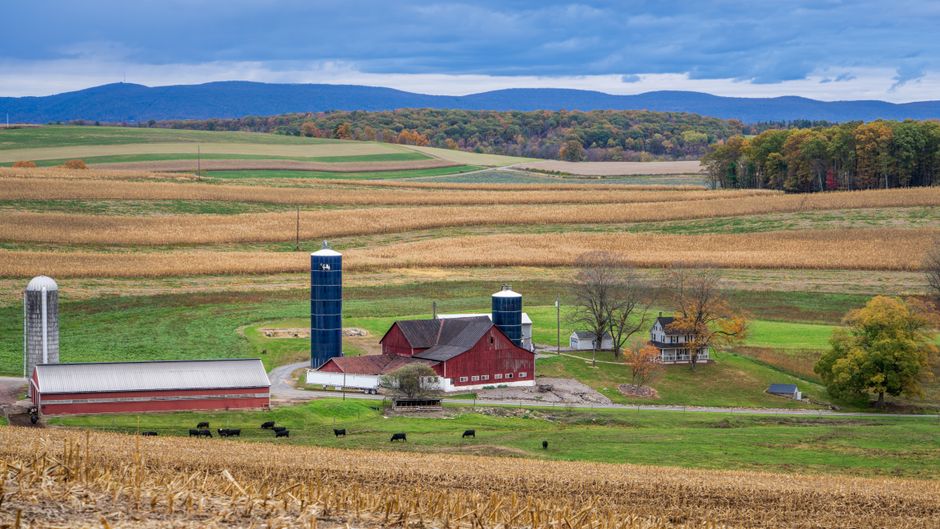

Pennsylvania
Your complete statewide energy guide: electricity rates, solar panel installation, home batteries, backup generators and EV charging. Compare incentives and utilities, find your city guide, then request a quote and get matched with a licensed installer who serves your area.
Electricity price: where Pennsylvania stands
The average a home paid per kilowatt-hour, compared with every state and D.C.
EIA Electric Power Monthly, residential average, July 2026 (preliminary). 1st is the cheapest.
Power outages: where Pennsylvania stands
Minutes a typical customer was without power in 2024, compared with every state and D.C.
See the year-by-year table and all 51 states →
EIA-861 reliability reports, 2019 to 2024. 1st is the fewest minutes. The year chips show Pennsylvania’s place each year, including major events.
Your Pennsylvania energy guide
Pennsylvania lets homes with solar bank credits at the full retail rate, and you can shop for your electricity supply. Four companies deliver most power: FirstEnergy Pennsylvania, PECO, PPL and Duquesne Light. A June 2026 state decision moves new PPL solar owners to hourly-priced credits, and FirstEnergy has asked for something similar. We found no state tax break for home solar. Winter storms, ice and summer thunderstorms are the main outage risks, and prices run above the national average.
Pennsylvania energy overview
Most Pennsylvania homes are served by FirstEnergy Pennsylvania (about 34 percent of customers: the former Met-Ed, Penelec, Penn Power and West Penn territories), PECO (about 28 percent, Philadelphia and the southeast), PPL Electric (about 24 percent, including the Lehigh Valley, Scranton and Wilkes-Barre) and Duquesne Light (about 10 percent, the Pittsburgh area). Rural electric cooperatives, UGI Utilities in Luzerne County and a few boroughs such as Chambersburg serve the rest. FEMA rates winter weather Very High for the state, with cold waves, heat waves and strong wind Relatively High. Your utility decides your solar rules, so check your bill first.
Pennsylvania at a glance
Price and outage ranks are at the top of the pageExplore energy guides by Pennsylvania city
Find your local utility, installation costs, rebates, permits, solar information and installer options for your Pennsylvania city. Search, pick your city, or browse by region; 32 city guides are published.
Philadelphia and Southeastern Pennsylvania
- Chester Energy GuideSolar · Battery · Generators · EV chargers
- King of Prussia Energy GuideSolar · Battery · Generators · EV chargers
- Lansdale Energy Guide
- Norristown Energy GuideSolar · Battery · Generators · EV chargers
- Philadelphia Energy GuideSolar · Battery · Generators · EV chargers
- Phoenixville Energy Guide
- Pottstown Energy GuideSolar · Battery · Generators · EV chargers
- West Chester Energy GuideSolar · Battery · Generators · EV chargers
Lehigh Valley
Lancaster, York and Reading
Harrisburg and Central Pennsylvania
- Altoona Energy GuideSolar · Battery · Generators · EV chargers
- Carlisle Energy GuideSolar · Battery · Generators · EV chargers
- Chambersburg Energy GuideSolar · Battery · Generators · EV chargers
- Harrisburg Energy GuideSolar · Battery · Generators · EV chargers
- Lebanon Energy GuideSolar · Battery · Generators · EV chargers
- State College Energy GuideSolar · Battery · Generators · EV chargers
- Williamsport Energy GuideSolar · Battery · Generators · EV chargers
Northeast Pennsylvania
Pittsburgh and Western Pennsylvania
- Baldwin Energy Guide
- Bethel Park Energy GuideSolar · Battery · Generators · EV chargers
- Erie Energy GuideSolar · Battery · Generators · EV chargers
- Monroeville Energy GuideSolar · Battery · Generators · EV chargers
- Murrysville Energy GuideSolar · Battery · Generators · EV chargers
- New Castle Energy GuideSolar · Battery · Generators · EV chargers
- Pittsburgh Energy GuideSolar · Battery · Generators · EV chargers
- Plum Energy GuideSolar · Battery · Generators · EV chargers
No guide for that name yet. Try another spelling, or use the quote form below and choose “Another Arizona city”.
Regional guides
Your city is not listed? The guides above are the ones we have published so far. Use the quote request to ask for installers anywhere in Pennsylvania, or read the incentives and laws below for the rules that apply statewide.
Explore Pennsylvania energy solutions
Four ways to use your own power at home. Choose your city and we take you to its page for that solution, or to the Pennsylvania quote form when the city has no page yet.
Solar panels and installation
Pennsylvania’s sun is middling (about 1,100 to 1,200 kWh a year per kW of panels in our city estimates), but power costs more than the national average and most utilities credit extra solar at retail, so a system sized to your own use can still pay. EnergySage puts the October 2026 average at $2.59 per watt, about $32,785 for a 12.64 kW system before incentives.
- Ask your utility, in writing, how a new system will be credited: PPL has moved to hourly-priced credits for new systems, and FirstEnergy has proposed the same.
- Pennsylvania has no state solar tax credit that we could confirm, and the federal home solar credit (25D) did not apply to spending after Dec. 31, 2025.
- Hire a contractor registered with the Attorney General and get at least three written proposals.
No city yet? Request an Arizona quote
Home battery backup
A battery keeps the lights on through winter ice and summer storms and lets you use midday solar in the evening. A 13 kWh home battery averages about $17,550 in Pennsylvania before incentives (EnergySage, October 2026). We found no state battery rebate.
- PPL’s storage policy says stand-alone batteries may not export power to the grid; a battery paired with solar goes through the same application.
- Boroughs set their own rules: Chambersburg’s application says battery storage needs the borough’s written approval.
- The federal credit for batteries (25D) did not apply to spending after Dec. 31, 2025.
No city yet? Request an Arizona quote
Standby generators
Ice storms, heavy snow, strong wind and summer thunderstorms cause multi-hour outages, so many homes keep a portable or standby generator, especially with a well pump or electric heat. State data show customers lost about 336 minutes of power in 2024 when major events are counted (131 without).
- A transfer switch is electrical work: use an electrician and expect a permit and inspection; electrical licensing is local in Pennsylvania, not statewide (not confirmed for every town).
- Run portable generators outdoors, well away from windows and doors, to avoid carbon monoxide poisoning.
- Never plug a generator into a wall outlet; back-feeding can injure line crews.
No city yet? Request an Arizona quote
Home EV charger installation
Pennsylvania had about 113,400 battery-electric and 55,900 plug-in hybrid cars registered through 2025, and 5,863 public charging ports at 2,073 locations (2,026 DC fast ports) in October 2026.
- The state’s Alternative Fuel Vehicle Rebate for buyers is closed, according to the Department of Environmental Protection.
- Electric vehicles pay a yearly Road User Charge in place of the fuel tax since April 1, 2025 (Act 85 of 2024).
- The federal charger credit (30C) ends for property placed in service after June 30, 2026; the state’s KEEP Home Energy Loan lists EV charging among eligible projects.
- Public ports: 5,907 statewide
No city yet? Request an Arizona quote
How Pennsylvania ranks among all states
The panels at the top give Pennsylvania’s place for price and outages. Here you can pick any year and compare every state side by side.
Pennsylvania in any year
Rank: 1st is the fewest minutes or interruptions among the 51 (50 states and D.C.). In every year from 2019 to 2024, Pennsylvania ranked between 22nd and 32nd for outage time including major events.
Every state, side by side
| State | Price, July 2026 (rank) | Outage minutes, all events (rank) | Outage minutes, no major events (rank) |
|---|
Prices: EIA Electric Power Monthly, residential average, July 2026 (preliminary). Outages: EIA-861 reliability reports, minutes without power per customer per year (SAIDI), customer-weighted across each state’s utilities. Utilities report on slightly different standards and a few states have little data, so a gap of a few minutes or a place or two is not meaningful. Rankings change from year to year.
How net metering works in Pennsylvania
Under the state’s Alternative Energy Portfolio Standards rules (52 Pa. Code Chapter 75), the big investor-owned utilities must offer net metering to customers who generate solar or other qualifying power on their own side of the meter. A home system can be up to 50 kW; other customers up to 3 MW. Each billing period, every kilowatt-hour your system makes is credited at the full retail rate, up to what you used; extra carries forward to later months. At the end of the year the utility pays for what is left at its price to compare, which is the supply-only part of the bill (11.8 to 14.1 cents per kWh across the big utilities since June 1, 2026), not the full retail rate. PPL’s yearly settlement happens at the end of May. Utilities may not add fees or equipment rules that are not authorized, and you keep the renewable energy credits unless your contract says otherwise.
The current rule text we read has only those size limits; the 200 percent-of-use cap the PUC adopted in 2016 is not in it. A law firm summary says the Commonwealth Court ruled in 2020 that the PUC’s independent-load requirement was invalid. If you buy your supply from a retail supplier instead of the utility, the supplier’s contract sets your credit terms and the utility credits only its delivery charge (52 Pa. Code 75.13(f)).
The rules are changing. On June 4, 2026 the PUC approved a PPL rate settlement. A power-industry analyst reports that systems in a 140 MW grandfathered group keep fixed-price credits until December 31, 2036, while other new PPL systems move to hourly-priced credits for the life of the project. FirstEnergy filed a similar proposal on February 3, 2026 for June 1, 2027, which is still pending. We found no change filed by PECO or Duquesne Light. Ask your utility in writing how a new system would be credited.
| Utility type | Export rule | Examples |
|---|---|---|
| Investor-owned: PECO and Duquesne Light | Statewide rule: monthly credit at the full retail rate, carry-forward, yearly payout at the price to compare. PECO uses a second ‘out’ meter; Duquesne Light bills under Rider 21. We found no change filed. | PECO, Duquesne Light |
| Investor-owned: PPL | Same statewide rule for grandfathered systems; hourly-priced credits for new systems after the June 2026 settlement (analyst report) | PPL Electric |
| Investor-owned: FirstEnergy Pennsylvania | Statewide rule today; hourly-priced credits proposed from June 1, 2027 and not yet decided | Former Met-Ed, Penelec, Penn Power, West Penn |
| UGI Utilities (electric) | Rule 17 in its tariff: surplus rolls into later bills and any year-end balance is paid at the price to compare (per UGI’s page); 2026 rate case pending | Luzerne and Wyoming counties |
| Co-ops and boroughs | Not guaranteed net metering under the PUC rules; each sets its own terms, forms and battery rules | Adams, Central, REA, Valley, Chambersburg borough and others |
| Customers of a retail supplier | Supplier’s contract sets the credit; the utility credits only the delivery part | Any customer who shops for supply |
Sources: 52 Pa. Code 75.13 (text read Oct. 21, 2026); PUC press release on PPL’s rate decision (June 4, 2026); Power Advisory analysis of the PPL settlement and FirstEnergy filing; PPL, PECO, Duquesne Light, UGI and FirstEnergy pages. We could not open the PUC order itself, so the hourly-pricing details are the analyst’s.
Pennsylvania energy incentives, rebates and tax credits
Statewide rules first, then the utility programs. Statuses were checked on October 21, 2026; amounts and rules change, so confirm on the program page before you count on one. The federal credits below have ended.
| Program | Available through | Eligible equipment | Amount or benefit | Eligibility | Status and source |
|---|---|---|---|---|---|
| Federal residential clean energy credit (25D) | Federal (IRS) | Rooftop solar and home batteries | Was 30% of cost | Not allowed for expenditures after December 31, 2025 | ENDED IRS FAQ |
| Federal home energy improvement credit (25C) | Federal (IRS) | Efficiency upgrades such as heat pumps, windows, insulation | Was up to 30% with annual limits | Ended for property placed in service after December 31, 2025 | ENDED IRS FAQ |
| Federal charger credit (30C) | Federal (IRS) | EV charging equipment | Was up to 30% of cost, with a cap | Ended for property placed in service after June 30, 2026 | ENDED IRS FAQ |
| Pennsylvania sales tax on home solar | State (Department of Revenue) | Solar panels | No exemption found | The Department of Revenue’s bulletin on the exemption for electricity-producing equipment says residential electric systems such as solar panels do not qualify; how a contractor’s installation bill is taxed was not confirmed | NOT CONFIRMED PA Revenue Sales and Use Tax Bulletin 2010-01 (July 28, 2010) |
| Pennsylvania state solar tax credit or rebate | State | Solar panels and batteries | None found | DEP’s page for residents lists only renewable energy credits and net metering as incentives for home solar | NOT CONFIRMED DEP Solar Energy Resource Hub for residents |
| Property tax on home solar | County and local assessors | Solar panels | No statewide exemption found | We found no state law that exempts home solar or tells assessors how to treat it; ask your county assessment office before you buy | NOT CONFIRMED DEP Solar Energy Resource Hub for residents (lists no property tax rule) |
| Net metering (52 Pa. Code 75.13) | Investor-owned utilities | Solar and other Tier I or II generation, up to 50 kW at a home | Monthly credit at the full retail rate; year-end balance paid at the price to compare | Customer-owned system on your side of the meter; PPL and FirstEnergy credit rules for new systems are changing | ACTIVE 52 Pa. Code 75.13 |
| PPL legacy rights for existing solar customers | PPL Electric | Home solar | Fixed-price credits until Dec. 31, 2036 for systems in a 140 MW group | Per an analyst report: interconnection application by Sept. 30, 2025 and operating by Dec. 31, 2026; the PUC approved the settlement June 4, 2026 | ACTIVE PUC press release on PPL rate decision; Power Advisory analysis |
| Alternative energy credits (AEPS solar credits) | Statewide market | Solar panels | Market price, not fixed; amount not confirmed | You own the credits unless your contract assigns them; sold through the state’s credit registry | ACTIVE DEP Solar Energy Resource Hub for residents |
| Pennsylvania Solar for All (PEDA, $156 million) | State (Pennsylvania Energy Development Authority) | Free or low-cost home solar for low-income households | Not open | EPA terminated the grant in 2025; PEDA’s page says the program is not operational and tells homeowners to ignore installers claiming to be partners; September 2026 court rulings went against EPA in other cases, and we could not confirm any effect here | NOT CONFIRMED DEP Solar for All page |
| KEEP Home Energy Loan | State (PEDA, run by NEIF) | Heating, cooling, water heating, EV charging, insulation and smart energy controls by approved contractors; solar not listed on DEP’s page | Loans of $2,500 to $25,000, below-market rates, 36 to 120 months | Owner-occupied home of up to four units on a permanent foundation; credit check | ACTIVE DEP KEEP Home Energy Loan |
| Penn Energy Savers (federal home energy rebates) | State (DEP) | Heat pumps, efficiency and electrification work | Not open; amounts not confirmed | DEP says it is adjusting the program to new federal guidance dated June 1, 2026 before launching it to consumers | NOT CONFIRMED DEP Inflation Reduction Act page |
| Act 129 Phase V efficiency rebates | Utilities with 100,000 or more customers | Heat pumps, smart thermostats and other efficiency equipment (not solar) | Amounts differ by utility and are not confirmed | Phase V runs June 1, 2026 to May 31, 2031; income-qualified households can get more | ACTIVE PUC press release on Phase V |
| PPL Electric rebates | PPL Electric | Heat pump water heaters, smart thermostats, dehumidifiers | $400 for a heat pump water heater; $50 or $100 for a smart thermostat; $25 or $50 for a dehumidifier | Page also showed a June 15, 2026 deadline that looks like the old program; current Phase V amounts not confirmed | NOT CONFIRMED PPL Electric all rebates |
| PECO electric vehicle bonus and thermostat discount | PECO | Electric vehicles; smart thermostats | $50 for telling PECO you bought an EV; discounted thermostats on its marketplace | PECO also lists an EV time-of-use rate and a Flex and Save program; we found no charger rebate | ACTIVE PECO EV programs and incentives |
| Duquesne Light EV time-of-use rate and smart charging rewards | Duquesne Light | Electric vehicles at home | Distribution rate of 9.93 cents peak and 7.94 cents off-peak; up to $80 a year in smart-charging rewards | Rate is limited to 1,500 customers, needs the time-of-use supply rate or a supplier rate, and an EV registration; we found no charger rebate | ACTIVE Duquesne Light EV time-of-use rate; smart energy rewards |
| Alternative Fuel Vehicle Rebate | State (DEP) | New and used electric and plug-in cars | Closed | DEP says the program is closed | ENDED DEP Alternative Fuel Vehicle Rebates |
Federal credits are shown separately. State and utility programs change often; rows marked NOT CONFIRMED are ones where we could not read a current amount or status. Checked Oct. 21, 2026.
Pennsylvania has no plug-in (balcony) solar law yet: House Bill 1971 (a 1.2 kW cap and no utility interconnection agreement) was still in committee in June 2026 and Duquesne Light has raised safety objections, so treat any system that feeds your home wiring as needing your utility’s approval (not confirmed).
Electricity providers across Pennsylvania
Your provider depends on your address, not on your city. A ZIP code or a city can overlap several territories, so check the top of your electric bill or ask the utility with your street address. We do not guess a provider from a ZIP code.
| Utility | General service region | Structure | Solar export rules | Special programs |
|---|---|---|---|---|
| FirstEnergy Pennsylvania (former Met-Ed, Penelec, Penn Power, West Penn) | Reading, York, Altoona, Erie, New Castle, parts of the Pittsburgh and Harrisburg suburbs and much of central and western Pennsylvania outside PPL and Duquesne territory | Investor-owned; about 2.09 million customers (34 percent of the state); delivery rates set by the PUC; customers may buy supply from a retail supplier | Statewide net metering rule applies today; a Feb. 3, 2026 filing proposes hourly-priced credits from June 1, 2027 (pending) | Level 1 application fee $100 for inverter systems of 10 kW or less; Act 129 Phase V rebates since June 1, 2026 (amounts not confirmed) |
| PECO | Philadelphia and the southeastern suburbs | Investor-owned; about 1.71 million customers (28 percent); PUC-regulated; supply can be bought from a retail supplier | Statewide credit rules with a second ‘out’ meter (PECO credits up to $400 toward it); optional time-of-use solar rates; yearly cash-out | $50 for reporting an EV; discounted thermostat; withdrew a 2026 base-rate request on April 16, 2026 |
| PPL Electric Utilities | Lehigh Valley, Lancaster and Harrisburg areas, Scranton and Wilkes-Barre, and parts of central Pennsylvania | Investor-owned; about 1.49 million customers (24 percent); the PUC approved a $275 million base-rate increase effective July 1, 2026 | Grandfathered systems keep fixed-price credits to Dec. 31, 2036; new systems get hourly-priced credits (analyst report); yearly cash-out about 13.1 cents per kWh for July 1 to Nov. 30, 2026 (PPL page) | Level 1 fee $100; stand-alone batteries may not export; rebates listed on its site (current amounts not confirmed) |
| Duquesne Light | Pittsburgh and Allegheny County area | Investor-owned; about 614,000 customers (10 percent); 2024 residential average 21.74 cents per kWh, the highest of the big four | Statewide credit rules under Rider 21; Level 1 fee $100, Level 2 $250 plus $1 per kW (per its page) | EV time-of-use distribution rate (1,500-customer cap); smart charging rewards up to $80 a year |
| UGI Utilities (electric) | Luzerne and Wyoming counties, including Kingston, Plymouth and Nanticoke | Investor-owned; about 62,700 customers; filed a base-rate case on March 27, 2026 asking about $17.3 million a year | Rule 17 net metering: surplus rolls into later bills, unused balance paid at the price to compare at year end | We found no solar, battery or EV rebates |
| Co-ops and municipal utilities | Rural areas and some boroughs: Adams, Central, REA, Tri-County, Northwestern, Valley, Claverack and Somerset co-ops; Chambersburg borough | Member-owned or borough-owned; rates not set by the PUC; customers cannot switch supply | Not covered by the PUC net metering rules as far as we could confirm; Chambersburg’s form covers inverter systems of 10 kW or less and requires approval for batteries | Ask each utility; we did not confirm programs |
Customer shares: EIA-861, 2024. Territories are from the EIA-861 service-territory file and each utility’s own pages. Detail for each city is in the city guides.
Pennsylvania electricity costs and regional differences
Your bill has a delivery part set by the PUC in each utility’s rate case and a supply part, the price to compare, that resets every June 1 and December 1 and that you can replace by shopping for a supplier.
| Measure | Scope | Value | Source and date |
|---|---|---|---|
| Residential average price | Pennsylvania, July 2026 (preliminary) | 21.72 cents per kWh (U.S. 18.31) | EIA Electric Power Monthly |
| Residential average price | Pennsylvania, July 2026 | 21.72 cents per kWh | EIA Electric Power Monthly Table 5.6.A (preliminary), Sept. 2026 release |
| Same month a year earlier | Pennsylvania, July 2025 | 19.51 cents per kWh | EIA Electric Power Monthly Table 5.6.A |
| Year to date | Pennsylvania, Jan. to Jul. 2026 | 21.04 cents per kWh | EIA Electric Power Monthly Table 5.6.B (preliminary) |
| Price to compare since June 1, 2026 | Duquesne Light (estimate), Met-Ed, Penn Power, PPL, Penelec, West Penn, PECO | 14.14, 13.95, 13.48, 13.15, 13.14, 12.08 and 11.76 cents per kWh | PUC press releases of May 20 and June 1, 2026 |
| Utility residential averages | FirstEnergy, PECO, PPL, Duquesne Light, UGI, 2024 | 17.37, 16.16, 16.99, 21.74 and 18.93 cents per kWh | EIA-861, 2024 |
| Co-op and borough residential averages | Eight co-ops and Chambersburg, 2024 | 13.96 to 20.08 cents per kWh (Chambersburg 11.95) | EIA-861, 2024 |
| Outage time | Pennsylvania, 2024 | 336.1 minutes per customer with major events (131.0 without) | EIA-861 reliability data, 2024 |
| Solar cost | Pennsylvania, Oct. 2026 | $2.59 per watt; $32,785 for 12.64 kW | EnergySage, updated Oct. 16, 2026 |
| PPL base-rate increase | PPL Electric, approved June 4, 2026 | $275 million a year, effective July 1, 2026 | PUC press release, June 4, 2026 |
- Prices rose about 11 percent from July 2025 to July 2026 (19.51 to 21.72 cents per kWh); the 2026 numbers are preliminary.
- PECO withdrew a request that would have raised a typical residential electric bill 12.5 percent starting January 2027 (April 16, 2026); we found no pending base-rate request from Duquesne Light or FirstEnergy.
- About 1.4 million Pennsylvanians had switched suppliers as of September 2026 (PA Power Switch); fixed and variable plans differ, so read the terms and expiry date.
Run your own numbers with the solar savings calculator and the battery backup calculator. Local detail is in your city guide.
| What it costs | Typical figure | Source |
|---|---|---|
| Rooftop solar, installed | $2.59 per watt (EnergySage, October 2026) | EnergySage Pennsylvania |
| Home battery | About $17,550 for 13 kWh before incentives | EnergySage |
| Home EV charger install | About $800 to $3,000 before the charger (a U.S. range) | EnergySage, 2026 |
Solar and backup power across Pennsylvania
Pennsylvania is not one climate. What you plan for depends on where you live.
Philadelphia and Southeastern Pennsylvania. Philadelphia, Chester, Norristown, King of Prussia, West Chester, Phoenixville, Lansdale and Pottstown. PECO serves most homes, with FirstEnergy and PPL at the edges. FEMA rates the county risk Very High in Philadelphia, with heat waves, cold waves and winter weather all Very High. Plan for heat, ice and storm outages. Read the Philadelphia and Southeast guide.
Lehigh Valley. Allentown, Bethlehem and Easton. PPL delivers power here, so the June 2026 settlement on solar credits matters most. FEMA rates county risk Relatively Moderate. Winter storms and summer thunderstorms are the main outage causes. Read the Lehigh Valley guide.
Lancaster, York and Reading. Lancaster, York and Reading. Lancaster and York counties mix PPL, FirstEnergy (Met-Ed) and PECO territory, so your address decides your solar rules. Lancaster County is rated Relatively High for hazards. Ask which company sends your bill before you sign a solar contract. Read the Lancaster and York guide.
Harrisburg and Central Pennsylvania. Harrisburg, Carlisle, Lebanon, Chambersburg, State College, Altoona and Williamsport. PPL and FirstEnergy share the area, rural cooperatives serve the edges and Chambersburg runs its own borough utility. Blair, Centre and Lycoming counties rate Relatively Low for hazards; Dauphin is Relatively Moderate. Read the Harrisburg guide.
Northeast Pennsylvania. Scranton, Wilkes-Barre and Hazleton. PPL serves most homes, UGI Utilities serves parts of Luzerne County and the Claverack co-op serves rural pockets. Hazard ratings are Relatively Moderate, and winter weather and cold are the main planning issues. Read the Northeast Pennsylvania guide.
Pittsburgh and Western Pennsylvania. Pittsburgh, Bethel Park, Monroeville, Plum, Murrysville, Baldwin, New Castle and Erie. Duquesne Light serves the Pittsburgh core, FirstEnergy (West Penn, Penn Power, Penelec) the suburbs and outlying towns, and co-ops the rural edges. Allegheny County is Relatively High for hazards. Expect winter storms and strong wind. Read the Pittsburgh guide.
Which approach fits?
| If you mainly want to | Consider | Why |
|---|---|---|
| Cut a bill that is mostly cooling or heating | Solar, sized to your own use | Power used at home saves the full retail price; what exports earn depends on your utility |
| Keep essentials on through storms or freezes | A battery, or solar plus a battery | The battery keeps lights, internet and a refrigerator on automatically |
| Run central air or heat for days in an outage | A standby generator (or a very large battery) | A generator runs as long as it has fuel; a battery is silent and automatic |
| Power a remote property without a utility | Off-grid solar, batteries and a generator | No service line needed; sized to your loads |
Details and costs are in each city’s guides. See also our backup power guide.
Pennsylvania energy laws, licensing and permits
| Topic | What applies statewide | Where to check |
|---|---|---|
| Contractor registration | Home improvement contractors must register with the Attorney General’s Bureau of Consumer Protection and show their registration number; the Attorney General’s phone line (1-888-520-6680) and website let you check. Written contracts are required for work over $500 | Attorney General contractor search |
| Electrician licensing | We found no statewide electrician license; cities such as Philadelphia and Pittsburgh license locally (not confirmed for every town), so ask your electrician for the local license | Attorney General contractor search (registration only) |
| Net metering and credits | 52 Pa. Code Chapter 75: 50 kW home limit, full-retail monthly credit, yearly payout at the price to compare, no unauthorized fees or insurance rules | 52 Pa. Code 75.13 |
| Utility interconnection | Apply before you install; Level 1 (inverter systems of 10 kW or less) fees of $100 are listed by FirstEnergy, PPL and Duquesne Light, and Level 2 is $250 plus $1 per kW (FirstEnergy, Duquesne Light). The utility installs a bidirectional meter after an electrical inspection | FirstEnergy Pennsylvania interconnection |
| Building and electrical permits | The Uniform Construction Code, adopted with the 2021 International Codes effective Jan. 1, 2026, applies where a municipality enforces it; some use a state-certified third-party agency for plan review or electrical inspection | L&I certified third-party agencies |
| HOA and solar rights | We found no enacted statewide law; House Bill 1239 passed the House 109-93 on July 1, 2026 and still needs the Senate and governor | Law firm summary of HB 1239 |
| Retail electricity choice | Customers of the big investor-owned utilities can buy supply from a licensed supplier through the PUC-run PA Power Switch; co-op and borough customers generally cannot | PA Power Switch |
| Solar sales consumer rules | The Home Improvement Consumer Protection Act applies to solar sales: written contract, registration number and a right to cancel (the Attorney General’s brochure says within three business days); get the system size, price and credit terms in writing | Home Improvement Consumer Protection Act text |
| Batteries and generators | Covered by the building and electrical codes and your utility’s interconnection rules; PPL says stand-alone batteries may not export, and Chambersburg requires written approval for batteries; no statewide residential battery rule found | L&I certified third-party agencies |
Find your city’s installation requirements. Choose your city above for local permits, codes and utility steps.
Pennsylvania EV charging and alternative fuel corridors
Pennsylvania has 5,907 public charging ports at 2,081 locations: 3,837 Level 2 and 2,058 DC fast (Alternative Fuels Data Center, public and open stations, read 2026-10-21). DC fast ports are listed in 208 of the 414 Pennsylvania cities with public chargers. About 113,400 battery-electric cars were registered through 2025, so home charging does most of the work.
Drive on another fuel? See every alternative fuel station in Baldwin: hydrogen, propane, natural gas, E85 ethanol, biodiesel and renewable diesel.
Where the fast chargers are. The biggest counts are in Philadelphia (144), Pittsburgh (102), Allentown (48), Harrisburg (46), Middletown (44), Erie (40).
The federal government certified Pennsylvania’s highway charging corridors as fully built out on Sept. 22, 2025, which lets PennDOT spend NEVI funds on any public road. Its page lists 88 active NEVI projects in 46 counties ($58.4 million in federal money) and says Pennsylvania has more operational NEVI-funded stations than any other state (more than 50). A $100 million community charging program began opening regional rounds in February 2026, though the federal government has been withholding some charging money.
| Fuel | Public stations in Pennsylvania | Station directories |
|---|---|---|
| EV charging | 2,081 locations | Statewide map · EV charging guide |
| Propane autogas | 76 | Propane guide |
| E85 ethanol | 217 | E85 guide |
| Compressed natural gas (CNG) | 27 | CNG guide |
| Biodiesel | 0 | Biodiesel guide |
| Renewable diesel, hydrogen, LNG | 0, 0, 0 | Few or none listed in Pennsylvania |
Station directories by city (each has its own map, addresses and directions): Allentown · Altoona · Bethlehem · Carlisle · Chambersburg · Chester · Erie · Harrisburg · Hazleton · New Castle · Norristown · Philadelphia · Pittsburgh · Plum · Pottstown · Reading · Scranton · State College · West Chester · Wilkes-Barre · Williamsport · York.
Pennsylvania energy updates
Verified statewide developments only, each with a date and an official source. Last checked 2026-10-21.
The PUC voted 5-0 to approve a $275 million base-rate increase for PPL effective July 1, 2026, with a legacy-rights framework for existing solar customers. An analyst reports that new systems move to hourly-priced credits.
Source: PUC press releaseFirstEnergy’s default service filing for June 2027 to May 2031 proposes hourly pricing for net-metered customers with 3 years of protection for existing projects; a decision was expected in fall 2026.
Source: Power Advisory analysisPECO withdrew its electric and gas rate filings, which would have taken effect in January 2027, after the governor demanded it.
Source: NBC10 PhiladelphiaHouse Bill 1239 passed 109-93; it would bar associations from banning solar on individually owned roofs and now goes to the Senate.
Source: King Spry law firm summaryRulings in Rhode Island (Sept. 18) and Washington, D.C. (Sept. 22) went against EPA; we could not confirm any effect on Pennsylvania’s $156 million award, and PEDA’s page still says the program is not operational.
Source: PV TechGet a quote and connect with licensed installers in your area
Ready to move forward? Tell us where your property is and which project you are considering: solar panels, a home battery, a standby generator or an EV charger. We reply ourselves and match you with a licensed installer who serves your area. It is free, with no obligation, and nothing is shared with an installer unless you choose one. We only say an installer serves your area when we have checked it.
Start your request
1. Choose your project. 2. Choose your location. 3. Continue to the form, which asks the project questions and your contact details.
Nothing is typed or sent on this step. We reply ourselves, and your details go only to an installer you choose.Are you a licensed installer in Pennsylvania? Join SolutionEnergy and get requests from homeowners and businesses →
Pennsylvania energy FAQs
What is the average electricity rate in Pennsylvania?
Statewide, the residential average was 21.72 cents per kWh in July 2026 (EIA, preliminary), against 18.31 cents for the U.S. Individual utilities and plans differ, so check your own bill.
Does Pennsylvania have net metering?
Yes, for customers of the investor-owned utilities. Under 52 Pa. Code 75.13, home systems up to 50 kW earn a monthly credit at the full retail rate up to what you use, extra carries forward, and the yearly leftover is paid at the utility’s price to compare. Co-ops and boroughs set their own terms.
Is there a limit of 200 percent of my yearly use?
Not in the current rule text we read; it has only the 50 kW home limit. The PUC adopted a 200 percent cap in 2016 and it is not in the code today. Proposals to bring back a use-based limit have been reported, but we found none enacted. Size the system to your own use anyway, because yearly leftovers pay only the supply price.
Will new solar customers of PPL still get full retail credit?
Not as before. The PUC approved a PPL settlement on June 4, 2026, and an analyst reports that a 140 MW group of existing and near-complete systems keeps fixed-price credits until Dec. 31, 2036, while other new systems get hourly-priced credits. Ask PPL in writing how your system would be credited before you sign.
What about FirstEnergy, PECO and Duquesne Light?
FirstEnergy filed on Feb. 3, 2026 to move customers to hourly-priced credits starting June 1, 2027; that is still pending. We found no similar filing from PECO or Duquesne Light, so the statewide full-retail rule applies to their customers today.
If I shop for an electricity supplier, what happens to my solar credit?
Your supplier’s contract sets the credit for extra power, and the utility credits only its delivery charge, per 52 Pa. Code 75.13(f). The PUC’s PA Power Switch site compares offers; ask suppliers about solar credits before you switch.
Is there a Pennsylvania tax credit or sales tax exemption for home solar?
We found none. The Department of Revenue’s bulletin says residential solar does not qualify for the exemption that covers electricity-producing equipment, and DEP’s resident page lists no state tax incentive. Property tax treatment is set locally; we could not confirm it, so ask your county assessor.
What happened to Solar for All in Pennsylvania?
The state was awarded $156 million in 2024, EPA terminated the grant in 2025, and PEDA’s page says the program is not operational. Courts ruled against EPA’s termination in other cases in September 2026, but we could not confirm any effect in Pennsylvania. Ignore installers claiming to be program partners.
Can my HOA stop me from installing solar?
We found no enacted Pennsylvania law that protects you, so your HOA rules and deed restrictions apply. House Bill 1239, which would bar associations from banning solar on individually owned roofs, passed the House on July 1, 2026 and is waiting on the Senate. Get written approval before you sign.
Do co-op and borough customers get net metering?
Not guaranteed. The state net metering rules cover the investor-owned utilities, so each co-op or borough sets its own terms, fees and battery rules. Chambersburg borough, for example, has its own application for inverter systems of 10 kW or less.
What permits and contractor checks do I need?
Expect a building and electrical permit from your municipality (or its third-party agency), a utility interconnection application before you install, and a final inspection before the utility switches your meter. Pennsylvania requires home improvement contractors to register with the Attorney General; check the number, and get a written contract.
Where can I find EV charging stations across Pennsylvania?
The Department of Energy map lists 5,907 public ports, and our city pages list stations near you.
How do I find qualified installers in my city?
Choose your city in the directory above, or use the quote request. We reply ourselves and suggest licensed installers that serve your area.
Sources, editorial policy and updates
| Figure or rule | Scope | Source | Data period | Verified |
|---|---|---|---|---|
| Residential electricity price, U.S. comparison | Pennsylvania statewide | EIA Electric Power Monthly | July 2026 (preliminary) | 2026-10-03 |
| Outage minutes and customer counts by utility | Pennsylvania statewide and by utility | EIA-861 | 2024 | 2026-10-21 |
| Net-metered home solar systems | Pennsylvania residential, net-metered only | EIA-861 Net Metering | 2024 | 2026-10-03 |
| Solar resource | Pennsylvania cities | NASA POWER | 2001-2020 | 2026-10-03 |
| Weather hazards | Pennsylvania statewide | FEMA National Risk Index | December 2025 | 2026-10-03 |
| Public charging and fuel stations | Pennsylvania statewide | Alternative Fuels Data Center | Read 2026-10-21 | 2026-10-21 |
| Federal credits | U.S. | IRS | In force 2026 | 2026-10-21 |
| Net metering rules and size limits | Pennsylvania | 52 Pa. Code 75.13 (LII) | Text read Oct. 2026 | 2026-10-21 |
| PPL rate decision and net metering framework | PPL Electric | PUC press release, June 4, 2026 | June 2026 | 2026-10-21 |
| Hourly pricing, 140 MW legacy group, FirstEnergy filing | PPL and FirstEnergy | Power Advisory analysis | 2026 filings | 2026-10-21 |
| Residential price | Pennsylvania | EIA Electric Power Monthly Table 5.6.A | July 2026 (preliminary) | 2026-10-21 |
| Price to compare | Pennsylvania utilities | PUC press release, June 1, 2026 | June 1, 2026 | 2026-10-21 |
| Outage minutes and utility averages | Pennsylvania | EIA-861 | 2024 | 2026-10-21 |
| Solar and battery costs | Pennsylvania | EnergySage solar cost | Oct. 2026 | 2026-10-21 |
| Sales tax and residential solar | Pennsylvania | PA Revenue Bulletin 2010-01 | July 28, 2010 | 2026-10-21 |
| Solar for All status | Pennsylvania | DEP Solar for All page | Read Oct. 2026 | 2026-10-21 |
| FirstEnergy interconnection fees and steps | FirstEnergy Pennsylvania | FirstEnergy Pennsylvania interconnection | Read Oct. 2026 | 2026-10-21 |
General information, not financial, tax, legal or electrical advice. Estimates are ours and are not promises. See our editorial policy. Full source notes for this page are kept with the site’s data files and refreshed when a program changes.