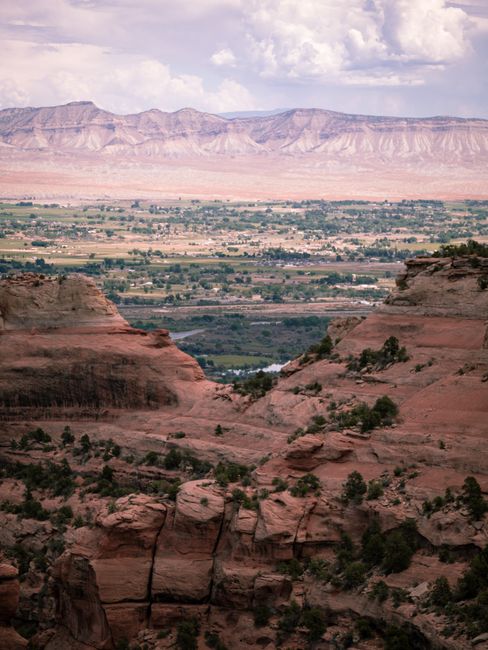
In short: Grand Junction homes buy power from Xcel Energy or Grand Valley Power, at about 15 to 16¢ per kWh in 2024. The valley gets more sun than Denver, about 1,460 kWh a year per kW of panels by our estimate, and FEMA rates Mesa County’s overall natural hazard risk “relatively low.”
Below: what each utility means for solar, batteries and EVs, what backup power is worth here, and how Mesa County handles permits. For statewide rules (net metering law, the plug-in solar law, tax exemptions, electrician licensing), see our Colorado energy guide.
Western Slope at a glance
- Two main utilities: Xcel Energy and Grand Valley Power, a member-owned co-op, both serve Mesa County; which one you have depends on your address. Your bill tells you.
- Grand Valley Power: about 15.9¢ per kWh for homes in 2024; 94 minutes without power per customer (EIA-861, 2024).
- Xcel Energy: about 15.1¢ per kWh; 352 minutes out with major events, 158 without, across its whole Colorado system, most of it on the Front Range.
- Sun: about 5.01 kWh per square meter per day in Grand Junction, with almost 8 in June (NASA POWER, 2001–2020). Our rough estimate: about 1,460 kWh a year per kW of panels.
- Top hazards: FEMA’s National Risk Index (December 2025) rates Mesa County’s overall risk “relatively low”, with landslides and lightning its highest-rated hazards, then drought, flooding, wildfire and winter weather.
- Public charging: 136 public charging ports at 68 locations in Grand Junction (AFDC, October 2026).
Your utility and what it means
Xcel Energy runs the same Colorado programs here as on the Front Range, under the state Public Utilities Commission:
- Net metering: extra solar goes into a “solar bank.” Choose continuous rollover and each extra kWh becomes a dollar credit at the energy rate that never expires (it cannot pay the monthly service charge or be cashed out); otherwise Xcel pays the bank out once a year at a much lower rate. New systems are capped at an expected 200% of your past year’s use.
- Time of use: on Xcel’s time-of-use rate, 5 to 9 p.m. on weekdays is the expensive window; you can opt for the flat rate.
- Renewable Battery Connect: $250 per kW of battery output up front (up to $5,000) plus $100 a year for five years, for listed Tesla and Enphase batteries.
- EV charging: a charger and wiring rebate of up to $500 (up to $2,300 for income-qualified homes).
Our Denver guide explains each Xcel program in more detail, with links to Xcel’s pages.
Grand Valley Power is a co-op owned by its members, with its own rates and solar rules. We could not read its program pages this month, so ask GVP directly for its net metering terms, any rebates and any time-of-use plan before you sign a solar or battery contract. Colorado law sets net metering rules for larger co-ops; the state page explains them.
Backup power on the Western Slope
Mesa County’s lower hazard ratings, and the fact that none of Xcel’s wildfire shutoffs from 2024 to 2025 named it, mean backup power is less pressing here than along the Front Range. Grand Valley Power’s 94 minutes a year is about an hour and a half without power. The reasons to plan for more are personal ones: medical equipment, a well pump, a home office, or a property out of town at the end of a long line.
- Short outages: a portable power station keeps Wi-Fi, lights, a fridge for a while and a CPAP running.
- Longer cover: a home battery paired with solar, or a standby generator on a transfer switch. In Mesa County a generator needs its own permit; see generator installation.
Compare the options in our backup power guide and size them with the battery backup calculator and generator sizing tool. Run a generator outdoors only, at least 20 feet from the house with the exhaust pointed away, and keep carbon monoxide alarms inside (CPSC).
Solar on the Western Slope
Grand Junction gets more sun than Denver or Fort Collins, and the most in June of any Colorado area we cover. By our rough estimate each kW of panels makes about 1,460 kWh a year, worth about $220 at Xcel’s 2024 average price or $233 at Grand Valley Power’s when you use it yourself. On Xcel, rollover credits keep most of the value of what you export. Summer sun is strong, so panels and inverters should be rated for heat. These are estimates, not quotes.
Check your roof with the solar potential tool and solar savings calculator, then read how solar installation works, what it costs and how net metering works. Farms and ranches with more land than roof may look at ground mounts, which need extra approvals (below); our off-grid guide covers cabins and outbuildings.
Home batteries on the Western Slope
On Xcel, a battery mainly shifts solar into the 5 to 9 p.m. peak and covers outages, and Battery Connect pays part of the cost. On Grand Valley Power, ask whether it has a time-of-use plan or a battery program before deciding. Keep the battery within the maker’s temperature range, out of direct summer sun. See home batteries, battery costs and battery installation.
EV charging on the Western Slope
At about 30 kWh per 100 miles, home charging costs roughly $4.50 per 100 miles at Xcel’s 2024 average price and $4.80 at Grand Valley Power’s (estimates). With 136 public ports in Grand Junction and long drives between towns, a home charger matters more here. A Level 2 charger needs a 240-volt circuit and a permit, installed by a licensed electrician. See EV charger installation and the EV charging cost calculator.
Drive on another fuel? See every alternative fuel station in Grand Junction: hydrogen, propane, natural gas, E85 ethanol, biodiesel and renewable diesel.
Permits and inspections
Mesa County’s Building Division (200 S. Spruce St., Grand Junction) publishes a solar energy systems guide. Key points:
- Batteries count as part of the solar system and go on the same application, with a full wiring diagram and spec sheets.
- Roof strength: rooftop systems need structural calculations from a Colorado professional engineer, and the site plan must show fire access pathways.
- Extra clearances: inside Grand Junction city limits and in unincorporated Mesa County, planning and fire clearance are required. Ground-mounted home systems need planning clearance everywhere.
- Generators: need a separate permit.
- Utility approval: Xcel asks you not to start building until it approves the interconnection; ask GVP for its steps. HOAs: get written approval before you sign.
Cities we cover
- Grand Junction
Get help on the Western Slope
Are you a licensed installer in Grand Junction? Join SolutionEnergy and get requests from homeowners and businesses →
Tell us about your project and we will connect you with a licensed, independent installer who serves the Western Slope area. It is free, there is no obligation, and only the installer you choose gets your details. Read how it works.
Western Slope energy questions
Is Grand Junction on Xcel Energy or Grand Valley Power?
Both serve the area, and the answer depends on your address, not just your city. Check a past bill or ask either utility. It matters: each sets its own solar credit, rate plans and rebates.
Is solar worth more in Grand Junction than in Denver?
Somewhat. NASA’s data puts Grand Junction’s sun about 3% above Denver’s over the year and well above it in summer. At similar power prices, that means a bit more value per panel. Your roof, shade and utility rules matter more than the city.
Do I need a permit for a home battery in Mesa County?
Yes. Mesa County treats energy storage as part of an active solar energy system, so it goes on the permit application with a wiring diagram and spec sheets. A standby generator needs its own, separate permit.
Has the Western Slope had wildfire power shutoffs?
None of Xcel’s shutoffs from April 2024 to December 2025 named Mesa County; they were along the Front Range. Wildfire is still a “relatively moderate” risk here, so sign up for your utility’s outage alerts, especially outside town.
Sources
EIA-861, 2024 data (price = residential revenue ÷ sales; service territory by county); Xcel Energy Colorado program pages and newsroom releases, April 2024 to December 2025; Mesa County Building Division solar energy systems guide; NASA POWER, 2001–2020; FEMA National Risk Index, December 2025; AFDC station data; CPSC. All read October 2026. Estimates are ours and labelled.