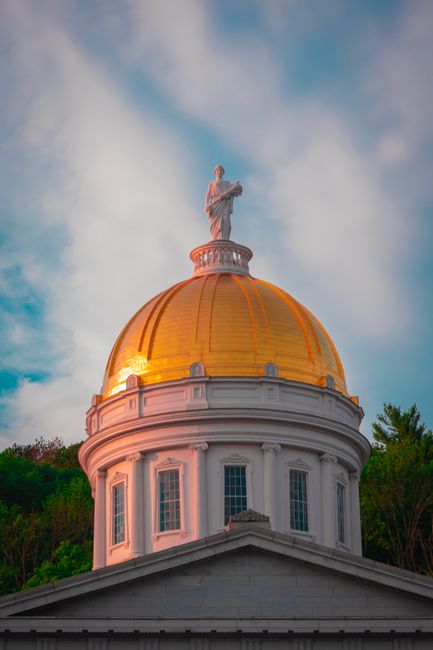
In short: Central Vermont homes are on Green Mountain Power, at about 22.1¢ per kWh in 2024, or in 41 mostly rural towns on member-owned Washington Electric Co-op, which lends a free Level 2 charger and pays $10 a month for off-peak charging. Montpelier gets the least sun of Vermont’s main cities, and a March 2025 ice storm hit central Vermont.
Below: what GMP and Washington Electric offer for solar, batteries and EVs around Montpelier, Barre and Rutland, how permits work, and storm planning. For statewide rules (net metering rates, the plug-in solar law, tax exemptions, licensing), see our Vermont energy guide.
Central Vermont at a glance
- Utilities: in Washington County, EIA lists Green Mountain Power (GMP), Washington Electric Co-op (WEC) and the municipal utilities of Northfield and Hardwick. In Rutland County it lists GMP only. Check your bill.
- Price, 2024 average: GMP about 22.1¢ per kWh for homes (EIA-861, revenue divided by sales). WEC averaged about 27.4¢ across all its customers.
- Outages, 2024: GMP reported 667 minutes per customer with major events and 281 without, under a non-IEEE standard (EIA-861). WEC did not appear in EIA’s reliability data.
- Sun: about 3.47 kWh per square meter per day in Montpelier and 3.66 in Rutland (NASA POWER, 2001–2020). Our rough estimate: about 1,010 and 1,070 kWh a year per kW of panels.
- Top hazards: FEMA’s National Risk Index (December 2025) rates Washington County “relatively moderate” for landslides, lightning and winter weather, and Rutland County “relatively moderate” for ice storms, lightning, strong wind and winter weather.
- Public charging: Montpelier 39 public ports, Rutland 36, Barre 17 (AFDC, October 2026).
Your utility and what it means
Washington Electric Co-op is member-owned and serves members in 41 Vermont towns, mostly rural.
- EV rebates: $500 for an electric vehicle and $250 for a plug-in hybrid, new or used, plus $500 more for income-qualifying members.
- PowerShift: WEC provides an eligible Level 2 charger at no cost, plus any transformer upgrade. Efficiency Vermont currently offers $500 toward installation. Avoid charging from 3 to 10 p.m. and you earn a $10 monthly bill credit, about $120 a year. Plug-in hybrids are not eligible yet, and a licensed electrician must install the charger.
- Solar: WEC publishes its own net metering tariff, application, interconnection forms and wiring schematics. Read them with your installer before you sign.
Green Mountain Power (listed in both counties; check your bill):
- Batteries: lease two batteries for $55 a month or $5,500 upfront over ten years, or join Bring Your Own Device, which pays $850 per kW enrolled for three-hour discharge or $950 for four hours, up to $10,500.
- EVs: up to $1,500 on a new all-electric car ($2,500 with the income adder), a free Level 2 charger while you stay in GMP’s home charging program, and up to $500 toward installation for EVs bought or leased in 2026. Two EV rates: Rate 72, where GMP manages charging around 5 to 7 peaks a month, and Rate 74, with a fixed 1 to 9 p.m. weekday peak.
Backup power in Central Vermont
In late March 2025 an unusual spring ice storm coated parts of central and southern Vermont, and by March 30 GMP had restored more than 14,000 customers. GMP’s resilience plan names rural central and southern Vermont as the hardest-hit areas it is working on first. For homes on long rural lines, a day or more without power is a realistic plan.
- GMP homes: a home battery through the lease or BYOD gives automatic backup and earns credits. Size it with the battery backup calculator.
- Wells, wood boilers and long outages: a generator with a transfer switch. WEC reminds members that a standby unit needs regular exercise runs and fresh fuel. See generator installation and the generator sizing tool.
- Apartments and camps: a portable power station.
Compare options in our backup power guide. Run generators outdoors only, at least 20 feet from the house with the exhaust pointed away, keep snow off the exhaust, and fit carbon monoxide alarms inside (CPSC).
Solar in Central Vermont
Sun is the limit here. By our rough estimate, a 6 kW system makes about 6,100 kWh a year in Montpelier and 6,400 in Rutland, about 5% more. Used at home, that would have been worth about $1,340 and $1,420 at GMP’s 2024 average price. December sun in Montpelier is less than a fifth of July’s, so solar banks credit in summer for winter. These are estimates, not quotes.
Check your roof with the solar potential tool and solar savings calculator, then read how solar installation works, what it costs and how net metering works.
Home batteries in Central Vermont
GMP customers have two paths: lease, with a fixed price, or own a battery and collect the BYOD payment. For example, 5 kW enrolled at three hours would earn $4,250. We found no WEC home battery rebate, so for co-op members a battery is mainly backup. In deep winter, solar recharge is weak, so many rural homes keep a generator too. See battery costs and battery installation.
EV charging in Central Vermont
At 30 kWh per 100 miles, home charging costs about $6.60 per 100 miles at GMP’s 2024 average home price (our estimate), less on its EV rates. For WEC we can only use its all-customer average, about $8.20 per 100 miles, before the PowerShift credit. Both utilities supply a free Level 2 charger in their programs. A Level 2 charger needs a 240-volt circuit installed by a licensed electrician. See EV charger installation and the EV charging cost calculator.
Drive on another fuel? See every alternative fuel station in Montpelier: hydrogen, propane, natural gas, E85 ethanol, biodiesel and renewable diesel.
Permits and inspections
- State rule: Vermont’s Division of Fire Safety does not require a state electrical permit for owner-occupied single-family homes, but a licensed electrician must do the work and local permits may apply. Rentals and duplexes need a state electrical permit.
- Rutland: the city’s Building Department has a building inspector and posts its fee schedule; building and zoning permits are applied for through the city.
- Montpelier and Barre: ask the city planning and zoning office about building or zoning permits for a generator pad or ground-mounted array.
- Net metering: solar is registered with the Public Utility Commission through ePUC and your utility.
License checks are on the state page. Check condo or HOA rules before you sign.
Cities we cover
- Montpelier
- Barre
- Rutland
Get help in Central Vermont
Are you a licensed installer in Montpelier? Join SolutionEnergy and get requests from homeowners and businesses →
Tell us about your project and we will connect you with a licensed, independent installer who serves the Central Vermont area. It is free, there is no obligation, and only the installer you choose gets your details. Read how it works.
Central Vermont energy questions
How does Washington Electric’s PowerShift program work?
Members with an electric vehicle get an eligible Level 2 charger from WEC at no cost, and Efficiency Vermont currently pays $500 toward installation. Set the car to avoid charging from 3 to 10 p.m. and you earn a $10 bill credit each month. Plug-in hybrids are not eligible yet.
Is solar worth it with Montpelier’s lower sun?
It can be, because power is expensive. Our rough estimate is about 1,010 kWh a year per kW in Montpelier, about 5% less than Rutland. A 6 kW system would make about 6,100 kWh, worth roughly $1,340 a year at GMP’s 2024 average price if used at home. Get a shading study and several quotes.
Do I need a permit for a generator or charger in Rutland?
Owner-occupied single-family homes do not need a state electrical permit in Vermont, but a licensed electrician must do the wiring, and the city may require building or zoning permits. Ask Rutland’s Building Department before work starts.
Which utility serves my Central Vermont home?
Check your bill. EIA lists GMP in Washington County and as the only utility in Rutland County. Washington Electric Co-op serves 41 mostly rural towns, and Northfield and Hardwick run their own municipal utilities.
Sources
EIA-861, 2024 (price = residential revenue ÷ sales, and all-customer revenue ÷ sales for WEC; outages; service territory); Washington Electric Co-op membership, incentives, flexible load and net metering pages; Green Mountain Power battery lease, Bring Your Own Device, EV rebate, home charging, EV rate and March 30, 2025 storm pages and October 10, 2023 Zero Outages release; City of Rutland Building Department pages; Vermont Division of Fire Safety permit code sheet; Vermont Public Utility Commission net-metering page; NASA POWER, 2001–2020; FEMA National Risk Index, December 2025; AFDC station data; CPSC. Read October 2026 unless noted. Estimates are ours and labelled.