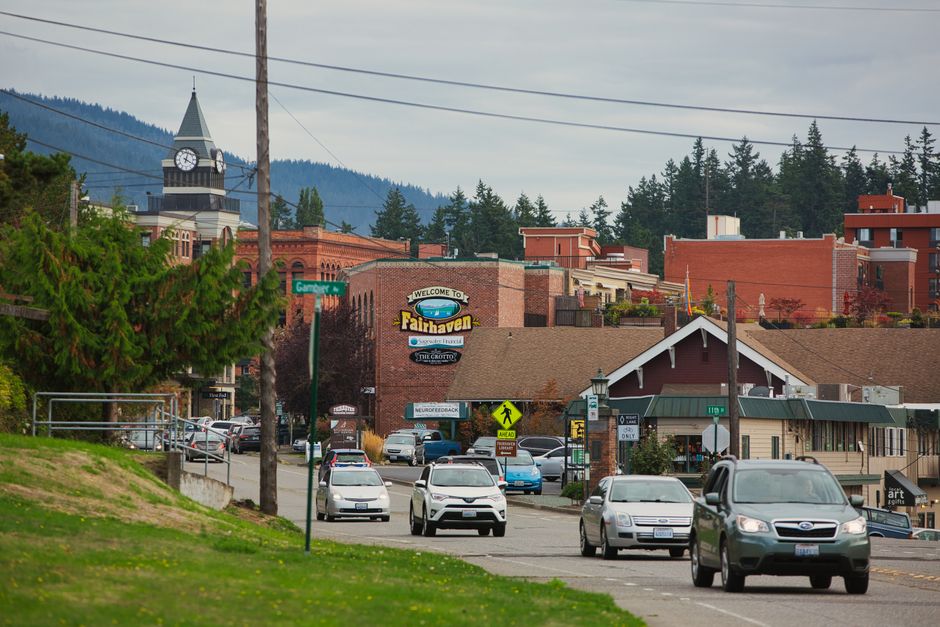
In short: Bellingham homes buy power from Puget Sound Energy, at about 14.6¢ per kWh in 2024. Whatcom County’s top hazards are ice storms and cold, and its December sun is the weakest of our Washington metros. On the plus side, Bellingham exempts most home solar from building permits and puts solar reviews at the head of the line.
Below: what PSE service, Whatcom’s weather and the city’s permit rules mean for solar, batteries, backup and charging. For statewide rules (net metering law, the solar sales tax exemption, licensing), see our Washington energy guide.
Bellingham at a glance
- Utility: Puget Sound Energy (PSE) serves all of Whatcom County, including Bellingham. About 14.6¢ per kWh for homes in 2024; across PSE’s whole system, about 1,196 minutes without power per customer with major events and 203 without (EIA-861, 2024).
- Sun: about 3.48 kWh per square meter per day in Bellingham (NASA POWER, 2001–2020), but only 0.77 in December. Our rough estimate: about 1,020 kWh a year per kW of panels.
- Top hazards: FEMA’s National Risk Index (December 2025) rates Whatcom County “very high” for ice storms and “relatively high” for cold waves, winter weather and earthquake.
- Permits: the City of Bellingham issues its own electrical permits, and most home solar needs no building permit.
- Public charging: 216 public ports at 96 locations in Bellingham (AFDC, October 2026).
Your utility and what it means
PSE is an investor-owned utility regulated by the Washington Utilities and Transportation Commission, so Bellingham homes get the same programs as PSE customers around Puget Sound:
- Net metering (Schedule 150): exported solar earns a retail-rate credit. The tariff keeps it open to new applicants until December 31, 2025 or until a replacement schedule is in place, whichever is later, so ask PSE which schedule a new system joins. Credits left on March 31 each year are lost.
- Flex Batteries: $75 per kWh of battery at enrollment, up to $1,000 per battery, plus $0.50 per kWh supplied during events, up to $500 a year; listed brands only.
- EV charger rebate: up to $300 on a prequalified smart Level 2 charger, or up to $600 plus up to $2,000 toward installation for income-qualified homes.
- Time-of-use plans with weekday peaks of 5 to 8 p.m. (and 7 to 10 a.m. in winter), and wildfire shutoffs that PSE says could happen anywhere in its area in extreme fire weather.
Our Seattle–Tacoma guide has more on each PSE program, with links to PSE’s pages.
Backup power in Bellingham
PSE’s 2024 outage average with major events was about six times its ordinary-day figure, a sign that big storms, not everyday faults, drive the risk. That figure covers PSE’s whole system; we found no Whatcom-only number. Locally, FEMA’s top rating is for ice storms, and cold waves and winter weather follow. Freezing weather is when an outage hurts most and when solar helps least.
- Multi-day ice storms: a standby generator with a transfer switch keeps heat going longest. See generator installation.
- Shorter outages: a home battery, charged from the grid in winter, carries the fridge, furnace fan, internet and lights; PSE’s Flex program pays you to share it.
- Apartments and students: a portable power station covers phones, laptops, lights and a CPAP.
Compare options in our backup power guide; size them with the battery backup calculator and generator sizing tool. Run a generator outdoors only, at least 20 feet from the house with the exhaust pointed away, and keep carbon monoxide alarms inside (CPSC).
Solar in Bellingham
Bellingham’s sun is close to Seattle’s over a year, but the swing is extreme: NASA’s average falls to 0.77 kWh per square meter a day in December and rises past 6.5 in July. Net metering carries summer credits into the fall, but they expire on March 31, so size panels to your yearly use. By our rough estimate each kW makes about 1,020 kWh a year, worth about $149 at PSE’s 2024 price; a 6 kW array might make 6,100 kWh, worth about $890. Estimates, not quotes.
The city makes the paperwork easier than most. Check your roof with the solar potential tool and solar savings calculator, then read how solar installation works, what it costs and how net metering works.
Home batteries in Bellingham
Retail net metering leaves little to gain from storing solar, so a battery here is for winter outages, plus PSE’s Flex payments. A typical 13.5 kWh battery would reach the $1,000 enrollment cap. See home batteries, battery costs and battery installation.
EV charging in Bellingham
At PSE’s 2024 average price and about 30 kWh per 100 miles, home charging costs roughly $4.40 per 100 miles by our estimate, less on a time-of-use plan overnight. A Level 2 charger needs a 240-volt circuit and a city electrical permit; see EV charger installation and the EV charging cost calculator.
Drive on another fuel? See every alternative fuel station in Bellingham: hydrogen, propane, natural gas, E85 ethanol, biodiesel and renewable diesel.
Permits and inspections
- Building permit: in 2009 Bellingham created Washington’s first building-permit exemption for solar panels, so most home systems need neither a building permit nor engineering. Solar projects also get fast-track review. See the city’s solar and renewable energy page.
- Electrical permit: Bellingham issues its own electrical permits and inspections (L&I list) through its Permit Center in Planning and Community Development.
- Outside city limits: electrical permits come from the state Department of Labor and Industries; building permits from Whatcom County.
- Utility approval: PSE must approve a grid-tied solar or battery system before you switch it on.
Hire a licensed electrical contractor (check them on L&I’s site, linked from the state page), and send plans to your HOA first if you have one.
Cities we cover
- Bellingham
Get help in Bellingham
Are you a licensed installer in Bellingham? Join SolutionEnergy and get requests from homeowners and businesses →
Tell us about your project and we will connect you with a licensed, independent installer who serves the Bellingham area. It is free, there is no obligation, and only the installer you choose gets your details. Read how it works.
Bellingham energy questions
Do I need a building permit for solar panels in Bellingham?
Usually not. Bellingham’s 2009 program, the first in Washington, exempts most residential solar from building permits and engineering. You still need an electrical permit from the city, and solar projects get fast-track review. Ask the Permit Center if your roof or system is unusual.
Who is the electric utility in Bellingham?
Puget Sound Energy, which serves all of Whatcom County. That means PSE’s net metering, Flex Batteries payments, EV charger rebate and time-of-use plans apply here, the same as in PSE’s Puget Sound territory.
Is solar worth it in Bellingham?
Slowly. By our estimate each kW of panels makes about 1,020 kWh a year, worth about $149 at PSE’s 2024 price, and December output is very low. The permit exemption and the state sales tax exemption trim the cost. Shade from tall trees is the biggest local factor.
What backup suits a Bellingham ice storm?
For outages of several days in freezing weather, a standby generator with a transfer switch, installed by a licensed electrician. For shorter ones, a home battery charged from the grid. Either way, know what heats your home and size the system to keep that running.
Sources
EIA-861, 2024 (price = residential revenue ÷ sales; outages, PSE system-wide); PSE service area sheet, Schedule 150, Flex Batteries, EV charger rebate, time-of-use and PSPS pages; City of Bellingham solar and renewable energy page; Washington L&I; NASA POWER, 2001–2020; FEMA National Risk Index, December 2025; AFDC station data; CPSC. All read October 2026. Estimates are ours and labelled.