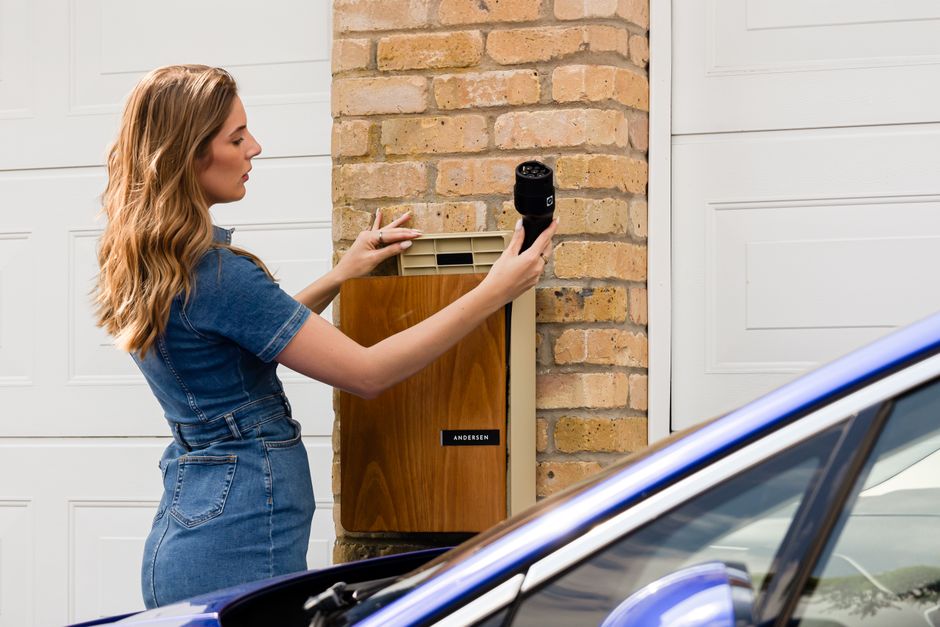
In short: a home Level 2 charger needs a dedicated 240-volt circuit installed by a licensed electrician, usually with a permit and inspection. The electrician checks your panel’s capacity first. Qmerit’s 2026 data puts a typical installation at $749 to $2,500, about $1,700 on average, plus the charger, and more if the panel needs an upgrade. The federal home charger tax credit doesn’t cover chargers installed after June 30, 2026, but many utilities still pay rebates.
This page explains each step, from the load calculation to the inspection: what really drives the price, how big the circuit should be, plug-in or hardwired, which rebates to look for, how to check an electrician’s license in your state, what to ask and which red flags to avoid, and how to find an EV charger installer near you. At the end, you can tell us about your home and car and we will reply ourselves.
EV charger installation at a glance
- Level 1 uses a normal 120 V outlet: about 1.9 kW, roughly 5 miles of range per hour (DOE Alternative Fuels Data Center, AFDC). No installation, but slow.
- Level 2 uses 240 V: most home units run at up to 30 amps, 7.2 kW, about 25 miles of range per hour (AFDC). This is what people install.
- Circuit size: the breaker must be at least 125% of the charger’s current, because the electrical code treats EV charging as a continuous load. A 40 A charger needs a 50 A circuit (EPA); a 48 A charger needs 60 A.
- Cost: installation $749 to $2,500, average $1,700 (Qmerit, March 2026); charger $400 to $1,000 (EPA, 2026).
- Tax credit: the federal charger credit (30C) does not apply to chargers placed in service after June 30, 2026. Look for utility and state rebates.
- Time: a simple install near the panel is usually one visit, with the inspection a few days later; a panel or service upgrade takes longer (our estimate; details below).
Not sure you need Level 2? Many drivers manage with a regular outlet. Compare them in Level 1 vs Level 2 charging, and work out your running cost with our EV charging cost calculator. If you’ve decided on a home Level 2 charger, our best home EV chargers guide compares the models electricians install most.
How much does EV charger installation cost?
The price depends mostly on how far the charger is from your panel and whether the panel has room for a new 240 V circuit. The totals below are our estimate, adding the sourced ranges together; they don’t include the charger, which EPA puts at $400 to $1,000 (May 2026).
| Your situation | What the sources say | Installation total (our estimate) |
|---|---|---|
| Simple install: charger on the wall next to the panel, panel has room | About $800 (EnergySage, June 2026) | about $800 (Qmerit’s low end is $749) |
| Long run: 60 to 80 feet of wire, through walls or a trench | Adds $1,000 to $1,500 (EnergySage, June 2026) | about $1,800 to $2,300 |
| Panel upgrade to 200 A needed | $1,500 to $3,000 for the panel (Qmerit, March 2026) | about $2,300 to $3,800 |
| Main service upgrade (new, bigger connection from the utility) | $1,500 to $4,000 or more (EnergySage, June 2026) | about $2,300 to $4,800 or more |
What the main sources say
| Item | Range | Source |
|---|---|---|
| Installation (Level 2) | $749 to $2,500; average $1,700 | Qmerit, March 2026 |
| Installation, by electrical setup | $800 to $3,000 | EnergySage (Qmerit data), June 2026 |
| Installation | $300 to $2,000 | U.S. EPA, May 2026 |
| Charger (equipment) | $400 to $1,000 | U.S. EPA, May 2026 |
| Panel upgrade to 200 A | $1,500 to $3,000 | Qmerit, March 2026 |
| Main service upgrade | $1,500 to $4,000 or more | EnergySage, June 2026 |
| Permit | $50 to $800; about $310 on average | Qmerit, March 2026 |
The sources differ because they measure different things; use them to sanity-check a quote, not as a price list. EnergySage’s 2026 state table ranges from about $1,834 (Oregon) to $3,680 (Mississippi) for installation without the charger. Full details, state by state, with the charger, wire, labor and upgrade costs line by line, are in our EV charger installation cost guide.
The installation process, step by step
- Choose where you’ll park and charge. Measure from your electrical panel to the charging spot. EnergySage says the distance from the panel is the biggest single cost driver: a charger next to the panel can cost about $800 to install, while a 60 to 80 foot run adds $1,000 to $1,500.
- Panel check and load calculation. A licensed electrician adds up what your home already uses and decides whether the panel can take a new 240 V circuit. EPA says a home with 200 amp service and two empty slots for a double-pole breaker likely has capacity. In the 2023 National Electrical Code (NEC), Section 220.57 says the charger counts in that calculation at 7,200 watts or its nameplate rating, whichever is larger (Washington State L&I, January 2025). Send photos of your panel label and breakers to get a faster, more accurate quote.
- Pick the charger and the connection. A plug-in charger on a NEMA 14-50 outlet is common; chargers rated 48 A or more must be hardwired (EPA). Choose an ENERGY STAR certified or UL/ETL listed charger. Our best home EV chargers and best chargers for a Tesla guides compare models.
- Size the circuit. The breaker and wire must be at least 125% of the charging current: 40 A of charging needs a 50 A circuit, 48 A needs 60 A. See the table in the next section.
- Written quote. It should list the breaker and wire size, the route of the wiring, any trenching or wall work, the permit, and whether the charger is included.
- Permit. The electrician pulls it. The AFDC notes that appropriate permits may be required; most cities and counties do require one for a new 240 V circuit.
- Install. New breaker, wire and the outlet or hardwired charger. A simple garage install is usually a single visit (our estimate); long runs, trenching or a panel upgrade take longer.
- Inspection and set-up. The inspector checks the work. Then set the charger’s current to match the circuit (Tesla’s manual has the breaker size programmed during commissioning), connect the app if it has one and set charging for cheaper night hours if your utility offers them.
- Tell your utility and sign up for an EV rate or rebate. Many rebates require it (see rebates below). A service upgrade also needs the utility’s own work.
How long EV charger installation takes
For a simple job, plan on one to three weeks from the first call to an inspected, working charger (our estimate): quotes, the permit, one visit for the work and the inspection. Some cities are fast: Ventura, California, says complete applications are usually approved over the counter or within a day or two, and inspections typically happen the next work day (city guideline, 2017). A panel or service upgrade takes longer and depends on your utility’s schedule. If you’re buying a new EV, start before the car arrives.
Circuit size, plug-in or hardwired, and GFCI
EV charging runs for hours at a time, so the NEC treats it as a continuous load (Article 625): the circuit must be rated at least 125% of the charging current. Tesla’s Gen 3 Wall Connector manual shows how that works out in practice; other brands follow the same pattern.
| Circuit breaker | Maximum charging current | Power at 240 V |
|---|---|---|
| 60 A | 48 A (must be hardwired) | 11.5 kW |
| 50 A | 40 A | 9.6 kW |
| 40 A | 32 A | 7.6 kW |
| 30 A | 24 A | 5.7 kW |
Source: Tesla Gen 3 Wall Connector installation manual (revision 1.0, January 2020); “must be hardwired” for 48 A per EPA (May 2026). A bigger circuit only helps if your car can take the power, so check your car’s maximum charging rate before paying for 60 A.
- Plug-in (NEMA 14-50 outlet): you can take the charger with you. ChargePoint’s Home Flex plugs in only on 40 A or 50 A circuits (32 A or 40 A of charging); Emporia asks for a dedicated 50 A breaker (July 2026).
- Hardwired: needed for 48 A and up. ChargePoint’s Home Flex hardwires on 20 A to 80 A breakers for up to 50 A of charging; Emporia’s needs a 60 A breaker for 48 A.
- GFCI on outlets: since the 2020 edition of the NEC, Section 625.54 requires ground-fault (GFCI) protection on every receptacle installed for EV charging (Leviton’s 2020 code guide), and Section 210.8(A) covers 250 V garage receptacles too (Qmerit, May 2026). Your inspector enforces the edition your state or city has adopted; the 2026 edition’s wording is under a proposed amendment (NFPA TIA 1892, 2026).
- Why many electricians hardwire: most home chargers have built-in ground-fault protection, and a second GFCI breaker can trip for no reason. Tesla says not to install a GFCI breaker for its Wall Connector, Emporia warns of nuisance tripping, and ChargePoint recommends hardwiring where a GFCI breaker would be required. The receptacle rule doesn’t apply to a hardwired charger (Qmerit, May 2026).
Panel capacity: the question that decides the price
EnergySage estimates that about 20% of homes need some electrical work to add a charger. Most 200 A panels are fine; a 100 A panel may struggle and a 60 A panel almost certainly needs an upgrade. Before you pay for a new service, ask about cheaper options the electrician can install to code:
- A lower-current charger (for example 24 or 32 A). Most cars still fill up overnight.
- Load management: a charger or device that slows charging when the house is using a lot of power. EPA suggests asking about it, and the NEC allows energy management systems to be taken into account (NEC 625.42, as summarized by Washington State L&I).
- Circuit sharing between two chargers, or with an appliance such as a dryer, using a listed device.
- A subpanel in the garage when the main panel is full but has capacity.
Rebates and the federal tax credit in 2026
Federal credit (30C): the IRS says the home credit covers property you buy and place in service at your main home from January 1, 2023, to June 30, 2026: 30% of the cost, up to $1,000, and only if the home is in an eligible low-income or non-urban census tract (IRS page reviewed May 26, 2026). It can’t be claimed for chargers placed in service after that date; earlier, eligible installs are claimed on Form 8911. The federal EV purchase credit (30D) ended September 30, 2025. More in our EV tax credit guide.
Utility rebates are where the money is now, and they’re local. Two examples we checked on the utilities’ own pages in October 2026:
- ComEd (northern Illinois): up to $1,000 toward a smart, ENERGY STAR certified Level 2 charger and its installation, or up to $2,500 for income-qualified customers and some communities. The rebate comes off the invoice of an installer in ComEd’s network, self-installed chargers don’t qualify, and you must stay on an hourly or time-of-day rate for three years (program terms, version 3.0, valid January 1, 2026, to December 31, 2028).
- LADWP (Los Angeles): up to $1,000 for buying and installing a qualifying home charger, $500 more for customers in its income-qualified programs, and $250 more for a dedicated EV meter. LADWP asks for a service assessment before installation (program page, checked October 3, 2026).
Rules like these are common: an approved charger list, a licensed or network installer, the permit and an EV or time-of-use rate. Check before the work starts, not after. Each of our state and city guides lists the utility programs we could confirm there, for example Illinois, California, Colorado or New York.
Garage, driveway or carport: placement tips
- Close to the panel saves money. The same wall as the panel is the cheapest spot, per EnergySage.
- Check the cable reach. Make sure the cable reaches your car’s charging port from where you actually park, and from both spaces if two EVs may share it.
- Outdoors needs an outdoor-rated charger and weather-resistant wiring and outlet covers; your electrician follows the code for wet locations.
- Think ahead. If a second EV is likely, ask about a circuit or chargers that can share power later, rather than paying for two separate jobs.
After the install: what charging costs
The U.S. average home electricity price was 18.31¢ per kWh in July 2026 (EIA). If your car uses about 30 kWh per 100 miles, that’s roughly $5.50 per 100 miles before charging losses (our estimate). Many utilities offer time-of-use or EV rates that are cheaper overnight; set your charger or car to start after the peak ends. ENERGY STAR says certified chargers use 40% less energy in standby. Your own numbers will differ: try the EV charging cost calculator or read how much it costs to charge an EV at home.
Renters, condos and apartments
EPA notes that many states have “right-to-charge” laws that may let renters and condo owners install a charger at their parking space, usually with the owner’s or association’s approval, an electrician and insurance. Ask your landlord or HOA early. If the building wants chargers for everyone, point them to our commercial and multifamily EV charging guide.
How to choose an EV charger installer
Any licensed electrician can install a home charger; ChargePoint says so in its own installation FAQ. Some carmakers and charger brands refer buyers to installer networks such as Qmerit, which says it works with more than 23,000 electricians; that’s convenient, but it’s still worth checking the license of the person who shows up. Work through this list with every electrician you’re considering.
- License: look it up on your state’s site (Texas TDLR, Florida DBPR, the North Carolina electrical board, South Carolina LLR; in Illinois, licensing is local). Each state page links its board: Texas, Florida, North Carolina, Illinois, California.
- Insurance: general liability, and workers’ compensation where required.
- Experience: ask how many chargers they’ve installed and whether they’ve used load management before.
- Brand certification, if you want it: Tesla has a “Find a Certified Installer” page for its Wall Connector, and ChargePoint offers to connect you with a ChargePoint Certified Installer. Certification shows brand training; it doesn’t replace a license.
- A real panel assessment: a load calculation before anyone quotes a panel or service upgrade.
- The permit in the price, with the electrician booking the inspection.
- A written, itemized quote: breaker and wire size, charging current, plug-in or hardwired, wire route, wall or trench work, permit, charger (included or not), warranty and payment schedule.
- Rebate know-how: whether they’re on your utility’s list, if the rebate needs one (ComEd’s does).
For a fuller checklist that works for solar, batteries, generators and chargers, see how to choose and check an installer.
Questions to ask
- Did you do a load calculation, and does my panel need an upgrade, or would load management avoid it?
- What breaker and wire size, and what charging current will my charger be set to?
- Plug-in (NEMA 14-50) or hardwired, and why? If plug-in, how will you handle the GFCI requirement?
- Is the permit included, and who schedules the inspection?
- Does my utility have a rebate or EV rate, and will you help with the paperwork?
- How long until the work is done, and what warranty do you give on it?
Red flags
- No permit, or “we’ll just add it to your dryer outlet” without a listed device.
- A breaker that isn’t at least 125% of the charger’s current, or a non-listed charger.
- A panel upgrade quoted without a load calculation.
- A cheap residential-grade outlet for a plug-in charger, or a plug cut off a charger to hardwire it (Emporia says cutting the plug voids its warranty).
- Promises of a federal tax credit for a charger installed after June 30, 2026.
- No license number on the quote, or a large upfront payment.
- Pressure to sign at your kitchen table. Under the FTC’s Cooling-Off Rule, for most sales made in your home of $25 or more, the seller must tell you about your right to cancel within three business days.
Can I install an EV charger myself?
For a Level 1 cord on an existing outlet, yes: there’s nothing to install. For Level 2, honestly, it’s a job for a licensed electrician: it means working inside your main panel, sizing a breaker and wire for a load that runs for hours, meeting the GFCI rules and passing an inspection. Some towns let homeowners pull a permit for their own house; many don’t. ChargePoint, Emporia and EPA all point you to a licensed electrician, and Tesla’s manual says only people trained and qualified for electrical work should install its charger. ComEd’s rebate also excludes self-installed chargers. What you can do yourself: pick the charger, measure the distance from the panel, photograph the panel and its label, and line up your rebate.
Finding an EV charger installer near you
Searching “EV charger installer near me” returns ads and lead sites first. A calmer way to build a shortlist:
- Start with your utility. If it pays a rebate, it may require an installer from its own list, as ComEd does. Our state and city guides name your utilities, the EV programs we could confirm and your state’s license lookup.
- Gather three names from neighbors with EVs, your car or charger brand’s installer finder and electricians you already trust.
- Check each license and run through the checklist above.
- Send each the same photos and details and compare written quotes line by line.
A local electrician knows your building department and will be around if something needs fixing. If you’d rather not do the legwork alone, send us your project below: we’ll reply ourselves and, if you want, connect you with an independent, licensed electrician. Your details are shared only with your consent.
What happens when you send us a request
You tell us about your car, your panel and your parking. We read it and reply ourselves with a plain explanation of what your install will likely involve, what to ask and which rebates to check. If you want, we can suggest an independent, licensed electrician, and only the one you choose sees your details. We never sell or negotiate installation contracts. Read how it works.
Get help with your project
Tell us your car, your panel size and where you park. We read every request and reply ourselves with what to expect and what to ask. Tell us about your project and we will connect you with a licensed, independent installer who serves your area. It is free, there is no obligation, and only the installer you choose gets your details. See how it works.
EV charger installation questions
How much does it cost to install a Level 2 charger at home?
Qmerit’s March 2026 data puts a typical installation at $749 to $2,500, about $1,700 on average, before the charger, which EPA puts at $400 to $1,000. A charger next to the panel can be about $800 to install (EnergySage); a long wire run, a panel upgrade or a new service adds $1,000 to $4,000 or more. See our installation cost guide for details.
Do I need a permit to install an EV charger?
Usually, yes. Adding a 240 V circuit is electrical work that most cities and counties require a permit and inspection for, and the AFDC notes permits may be required. Your electrician normally pulls it; Qmerit’s 2026 data puts permit fees at $50 to $800, about $310 on average. An inspected install also helps with insurance and when you sell the home.
How long does EV charger installation take?
The work itself is usually one visit for a charger near the panel. With quotes, the permit and the inspection, a simple job typically takes one to three weeks from the first call (our estimate). Some cities issue permits the same day; Ventura, California, says inspections are typically the next work day. Panel or service upgrades take longer.
Can I install a Level 2 charger myself?
We don’t recommend it. The job means working in your main panel, sizing the breaker and wire for a continuous load, and passing an inspection. EPA advises using a qualified electrician who can do the load calculation, permits and inspection. Some areas allow homeowner permits, but mistakes can cause overheating and fires, and may affect insurance or warranties.
Will I need a new electrical panel?
Probably not. EnergySage estimates about 20% of homes need electrical work for a charger; most 200 A panels can handle one, while 100 A panels may struggle and 60 A panels usually need an upgrade. Ask the electrician about a lower-current charger or load management first. A panel upgrade to 200 A runs about $1,500 to $3,000 (Qmerit, 2026).
What size breaker does an EV charger need?
At least 125% of the charger’s maximum current, because the electrical code treats EV charging as a continuous load. A 32 A charger needs a 40 A circuit, a 40 A charger a 50 A circuit, and a 48 A charger a 60 A circuit, which must be hardwired. Your electrician sizes the wire to match and sets the charger accordingly.
Is it better to plug in or hardwire a home EV charger?
A plug-in charger on a NEMA 14-50 outlet is easy to take with you, but the code requires GFCI protection on that outlet, which can clash with the charger’s own protection and cause nuisance trips. Hardwiring avoids that, allows 48 A charging, so many electricians prefer it. ChargePoint and Emporia both suggest hardwiring when a GFCI breaker would be needed.
Is there a tax credit for a home EV charger in 2026?
Not for new installs. The IRS says the 30C credit can’t be claimed for charging equipment placed in service after June 30, 2026. Chargers placed in service at your main home by that date, in an eligible census tract, can get 30% of the cost up to $1,000. Some utilities and states still offer rebates or special EV rates; ComEd, for example, offers up to $1,000 ($2,500 if income-qualified) through 2028. Check your utility’s website and our state pages before you buy.
Do I need to tell my utility about a new EV charger?
Often, yes, and it’s usually required for the savings: ComEd’s rebate requires a time-variant rate for three years, and LADWP asks for a service assessment before you install. A bigger service also needs the utility’s own work. Your electrician can tell you whether your utility wants to be notified.
How do I find a good EV charger installer near me?
Collect three names from neighbors with EVs, your car or charger brand’s installer finder (Tesla and ChargePoint both have certified installer programs) and your utility’s list if its rebate requires one. Check each license on your state or city site, and compare written quotes. Our state and city guides link the license lookups, and we can connect you with an independent, licensed electrician if you ask; your details are shared only with your consent.
Keep exploring
Back to the EV charging hub. See EV charger installation cost, best home EV chargers, Level 1 vs Level 2, what it costs to charge at home and EV charging with solar. Want backup power too? Read our backup power guide.
Sources
Charging levels and permits: U.S. Department of Energy Alternative Fuels Data Center (AFDC), read October 2026. Circuit sizing, hardwiring, panel guidance, certification, right-to-charge and costs: U.S. EPA, “Getting Started with Home EV Charging,” May 2026. Continuous-load rule: National Electrical Code Article 625, as summarized by code-training sources; NEC 220.57 and 625.42: Washington State Department of Labor & Industries, Electrical Currents, January 2025; NEC 625.54 GFCI: Leviton 2020 NEC code guide, Qmerit (May 2026) and NFPA TIA 1892 (2026). Breaker and output table, GFCI and mounting heights: Tesla Gen 3 Wall Connector installation manual (January 2020). Plug-in and hardwired circuit ratings: ChargePoint Home Flex installation FAQ and Emporia EV charger installation guide (July 2026), read October 2026. Permit and inspection example: City of Ventura, California, residential EV charging station guideline (2017). Installation, panel and permit costs: Qmerit, March 2026; EnergySage, June 2026. Installer network size: Qmerit (self-reported). Tax credits: IRS (30C page reviewed May 2026, Form 8911 instructions). Utility rebates: ComEd EV Charger and Installation Rebate Program terms, version 3.0 (2026–2028); LADWP Residential EV Charger Rebate Program, checked October 3, 2026. Electricity price: U.S. EIA, July 2026. Cancellation rights: FTC Cooling-Off Rule. Licensing boards: state agencies, checked October 2026. Estimates on this page are ours and labelled.