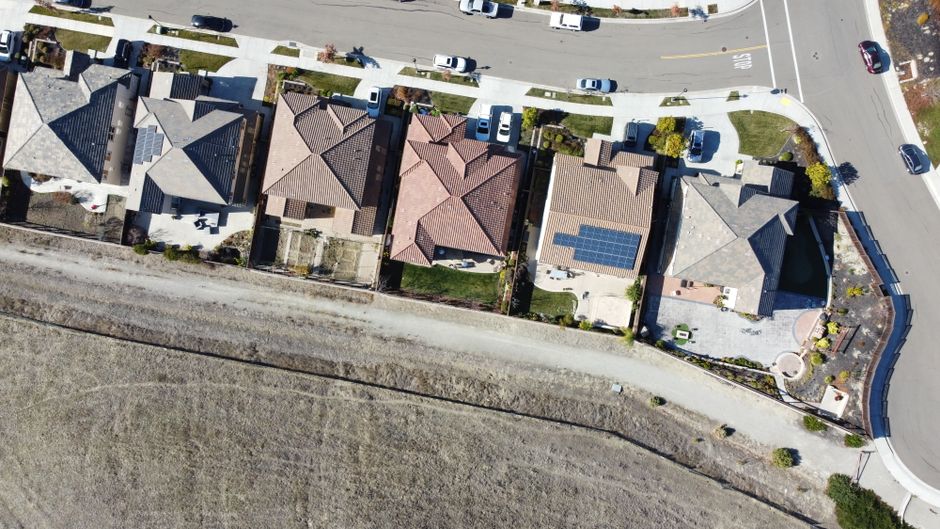
In short: Phoenix-area homes get power from APS or SRP, depending on the address. In 2024 SRP homes paid about 13.5¢ per kWh and APS homes 16.5¢, and outages averaged 1 to 1.5 hours a year (EIA). Exported solar earns just 3.45¢ (SRP) to 5.55¢ (APS), so solar pays through self-use.
Below: what each Valley utility pays for solar, its battery and EV programs, and how permits work. For statewide rules (the Form 310 solar credit, sales and property tax breaks, contractor licensing), see our Arizona energy guide.
Phoenix at a glance
- Two main utilities: Maricopa County says homes are served by Salt River Project (SRP) or Arizona Public Service (APS), depending on location. Your bill, or either utility, can tell you which.
- SRP: about 13.5¢ per kWh for homes in 2024; 58 minutes without power per customer with major events, 53 without (EIA-861, 2024).
- APS: about 16.5¢ per kWh; 87 minutes with major events, 81 without, across its whole Arizona system.
- City of Mesa Electric: a small city-run utility around downtown Mesa; about 16.9¢ per kWh, and 64 minutes out with major events, 25 without.
- Sun: about 5.85 kWh per square meter per day in Phoenix (NASA POWER, 2001–2020). Our rough estimate: about 1,700 kWh a year per kW of panels.
- Top hazards: FEMA’s National Risk Index (December 2025) rates Maricopa County “very high” for heat waves, hail, strong wind and inland flooding, and “relatively high” for drought, lightning and wildfire.
- Public charging: 2,181 public charging ports at 765 locations across Phoenix, Scottsdale, Mesa, Chandler, Gilbert, Glendale and Peoria, close to half of Arizona’s total (AFDC, October 2026). Phoenix alone has 922.
Your utility and what it means
APS is regulated by the Arizona Corporation Commission. New solar customers get net billing: power you use as it is made saves the full retail price, and power you send to the grid earns the Resource Comparison Proxy (RCP) export rate. Under APS’s tariff, customers who join between September 1, 2026 and August 31, 2027 get 5.554¢ per kWh, locked for 10 years from interconnection. APS’s peak hours are 4 to 7 p.m. on weekdays.
- Storage Rewards (APS): a five-year pilot paying $110 per average kW your battery supplies each summer season, on up to 60 conservation days between May and October, for one to four hours between 4 and 10 p.m. You can opt out of any event. See APS Storage Rewards.
- EV Overnight plan (APS): 8.468¢ per kWh from 11 p.m. to 5 a.m. on weekdays all year, against over 34¢ in the 4 to 7 p.m. peak. You must have an EV.
SRP is a public power utility run by its own elected board, so it sets its own solar rules. It offers two kinds of solar plan. Demand plans net your use against your production and add a monthly demand charge. Export plans credit every kWh you send out at a fixed 3.45¢. SRP’s summer peak is 2 to 8 p.m. on weekdays, and in July and August its Time-of-Use Export plan charges about twice as much on-peak as off-peak. SRP has said both export plans will be discontinued from the November 2029 billing cycle, so ask how a plan change would affect you. Compare SRP’s solar price plans.
- Battery Partner (SRP): about $55 per average kW in bill credits twice a year for letting SRP discharge your battery during conservation events. SRP never takes it below 20%. It is a pilot through April 30, 2030, capped at 5,000 customers.
- EV charger rebate (SRP): up to $250 on eligible Level 2 chargers, instantly through SRP’s online marketplace or by application within 90 days of purchase.
City of Mesa Electric still offers net metering under its FY 2026-27 solar program, with limits: home systems up to 5 kW, or up to 10 kW of panels when paired with a battery. You must apply and be accepted before installing; see Mesa’s solar program.
Backup power in Phoenix
Valley outages are short and rare, but a summer storm with hail and strong wind can cut power on a 110-degree afternoon. Neither utility lists the Valley among its wildfire shutoff areas: SRP’s are around Roosevelt Lake and Tonto Basin, and APS’s are in Coconino, Gila, Navajo, Pinal and Yavapai counties. So here backup is mostly about heat and medical needs.
- Keeping one room cool: a home battery or a standby generator can run a mini-split or one air conditioner; a whole central system needs a bigger setup. See generator installation.
- Medical devices and short outages: a portable power station covers a CPAP, Wi-Fi, lights and a fan.
Compare the options in our backup power guide and size them with the battery backup calculator and generator sizing tool. Run a generator outdoors only, at least 20 feet from the house with the exhaust pointed away, and keep carbon monoxide alarms inside (CPSC).
Solar in Phoenix
Panels here produce a lot: about 1,700 kWh a year per kW by our rough estimate. What changes the math is where that power goes. Used at home, each kW is worth about $280 a year at APS’s 2024 average price, or about $230 at SRP’s. Exported, it is worth only about $95 (APS) or $60 (SRP). Estimates, not quotes: size the system to your daytime use, run the pool pump and pre-cool at midday, and consider a battery for the evening peak.
Federal home solar credits ended after 2025; Arizona’s own credit and tax exemptions are on the state page. Check your roof with the solar potential tool and solar savings calculator, then read how solar installation works, what it costs and net metering vs net billing.
Home batteries in Phoenix
Low export rates and late-afternoon peaks make a battery more useful here than in most cities: it stores midday solar for the 4 to 7 p.m. (APS) or 2 to 8 p.m. (SRP) peak and keeps essentials running in an outage. Both big utilities will also pay you to share it, through APS Storage Rewards or SRP Battery Partner. Each program pays only for brands it lists, so check before you buy. Batteries dislike heat: install them where the maker allows, out of afternoon sun. See home batteries, battery costs and battery installation.
EV charging in Phoenix
Home charging beats public charging on price. Our estimate at about 30 kWh per 100 miles: roughly $4.90 per 100 miles at APS’s average price, about $2.50 on the APS overnight rate, and about $4 at SRP’s average. A Level 2 charger needs a 240-volt circuit installed by a licensed electrician; see EV charger installation and the EV charging cost calculator.
Drive on another fuel? See every alternative fuel station in Phoenix: hydrogen, propane, natural gas, E85 ethanol, biodiesel and renewable diesel.
Permits and inspections
- City of Phoenix: the Planning & Development Department accepts SolarAPP+ designs for simple rooftop systems on houses and duplexes by Arizona-licensed contractors. Systems with batteries, panel upgrades or ground mounts go through regular review, and the Phoenix Fire Department issues its own permits for solar and battery systems.
- Other Valley cities: Scottsdale, Mesa, Chandler, Gilbert, Glendale and Peoria each issue their own permits; ask your city’s building department.
- Unincorporated areas: Maricopa County Planning & Development, which also accepts SolarAPP+ designs.
- Utility approval: SRP needs the application before installation, through its online portal, and then a signed interconnection agreement and design review. APS and Mesa also approve systems before you switch on.
- HOAs: under A.R.S. 33-1816 an HOA cannot ban solar panels, but it can set reasonable placement rules that do not hurt output or raise cost. Send your plans for approval first.
Cities we cover
- Phoenix
- Scottsdale
- Mesa
- Chandler
- Gilbert
- Glendale
- Peoria
Get help in Phoenix
Are you a licensed installer in Phoenix? Join SolutionEnergy and get requests from homeowners and businesses →
Tell us about your project and we will connect you with a licensed, independent installer who serves the Phoenix area. It is free, there is no obligation, and only the installer you choose gets your details. Read how it works.
Phoenix energy questions
Am I on APS or SRP?
It depends on your exact address, not your city: both serve large parts of the Valley, and a small area around downtown Mesa is served by the City of Mesa. Look at a past bill, or give your address to APS or SRP. The answer decides your solar export rate, rate plans and rebates.
What does SRP pay for exported solar?
On SRP’s export plans, every kWh you send to the grid is credited at a fixed 3.45¢. Its demand plans net your use against production instead but add a monthly demand charge. SRP plans to discontinue the two export plans from the November 2029 billing cycle, so ask SRP what that would mean for a new system.
What is the APS solar export rate in 2026?
Under APS’s RCP tariff, customers who join between September 1, 2026 and August 31, 2027 are credited 5.554¢ per exported kWh, locked for 10 years from interconnection. Those who joined the year before locked in 6.171¢. Power you use yourself still saves the full retail price.
Can APS or SRP pay me for my home battery?
Yes, through pilots. APS Storage Rewards pays $110 per average kW your battery supplies in the May to October season. SRP Battery Partner pays about $55 per average kW twice a year and caps enrollment at 5,000 homes. Both list eligible battery brands; check before you buy.
Do Phoenix homes face wildfire power shutoffs?
Not in the Valley itself, based on the utilities’ own lists. SRP’s shutoff areas are around Roosevelt Lake and Tonto Basin, and APS’s are in Coconino, Gila, Navajo, Pinal and Yavapai counties. Cabins up north are a different story; see our Northern Arizona guide.
Sources
EIA-861, 2024 data (price = residential revenue ÷ sales); APS Rate Rider RCP (effective September 1, 2026), EV Overnight plan, Storage Rewards and PSPS pages; SRP solar price plans, Battery Partner, EV charger rebate, contractor and PSPS pages; City of Mesa solar program; Maricopa County; City of Phoenix PDD; A.R.S. 33-1816; NASA POWER, 2001–2020; FEMA National Risk Index, December 2025; AFDC station data; CPSC. All read October 2026. Estimates are ours and labelled.