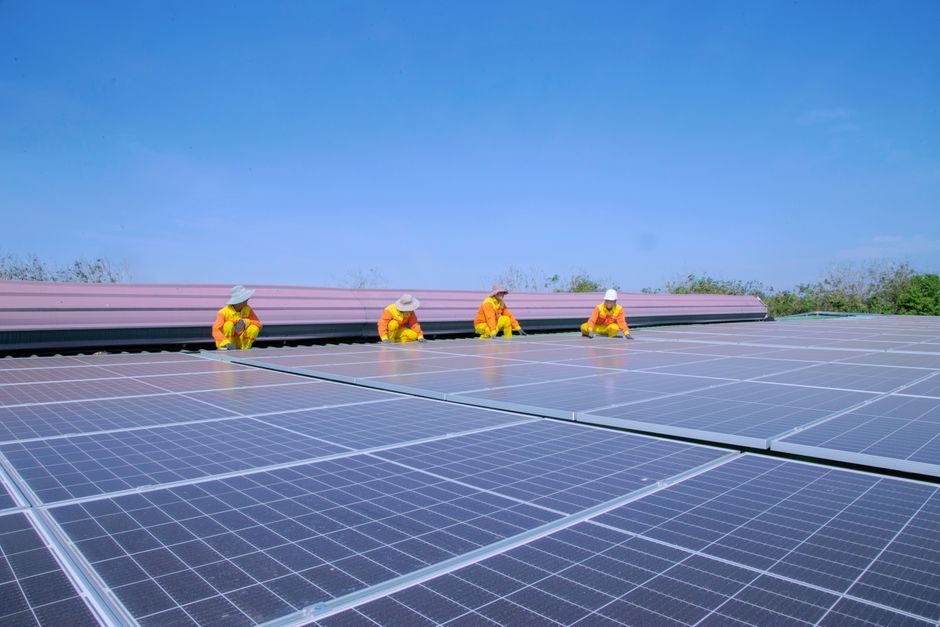
In short: commercial solar costs less per watt than home solar: Berkeley Lab’s 2024 medians were $3.2 per watt for business systems up to 100 kW and $2.4 for larger ones. Whether it pays depends on your rate, your roof or land, and how you buy it. Federal credits for new solar are tightening; check them with a tax professional.

This guide is for owners and managers of offices, shops, warehouses, farms, apartment buildings, hotels and nonprofits. It covers who commercial solar suits, roof vs carport vs ground mounts, sizing, demand charges, costs, tax credits after the 2025 law changes, ownership options, permits and upkeep, then how to get help.
Commercial solar at a glance
- Installed price (2024, before incentives): median $3.2/W for small non-residential systems (most $2.5 to $4.3) and $2.4/W for systems over 100 kW (most $1.9 to $3.3), Berkeley Lab.
- Typical size: the median non-residential system in 2024 was 35 kW, but the average was 232 kW because of a long tail of big projects (Berkeley Lab).
- Who installs it: 53% of 2024 non-residential systems were on commercial buildings, 34% on agricultural land, the rest at schools, government and houses of worship (Berkeley Lab).
- Market: U.S. commercial solar installed 638 MWdc in Q2 2026, up 11% from a year earlier, while home solar fell (SEIA/Wood Mackenzie, September 2026).
- Federal credit: new solar projects must be placed in service by December 31, 2027 to qualify for the clean electricity credits, unless construction began by July 4, 2026 (IRS Notice 2025-42), and foreign-entity sourcing rules now apply.
Who commercial solar suits
- Offices and retail: daytime use lines up with solar output. Retail, warehouse, industrial and office buildings were the largest business types in Berkeley Lab’s 2024 data. If you lease your space, the landlord’s permission and the lease term decide what’s possible.
- Warehouses and light industrial: big flat roofs and steady loads. Check the roof’s structural capacity and remaining life before anything else.
- Farms and ranches: ground mounts on spare land, pumps, barns, cold storage and shops. A third of 2024 non-residential systems were agricultural.
- Multifamily buildings: solar usually serves the building’s own meter (common areas, laundry, lighting, pumps) unless your state allows sharing credits with tenants. Check your utility’s rules.
- Hotels and hospitality: solar often pairs with backup power and EV charging for guests; see energy for hotels.
- Nonprofits, schools, local government: these tax-exempt owners used third-party ownership far more often (40% of their 2024 systems vs 16% for businesses and farms, Berkeley Lab).
Commercial solar is a harder sell where business electricity is cheap. EIA’s July 2026 average commercial price was 8.47 cents per kWh in Texas but 24.41 cents in Massachusetts and 30.56 cents in California; each kWh the same panels make is worth about three times more in those states. Look up your state on our state pages.
Roof, carport or ground mount
| Mount | Good for | Watch for |
|---|---|---|
| Roof | Warehouses, shops, offices, apartment buildings with sound, flat or south-facing roofs | Roof age and warranty, structural load, fire-access pathways set by local code, roof penetrations |
| Carport / canopy | Parking lots at offices, hotels, retail; adds shade and a place for EV chargers | Higher structure cost, foundations, lighting and drainage under the canopy |
| Ground | Farms, ranches, campuses with open land | Zoning and setbacks, fencing, trenching back to the meter, land you can’t use for anything else |
Ground mounts are common: Berkeley Lab found almost half of large non-residential systems and a quarter of small ones were ground-mounted in 2024, mostly fixed-tilt rather than tracking.
Sizing a commercial solar system
- Get 12 months of interval data from your utility (usage in 15-minute or hourly steps, not just monthly totals). It shows when you use power and what sets your peak.
- Find the space: usable roof area, parking or land, and the distance to your electrical service.
- Read the export rules. If your utility pays little for power you send back, size closer to your daytime use; if it credits exports well, you can go bigger. Interconnection limits can also cap size.
- Estimate output. As a rough guide, each kW of panels makes roughly 1,100 to 1,750 kWh a year in the lower 48, from Seattle to Phoenix (NREL PVWatts runs). Our state pages give an estimate per state; for example about 1,360 kWh per kW in Houston (our estimate from NASA solar data). A 100 kW roof there would make roughly 136,000 kWh a year (our arithmetic). Ask installers for a PVWatts or similar model for your exact site.
Demand charges: why solar alone may not cut them
Many business tariffs bill you twice: for energy (kWh) and for your highest power draw in the month (kW), the demand charge. NREL’s survey of more than 10,000 tariffs found that nearly 5 million U.S. commercial customers can be on rates with demand charges above $15 per kW, and that demand charges can make up 30% to 70% of a bill (2017). Solar lowers your kWh, but a cloudy afternoon or an evening peak can still set the demand charge. A battery that discharges at your peak is what reliably trims it; see commercial battery storage.
What commercial solar costs
| System | 2024 median, Berkeley Lab | Example (our arithmetic, before incentives) |
|---|---|---|
| Small non-residential (up to 100 kW) | $3.2/W (20th to 80th percentile $2.5 to $4.3) | 50 kW × $3.2/W ≈ $160,000 |
| Large non-residential (over 100 kW) | $2.4/W ($1.9 to $3.3) | 250 kW × $2.4/W ≈ $600,000 |
| Adding a battery | Median paired systems cost $2.2/W more (small) and $0.8/W more (large) than solar alone, per W of solar | 50 kW solar with a battery ≈ $110,000 more |
Berkeley Lab’s prices are self-reported by owners of systems they own, before incentives, and vary widely within each size. Your price depends on the mount, roof work, electrical upgrades, utility requirements and labor rules attached to any tax credit. Get at least three bids with the same scope so you can compare price per watt fairly. Home-scale numbers are on our solar cost page.
Tax credits and incentives for business solar in 2026
Here’s what we confirmed on IRS pages; it isn’t tax advice. Since 2025, business solar falls under the technology-neutral clean electricity credits: the investment credit (48E) and the production credit (45Y). The base investment credit is 6%, rising to 30% for projects that meet prevailing wage and apprenticeship requirements (IRS). The 2025 law (Public Law 119-21) ends these credits for solar facilities placed in service after December 31, 2027, unless construction began by July 4, 2026 (IRS Notice 2025-42). Projects that begin construction after 2025 must also meet rules on “material assistance” from prohibited foreign entities (IRS Notice 2026-15, February 2026). Battery storage is not under the same 2027 solar cutoff, but the foreign-entity rules apply to it too.
Timing now decides eligibility, so talk to a tax professional before you sign. Nobody should promise you a credit amount in a sales proposal. Other programs to check:
- Illinois: ComEd’s distributed generation rebate pays $300 per kW of solar for residential and small commercial customers and $250 per kW for larger ones, plus $300 or $250 per kWh for paired storage (ComEd terms; check the current version).
- Farms and rural small businesses: USDA’s Rural Energy for America Program (REAP) paused new grant awards for fiscal 2026 while it rewrites its rules; its guaranteed loans were still taking applications (USDA, March 2026).
- State and utility programs: search DSIRE and see our incentives page.
How to pay for it: purchase, loan, lease or PPA
| Option | How it works | Who claims credits | Fits when |
|---|---|---|---|
| Cash purchase | You own the system from day one | You, if eligible | You have capital and tax appetite, and own the building |
| Loan | You own it and repay over time | You, if eligible | You want ownership without tying up cash |
| Lease | A company owns it; you pay a fixed monthly rent | The owner | You want predictable payments and no upkeep |
| Power purchase agreement (PPA) | A company owns it; you buy the power it makes at an agreed price per kWh | The owner | Tax-exempt owners, or businesses that prefer paying only for output |
With a lease or PPA, read the term (home leases and PPAs typically run 20 years, says the FTC; business contracts vary), any yearly price escalator, the buyout terms, who maintains the system and what happens if you sell or move. Our buy vs lease guide walks through the trade-offs.
Permits, interconnection and timeline
Expect building and electrical permits, a structural review for roof systems, fire department review in many areas, zoning for ground mounts and carports, and a utility interconnection study. Size changes everything here. Berkeley Lab’s September 2026 study found a median of about 2 months from application to permission to operate for solar under 30 kW, but projects over 100 kW took substantially longer, and solar between 1 and 5 MW had a median of 45 months (2020 to 2025 data). Larger projects may also have to pay for grid upgrades. Ask your utility early about capacity on your feeder.
Operations and maintenance
Budget for monitoring, periodic inspections, cleaning where dust or pollen is heavy, vegetation control on ground mounts, and an inverter replacement during the system’s life. Ask bidders to price an O&M contract with response times, and to show how they’ll report output against the estimate. More detail is in solar maintenance and repair.
Choosing a commercial solar installer
- A contractor license for your state and project type (each state page links to the lookup), plus insurance and, for larger jobs, bonding.
- References for projects of a similar size and type you can visit or call.
- NABCEP-certified staff (PV Installation Professional, PV Design Specialist).
- A production model for your site, a clear scope (who handles roof work, interconnection, utility upgrades) and a written workmanship warranty.
Weighing the whole picture for your business, including backup power and EV charging? Start at energy for businesses. Back to the solar hub.
Get help with your business solar project
Tell us about your project and we will connect you with a licensed, independent installer who serves your area. It is free, there is no obligation, and only the installer you choose gets your details. How it works.
Commercial solar questions
How much does commercial solar cost?
Berkeley Lab’s 2024 medians were $3.2 per watt for business systems up to 100 kW and $2.4 per watt for larger ones, before incentives. That’s roughly $160,000 for 50 kW or $600,000 for 250 kW at the medians (our arithmetic). Prices vary widely with the mount, roof work and electrical upgrades, so compare at least three bids with the same scope.
Can a business still get a solar tax credit in 2026?
Possibly, but timing is tight. Under IRS Notice 2025-42, solar projects must be placed in service by December 31, 2027 unless construction began by July 4, 2026, and projects starting after 2025 must meet foreign-entity sourcing rules. The base credit is 6%, or 30% with wage and apprenticeship rules met. Ask a tax professional before signing.
Does solar reduce demand charges?
Not reliably on its own. Demand charges are set by your highest power draw in the billing period, and that peak can happen on a cloudy day or after sunset. Solar cuts the energy part of the bill. To trim peaks, businesses pair solar with a battery that discharges at the peak, or change when big equipment runs.
Is a PPA or a purchase better for a business?
A purchase usually gives the most long-term value if you own the building, have capital and can use any tax credit. A PPA or lease needs little or no money upfront and puts maintenance on the owner, which suits tax-exempt organizations and businesses that would rather not own equipment. Compare the total cost over the contract term, including escalators.
How long does a commercial solar project take?
It depends mostly on size and your utility. Berkeley Lab’s 2026 study found small systems under 30 kW reached permission to operate in a median of about 2 months from application, while projects over 100 kW took substantially longer and 1 to 5 MW solar had a median of 45 months. Ask your utility about feeder capacity early.
Sources
Berkeley Lab, U.S. Distributed Solar and Storage: 2025 Data Update (October 2025) and Interconnection Timelines and Costs for Distributed Energy Projects (September 2026); SEIA/Wood Mackenzie, Solar Market Insight Q3 2026; EIA Electric Power Monthly Table 5.6.A (July 2026); NASA POWER solar data (our per-state estimates); NREL, A Survey of U.S. Demand Charges (2017); IRS Clean Electricity Investment Credit page, Notice 2025-42 and Notice 2026-15; ComEd distributed generation rebate terms; USDA Rural Development REAP FAQ (March 2026); Berkeley Lab ownership data. Checked October 3, 2026.