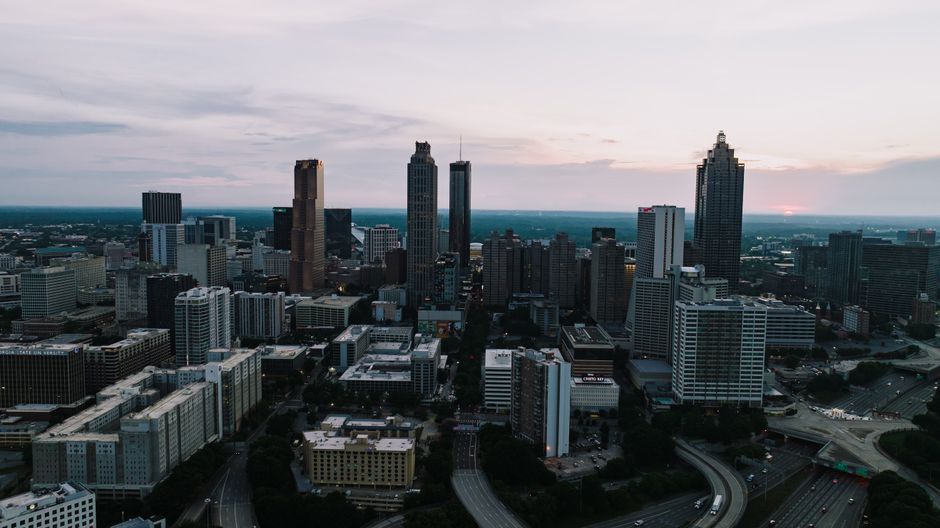
In short: Metro Atlanta homes buy power from Georgia Power (about 15.5¢ per kWh in 2024), a city utility like Marietta Power, or a co-op such as Cobb, Jackson or Sawnee EMC (about 11.5¢). Cobb and Sawnee members lost only about an hour of power on average in 2024. Lightning, ice storms and tornadoes are the area’s top hazards.
This page covers Atlanta, Marietta, Alpharetta, Roswell, Johns Creek, Sandy Springs, Lawrenceville and Newnan. Statewide rules, licensing and averages are on our Georgia energy guide; here we cover what is local.
Atlanta at a glance
- Georgia Power: serves the City of Atlanta and much of the metro. About 15.5¢ per kWh for homes (2024 average). Company-wide 2024 outages: 128 minutes per customer on normal days, 1,516 (about 25 hours) with major storms, mostly Helene damage elsewhere in Georgia (EIA-861).
- Cobb EMC: about 11.4¢; 35 minutes on normal days, 60 minutes with major events.
- Jackson EMC (Gwinnett and northeast): about 11.4¢; 74 and 129 minutes.
- Sawnee EMC (north Fulton, Forsyth, north Gwinnett): about 11.5¢; 46 and 62 minutes.
- GreyStone Power (west and south): about 12.2¢; 95 and 114 minutes. Walton EMC, Snapping Shoals EMC and Coweta-Fayette EMC serve other parts of the metro.
- City utilities: Marietta Power (about 11.9¢; 129 minutes), Lawrenceville (about 15.8¢) and Newnan Utilities (about 13.2¢; 23 minutes), plus smaller city systems such as College Park and East Point (EIA-861, 2024).
- Sun: 4.51 kWh per square meter per day (NASA POWER, 2001 to 2020), about 1,320 kWh a year per kW of panels by our rough estimate.
- Top hazards: lightning rated “very high” in Fulton, Cobb, Gwinnett and DeKalb; ice storms “very high” in DeKalb and “relatively high” in Fulton, Cobb and Gwinnett, along with tornadoes, hail, cold waves and inland flooding (FEMA National Risk Index, December 2025).
- Public charging: 2,396 public ports in Atlanta, 217 in Alpharetta, 116 in Lawrenceville, 101 in Marietta, and over 3,000 across our eight cities (AFDC, October 3, 2026).
Your utility and what it means
Metro Atlanta is a patchwork: neighbors can have different utilities, prices and solar rules, so start with the name on your bill.
Georgia Power. New rooftop solar customers join “RNR Instantaneous Netting”: solar you use as it is made saves the full retail price, and each kWh you send to the grid earns the 2026 solar avoided cost of about 3.2¢ plus a 4¢ adder approved by the Public Service Commission, about 7.2¢ in total. Home systems are limited to 10 kW AC, the program is open until it reaches a capacity cap, and you or your installer apply through Georgia Power’s PowerClerk portal before a witness test and permission to operate. For EVs, the Overnight Advantage plan prices power at about 2¢ per kWh from 11 p.m. to 7 a.m. every day, with a high summer weekday peak from 2 to 7 p.m. and a charge tied to your peak demand, so read the plan before you switch. Georgia Power also lists a rebate of up to $150 for a home Level 2 charger, while funds last.
Cobb, Jackson, Sawnee and GreyStone. These co-ops set their own rules. Cobb EMC limits home systems to 10 kW and buys exported power under its distributed generation rate schedule. Jackson EMC credits exports at its avoided energy cost and, when we checked, offered a one-time solar rebate of $450 per kW (up to 10 kW) for member-owned systems installed by NABCEP-certified professionals; check the program page, because amounts change. Sawnee EMC has a plug-in EV rate on a separate meter. GreyStone, Walton, Snapping Shoals and Coweta-Fayette publish their own riders: ask for the export rate in writing.
Marietta Power and Newnan Utilities. Marietta takes home solar up to 10 kW with an interconnection application, an interconnection agreement and a power exchange agreement, and pays for exports under its distributed generation policy. Newnan Utilities posts its interconnection application and distributed generation rider online. Lawrenceville sells both electricity and natural gas; ask the city for its solar terms.
Backup power in Atlanta
Atlanta’s co-op numbers show a grid that is usually steady: Cobb, Sawnee and Jackson members averaged one to two hours without power in 2024. Hurricane Helene, the most destructive storm in Georgia Power’s history with over 1.5 million customer outages, hit south and east Georgia hardest. The local risks are different: FEMA rates lightning “very high” across the core counties, and ice storms, tornadoes and strong wind are rated high. An ice storm in January can leave a neighborhood dark and cold for days.
- Short outages: a portable power station for Wi-Fi, phones, lights and a CPAP.
- Several hours to a day: a home battery on essential circuits; with solar it refills on sunny days.
- Multi-day ice storms: a natural gas or propane standby generator keeps the furnace blower or heat pump running.
Read our backup power guide, size loads with the generator sizing tool or the battery backup calculator, and see generator installation. The CPSC says to run portable generators outdoors only, at least 20 feet from the house with exhaust pointed away, never in a garage, and to keep battery-backed CO alarms on every level. A licensed electrician should fit a transfer switch or interlock; a licensed gas contractor runs the fuel line.
Solar in Atlanta
Each kW of panels in Atlanta makes about 1,320 kWh a year (our estimate). For a Georgia Power customer, that is worth about $205 a year if you use it all at home at 15.5¢, but only about $95 if it is all exported at 7.2¢. Co-op members pay less for power, about 11.4¢ at Cobb or Jackson, so the same kW saves about $150 a year. Either way, the share you use at home decides the payback: size the system to your daytime use, or add a battery. EIA counted 11,208 home solar systems on Georgia Power in 2024 and about 600 to 1,060 each at Jackson, Sawnee, Cobb and GreyStone.
The federal 25D credit ended for systems completed after 2025. Run the solar potential calculator, compare solar costs, and read solar installation for the steps.
Home batteries in Atlanta
Georgia Power notes that grid-tied solar shuts off in an outage unless a battery is installed. A battery keeps the lights on through a lightning or ice-storm outage and lets you use midday solar in the evening instead of exporting it at the lower credit. On Overnight Advantage, a battery can also charge at the cheap overnight price. Battery-paired solar is still rare in EIA’s data, so ask installers how many they have connected in your utility’s territory. See battery installation and home battery cost.
EV charging in Atlanta
Atlanta has one of the densest public networks in the Southeast, with 2,396 ports in the city alone. At home, using about 30 kWh per 100 miles, Georgia Power’s 15.5¢ average works out to about $4.65 per 100 miles or $560 for 12,000 miles a year; at a co-op’s 11.4¢ it is about $3.40 and $410 (estimates). On Overnight Advantage, the overnight energy charge alone is well under $1 per 100 miles, before the plan’s other charges. A Level 2 charger needs a 240-volt circuit, a permit and a licensed electrician: see EV charger installation and the EV charging cost calculator.
Drive on another fuel? See every alternative fuel station in Atlanta: hydrogen, propane, natural gas, E85 ethanol, biodiesel and renewable diesel.
Permits and inspections
- City of Atlanta: the Office of Buildings issues permits for houses, including solar, through online permitting, and publishes submittal information for residential solar and a PV inspection checklist.
- Marietta, Alpharetta, Roswell, Johns Creek, Sandy Springs, Lawrenceville and Newnan: your city’s building department issues the permit; in unincorporated areas, the county does.
- Utility approval: Georgia Power, your EMC or your city utility must approve grid-connected solar or batteries before they are switched on.
Hire a licensed electrical contractor (license check on the state page); they normally pull the permit and book inspections. Many Atlanta suburbs have HOAs: check covenants for panels and generator placement first.
Cities we cover
- Atlanta
- Marietta
- Alpharetta
- Roswell
- Johns Creek
- Sandy Springs
- Lawrenceville
- Newnan
Get help in Atlanta
Are you a licensed installer in Atlanta? Join SolutionEnergy and get requests from homeowners and businesses →
Tell us about your project and we will connect you with a licensed, independent installer who serves the Atlanta area. It is free, there is no obligation, and only the installer you choose gets your details. See how it works.
Atlanta energy FAQ
Who is my electric company in metro Atlanta?
It depends on your address. Georgia Power serves the City of Atlanta and much of the metro; Cobb, Jackson, Sawnee, GreyStone, Walton, Snapping Shoals and Coweta-Fayette EMCs serve large suburban areas; and cities such as Marietta, Lawrenceville and Newnan run their own utilities. Your bill names yours, and it sets your rates and solar rules.
How much does Georgia Power pay for exported solar in 2026?
Under RNR Instantaneous Netting, about 7.2¢ per kWh: the 2026 solar avoided cost of 3.2188¢ plus a 4¢ adder approved by the Public Service Commission. Solar you use in the home as it is produced saves the full retail price instead, which is why sizing to your own use matters.
Is there an EV charger rebate in Atlanta?
Georgia Power lists a rebate of up to $150 for installing a Level 2 charger at home, while funds last and subject to change. Co-op members should ask their EMC; Sawnee EMC, for example, offers a plug-in EV rate on a separate meter. The federal charger credit ended for chargers placed in service after June 30, 2026.
Do I need a permit for solar panels in Atlanta?
Yes. The City of Atlanta’s Office of Buildings permits residential solar through its online portal and publishes a PV inspection checklist. Suburban cities and counties run their own permit offices. Your utility must also approve the system before it is turned on.
Sources
U.S. Energy Information Administration, Form EIA-861 for 2024 (sales, reliability, service territories, net metering), read October 3, 2026. Georgia Power: rooftop solar FAQ, RNR-11 tariff, Overnight Advantage plan, EV rebate page and Hurricane Helene storm page, read October 3, 2026. Cobb EMC, Jackson EMC, Sawnee EMC, Marietta Power and Newnan Utilities program pages. City of Atlanta Office of Buildings. FEMA National Risk Index (December 2025). NASA POWER, 2001 to 2020. AFDC Station Locator, October 3, 2026. CPSC generator safety guidance.