This article contains affiliate links: if you buy through them we may earn a commission, at no extra cost to you. Learn more.
It’s 9 p.m. You pull into the driveway with 40 miles left on the battery and a long drive tomorrow. With a standard wall outlet, that’s a nervous night: the car gains a few miles an hour and might not be full by morning. With a Level 2 charger on the garage wall, you plug in, go to bed, and wake up to a full battery, charged at a cheaper overnight rate. That one box is the difference between “EV life is a hassle” and “I never think about it.”
In short: an EV charger for home is usually a Level 2 unit on a 240-volt circuit. The US Department of Energy says a typical home Level 2 charger at 30 amps adds about 25 miles of range per hour, versus about 5 miles per hour on a regular 120-volt outlet. Most good chargers cost about $300 to $650, and Qmerit’s 2026 data puts a typical installation at $749 to $2,500, done by a licensed electrician with a permit.
This guide covers what a home charger actually does, Level 1 vs Level 2, how many amps you need, plug-in vs hardwired, J1772 vs Tesla’s NACS plug, your electrical panel, installation costs, what charging costs per month, the incentives that are left in 2026, and the chargers worth buying. We researched and compared; we did not test these chargers.
What a home EV charger is (and isn’t)
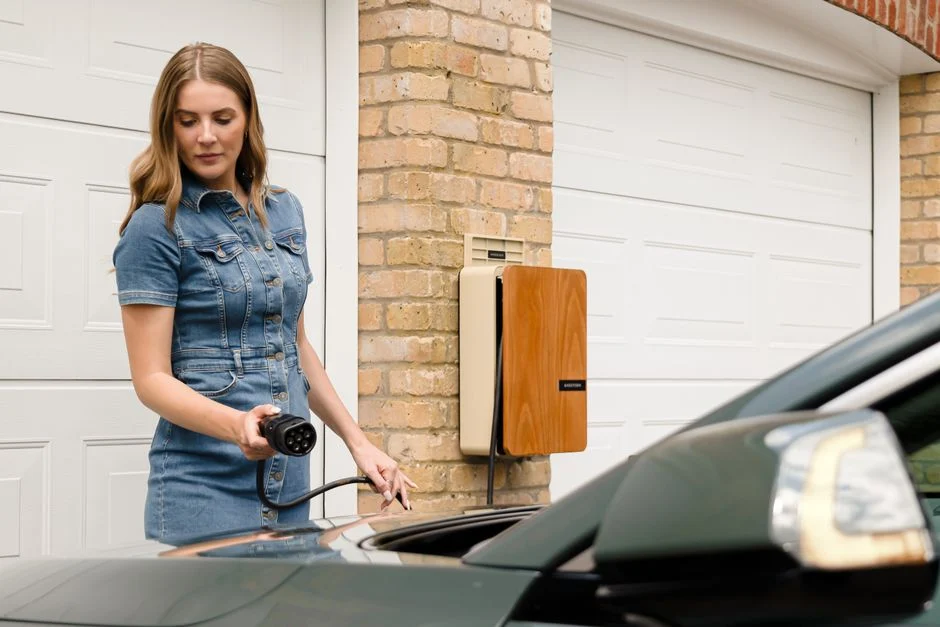
Here’s a fact that surprises most new EV owners: the box on the wall isn’t really the charger. The part that turns AC power from your house into DC power for the battery is the onboard charger inside the car. The wall unit is officially called EVSE (electric vehicle supply equipment). It’s a smart, safe switch: it talks to the car, tells it how much current it may draw, checks for ground faults, and only energizes the cable once the plug is locked in. Everyone calls it a charger, and so will we.
That matters for one reason: your car sets the speed limit. If your car’s onboard charger accepts 7.2 kW, a 48-amp, 11.5 kW wall unit won’t charge it any faster than a 32-amp one. Check the “AC charging” or “onboard charger” figure in your owner’s manual before you pay for amps you can’t use.
Level 1 vs Level 2 charging at home
Home charging comes in two levels. DC fast charging (sometimes called Level 3) is the highway kind; it isn’t installed in homes.
| Level 1 | Level 2 | |
|---|---|---|
| Outlet / circuit | Standard 120 V household outlet | 240 V circuit (like a dryer or oven) |
| Typical power | About 1.9 kW | About 7.2 kW at 30 A; up to 11.5 kW at 48 A |
| Range added per hour | About 5 miles | About 25 miles at 7.2 kW (Tesla says 44 miles at 48 A) |
| Equipment | Cord set (often comes with the car) | Wall-mounted unit, plug-in or hardwired |
| Installation | Usually none | Licensed electrician, permit where required |
Power and range figures are from the DOE Alternative Fuels Data Center; the 44-mile figure is Tesla’s own for its 48-amp Wall Connector. Level 1 sounds slow, and it is, but about 5 miles an hour over a 12-hour night is about 60 miles. If you drive 30 miles a day and park for long stretches, Level 1 may be all you need. Our Level 1 vs Level 2 charging guide walks through that decision.
Do you need a Level 2 charger?
Ask three questions. How many miles do you drive on a typical day? How many hours is the car parked at home? And do you ever need a full battery fast, for a road trip or a surprise errand? A quick test: multiply the hours you’re parked overnight by 5. If the answer comfortably beats your daily miles, Level 1 works. If it’s close, or you have two EVs, a long commute, or very cold winters (batteries charge more slowly and cars use more energy in the cold), Level 2 is worth it.
Level 2 also lets you fit all your charging into the cheapest hours on a time-of-use rate. A 12 kWh top-up takes about 6 hours on Level 1 at 1.9 kW but under 2 hours at 7.2 kW, so it fits inside even a short off-peak window.
How many amps do you need?
Power in kilowatts is amps times volts. At 240 V, each amp is 0.24 kW. EV charging counts as a continuous load, so the National Electrical Code (NEC 625.41) requires the circuit and breaker to be rated at 125% of the charger’s current. In plain words: the breaker must be bigger than the charger.
| Charger setting | Power at 240 V | Breaker needed (125%) | Range per hour (our estimate) |
|---|---|---|---|
| 16 A | 3.8 kW | 20 A | About 13 miles |
| 24 A | 5.8 kW | 30 A | About 20 miles |
| 32 A | 7.7 kW | 40 A | About 27 miles |
| 40 A | 9.6 kW | 50 A | About 33 miles |
| 48 A | 11.5 kW | 60 A | About 40 miles (Tesla says 44) |
Range estimates use the DOE ratio of about 25 miles per 7.2 kW (about 3.5 miles per kWh). An efficient sedan will do better, a big truck worse. For most homes, 32 to 40 amps is the sweet spot: it refills a typical day’s driving in an hour or two, fits on a 40- or 50-amp circuit, and is what a NEMA 14-50 outlet allows. Go to 48 amps only if your car accepts 11.5 kW and your panel has room for a 60-amp circuit.
Plug-in or hardwired?
Plug-in chargers use a 240 V outlet, usually a NEMA 14-50 (the same type many RV parks use) or a NEMA 6-50. They top out at 40 amps on a 50-amp circuit. You can unplug the charger and take it with you when you move. The NEC (625.54) requires ground-fault (GFCI) protection on receptacles installed for EV charging, which usually means a GFCI breaker; some chargers have their own ground-fault detection and can trip a GFCI breaker by mistake, which is something your electrician will know how to handle. Ask for an industrial-grade outlet: cheap receptacles are a known weak point under hours of heavy current.
Hardwired chargers connect straight to the circuit. That’s required for 48 amps and above, it skips the outlet as a failure point, and it’s the only option for the Tesla Wall Connector and some others. It’s usually the better choice for an outdoor install. The cost difference is small; the electrician runs the same wire either way.
J1772 or NACS: which plug?
North America has two Level 2 plugs. J1772 is the long-standing standard on most non-Tesla EVs. NACS, Tesla’s plug, has been standardized as SAE J3400, and many other automakers have moved or are moving their new models to it. Most chargers in this guide are sold in either version, so buy the plug that matches the car you’ll charge most.
- Tesla owners: the DOE says every Tesla comes with a J1772 adapter, so a Tesla can use a J1772 charger. A NACS charger simply skips the adapter.
- Mixed households: Tesla’s Universal Wall Connector has a NACS plug with a J1772 adapter that docks in its side, so it charges either kind of car.
- Adapters: use the one from your automaker, or one certified to UL 2252 (the US safety standard for EV adapters). Avoid no-name adapters; they carry a lot of current for hours.
More on this in our best EV charger for Tesla guide.
Will your electrical panel handle it?
A Level 2 charger is often the biggest load in the house, running for hours. Before anything else, the electrician does a load calculation: your panel’s size (100, 150 or 200 amps is typical), what’s already on it (electric range, dryer, water heater, central AC, heat pump), and whether there’s room for a new 40- to 60-amp circuit. The DOE notes that some homes simply don’t have enough capacity for Level 2 without changes.
If the panel is tight, you have options before a costly service upgrade:
- Charge at fewer amps. Most chargers can be set lower (Grizzl-E: 16, 24, 32 or 40 A). A 24-amp circuit still adds about 20 miles an hour, enough for most commutes.
- Load management. The Emporia Pro comes with an energy monitor that slows charging when the house draws a lot, which Emporia says can avoid a panel upgrade. Wallbox’s Dynamic Load Management does the same with an added power meter.
- Power sharing. Two EVs? Several chargers, including Tesla’s, can share one circuit and split the current.
If you do need a bigger service, Qmerit puts an upgrade to 200 amps at about $1,500 to $3,000 on top of the install, and it involves your utility.
Installation: who does it and what it costs
Running a 240-volt circuit is a job for a licensed electrician, with a permit where required. The DOE notes that permits may be needed from your local building department and that some places want a site plan approved before work starts. The permit brings an inspection, which protects you, your insurance and your home’s resale. Many chargers’ warranties also expect professional installation: read the maker’s manual.
What drives the price is mostly distance and capacity: how far the charger is from the panel, whether the wire runs through a finished wall or along a garage, indoor or outdoor, and whether the panel needs work. Qmerit’s 2026 figures:
| Item | Typical cost (Qmerit, 2026) |
|---|---|
| Level 2 charger | $300–$900 |
| Electrician labor and permitting | $500–$1,200 |
| Conduit, wire, breaker | $200–$500 |
| Permit alone (average) | About $310 |
| Total installed | $749–$2,500, average about $1,700 |
| Service upgrade to 200 A, if needed | Add $1,500–$3,000 |
Get two or three quotes. Our EV charger installation cost guide breaks it down further. Renting or in a condo? You’ll need the owner’s or HOA’s written OK first; a plug-in charger on a 14-50 outlet is the easiest thing to leave behind or take with you.
Smart features worth paying for
- Scheduling. Charge only in off-peak hours. Many cars can do this themselves, so a “dumb” charger like the Grizzl-E Classic plus the car’s app works fine.
- Energy tracking. See exactly what charging costs each month; handy if you’re reimbursed by an employer.
- Utility programs. Some utilities pay rebates or bill credits for a connected charger that lets them shift your charging. ENERGY STAR notes certified chargers may qualify for these programs.
- ENERGY STAR. Certified chargers use 40% less energy in standby than standard ones, says ENERGY STAR, and are safety-tested by a recognized lab.
- OCPP. An open protocol (Wallbox, some Grizzl-E models) that lets the charger work with other apps if the maker’s app goes away.
That last point is not theoretical. When Enel X Way’s North American business shut down in October 2024, JuiceBox chargers lost their app and cloud features. They kept charging as basic chargers, and a new owner later took over the software, but buyers learned that a smart charger is only as smart as the company behind it. A charger that works fine without an app is a safe choice.
What it costs to charge at home
The US average residential price was 18.31 cents per kWh in July 2026, according to the EIA. Here’s an example (our estimate): you drive 40 miles a day in a car that uses 30 kWh per 100 miles. That’s 12 kWh a day, about $2.20 a day or about $66 a month at the average price, plus roughly 10% for charging losses. Your own rate, and especially an off-peak EV rate, can change that a lot. Our cost to charge an EV at home guide does the math for your numbers.
Pairing the car with solar panels can push the cost of those miles down further; see EV charging with solar. A charger doesn’t keep the car charging in a blackout, though; for that you’d need a home battery backup (a few car-and-charger systems can power a home, but only with special equipment).
Tax credits and rebates in 2026
The federal home charger credit (Section 30C) gave 30% of the cost, up to $1,000 per charging port, for chargers at a primary residence in an eligible low-income or non-urban census tract. It ended for chargers placed in service after June 30, 2026. If yours was installed and working by that date and your address qualifies on the IRS eligibility locator, you claim it on Form 8911 with your 2026 return. A charger installed now doesn’t qualify. The federal EV purchase credit (30D) also ended, for cars acquired after September 30, 2025. More in our EV tax credit 2026 explainer.
What’s left is local: many utilities and some states offer rebates on ENERGY STAR chargers or installation, or special EV rates. Search DSIRE, the DOE’s Alternative Fuels Data Center laws and incentives database, and your utility’s website before you buy, because some rebates require a specific charger or pre-approval. Our home energy rebates guide shows how to find them. We can’t promise money: check your state and utility.
Which guide is for you?
| Your question | Read this |
|---|---|
| Which Level 2 charger should I buy? | Best EV chargers for home |
| I drive a Tesla (or a NACS car) | Best EV charger for Tesla |
| What will the electrician charge? | EV charger installation cost |
| Is a regular outlet enough? | Level 1 vs Level 2 charging |
| What will charging add to my bill? | Cost to charge an EV at home |
| Can my solar panels charge my car? | EV charging with solar |
Our top home EV charger picks
Prices change often. The prices below are what we saw at the maker or a major retailer in October 2026; check the current price before you buy.
ChargePoint Home Flex
- Up to 50 A hardwired, 40 A on a 14-50
- J1772 or NACS, 23 ft cable
- About $549–$599 (maker, Oct 2026)
Emporia Pro EV Charger
- 48 A hardwired, 40 A on a 14-50
- Energy monitor + load management included
- About $599 (maker, Oct 2026)
Grizzl-E Classic 40A
- 40 A, NEMA 14-50 or 6-50 plug
- Aluminum NEMA 4 case, no app needed
- About $300 (maker, Oct 2026)
Tesla Universal Wall Connector
- 48 A, hardwired
- NACS plug + docked J1772 adapter
- About $600 (Tesla, Oct 2026)
Wallbox Pulsar Plus
- 48 A hardwired, 40 A plug-in
- Wi-Fi, Bluetooth, OCPP
- About $650 (maker, Oct 2026)
Why these: the ChargePoint Home Flex covers almost every install (14-50 plug, 6-50 plug or hardwired up to 50 A) with a polished app. The Emporia Pro is the one to look at if your panel is already busy. The Grizzl-E Classic is a tough, simple, made-in-Canada charger for about $300. The Tesla Universal Wall Connector is the easy answer when a Tesla and a non-Tesla share the garage. The Wallbox Pulsar Plus is small, smart and open (OCPP). Full specs, downsides and more picks are in our best EV chargers for home guide.
How to choose, in five steps
- Find your car’s AC charging limit (owner’s manual) and your typical daily miles.
- Have an electrician check the panel and quote a 40- or 50-amp circuit (60 for 48 A).
- Pick the plug (J1772 or NACS) for the car you’ll charge most, or a Universal for both.
- Check rebates first: your utility may require an ENERGY STAR or listed model.
- Choose plug-in or hardwired, and a cable long enough to reach the charge port wherever you park (about 23 to 25 ft on most chargers here).
Keep exploring
Learn how your home’s power works in electrical energy, why EVs are part of clean energy, and how to lower your electric bill once the car is on it. Thinking about backup power too? See home battery backup and portable power stations. Browse everything in our electric vehicles section.
Home EV charger questions
What is the best EV charger for home?
For most homes, a 40- to 48-amp Level 2 charger. Our top pick is the ChargePoint Home Flex because it fits almost any install (NEMA 14-50, 6-50 or hardwired up to 50 A) and comes with J1772 or NACS. On a budget, the Grizzl-E Classic is about $300. If your panel is full, the Emporia Pro’s load management can help.
Can I install a Level 2 charger myself?
Mounting the unit is easy; the 240-volt circuit is not. Have a licensed electrician run the circuit, size the breaker at 125% of the charger’s current, add GFCI protection where code requires it, and pull a permit where required. An inspected install protects your home, your insurance and often the charger’s warranty.
How long does it take to charge an EV at home?
It depends on the battery and the charger. The DOE says Level 1 adds about 5 miles of range per hour and a 7.2 kW Level 2 charger about 25. So a typical 40-mile day takes about 8 hours on Level 1 and under 2 hours on Level 2. A full charge of a large battery on Level 2 usually fits in one night.
Is a NEMA 14-50 outlet enough for an EV?
Yes, for most cars. A 14-50 outlet on a 50-amp circuit supports up to 40 amps of charging, about 9.6 kW. The NEC requires GFCI protection for outlets installed for EV charging, and an industrial-grade receptacle is worth asking for. For 48 amps, the charger must be hardwired on a 60-amp circuit.
Is there still a tax credit for home EV chargers?
Not for new installs. The federal 30C credit (30%, up to $1,000) ended for chargers placed in service after June 30, 2026. Chargers working by that date in an eligible census tract can still be claimed on Form 8911 for 2026. Many utilities and some states still offer rebates: check DSIRE and your utility.
Do I need a smart (Wi-Fi) charger?
Not always. Most EVs can schedule charging from their own app, so a basic charger plus the car’s timer catches off-peak rates. A connected charger is worth it if your utility pays for one, you want to track costs, or you need load management. Prefer one that still charges normally if the app goes offline.